

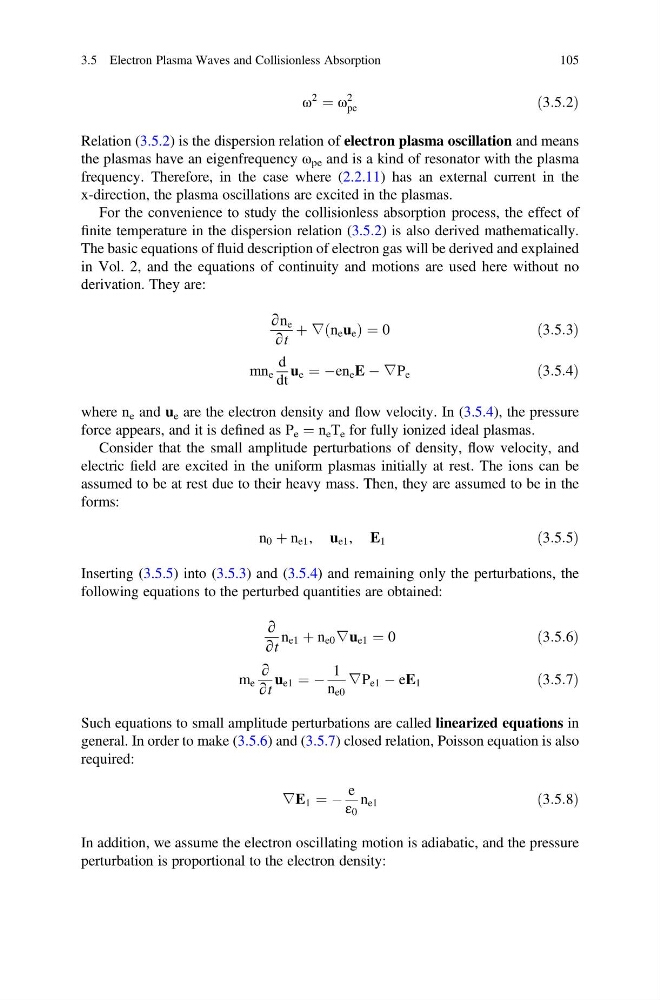
ω
2
¼ ω
2
pe
ð3:5:2Þ
Relation (3.5.2) is the dispersion relation of electron plasma oscillation and means
the plasmas have an eigenfrequency ω pe and is a kind of resonator with the plasma
frequency. Therefore, in the case where (2.2.11) has an external current in the
x-direction, the plasma oscillations are excited in the plasmas.
For the convenience to study the collisionless absorption process, the effect of
finite temperature in the dispersion relation (3.5.2) is also derived mathematically.
The basic equations of fluid description of electron gas will be derived and explained
in Vol. 2, and the equations of continuity and motions are used here without no
derivation. They are:
∂n e
∂t
þ ∇ n e u e
ð
Þ ¼ 0
ð3:5:3Þ
mn e
d
dt
u e ¼ Àen e E À ∇P e
ð3:5:4Þ
where n e and u e are the electron density and flow velocity. In (3.5.4), the pressure
force appears, and it is defined as P e ¼ n e T e for fully ionized ideal plasmas.
Consider that the small amplitude perturbations of density, flow velocity, and
electric field are excited in the uniform plasmas initially at rest. The ions can be
assumed to be at rest due to their heavy mass. Then, they are assumed to be in the
forms:
n 0 þ n e1 , u e1 , E 1
ð3:5:5Þ
Inserting (3.5.5) into (3.5.3) and (3.5.4) and remaining only the perturbations, the
following equations to the perturbed quantities are obtained:
∂
∂t
n e1 þ n e0 ∇u e1 ¼ 0
ð3:5:6Þ
m e
∂
∂t
u e1 ¼ À
1
n e0
∇P e1 À eE 1
ð3:5:7Þ
Such equations to small amplitude perturbations are called linearized equations in
general. In order to make (3.5.6) and (3.5.7) closed relation, Poisson equation is also
required:
∇E 1 ¼ À
e
ε 0
n e1
ð3:5:8Þ
In addition, we assume the electron oscillating motion is adiabatic, and the pressure
perturbation is proportional to the electron density:
3.5 Electron Plasma Waves and Collisionless Absorption
105
2
¼ ω
2
pe
ð3:5:2Þ
Relation (3.5.2) is the dispersion relation of electron plasma oscillation and means
the plasmas have an eigenfrequency ω pe and is a kind of resonator with the plasma
frequency. Therefore, in the case where (2.2.11) has an external current in the
x-direction, the plasma oscillations are excited in the plasmas.
For the convenience to study the collisionless absorption process, the effect of
finite temperature in the dispersion relation (3.5.2) is also derived mathematically.
The basic equations of fluid description of electron gas will be derived and explained
in Vol. 2, and the equations of continuity and motions are used here without no
derivation. They are:
∂n e
∂t
þ ∇ n e u e
ð
Þ ¼ 0
ð3:5:3Þ
mn e
d
dt
u e ¼ Àen e E À ∇P e
ð3:5:4Þ
where n e and u e are the electron density and flow velocity. In (3.5.4), the pressure
force appears, and it is defined as P e ¼ n e T e for fully ionized ideal plasmas.
Consider that the small amplitude perturbations of density, flow velocity, and
electric field are excited in the uniform plasmas initially at rest. The ions can be
assumed to be at rest due to their heavy mass. Then, they are assumed to be in the
forms:
n 0 þ n e1 , u e1 , E 1
ð3:5:5Þ
Inserting (3.5.5) into (3.5.3) and (3.5.4) and remaining only the perturbations, the
following equations to the perturbed quantities are obtained:
∂
∂t
n e1 þ n e0 ∇u e1 ¼ 0
ð3:5:6Þ
m e
∂
∂t
u e1 ¼ À
1
n e0
∇P e1 À eE 1
ð3:5:7Þ
Such equations to small amplitude perturbations are called linearized equations in
general. In order to make (3.5.6) and (3.5.7) closed relation, Poisson equation is also
required:
∇E 1 ¼ À
e
ε 0
n e1
ð3:5:8Þ
In addition, we assume the electron oscillating motion is adiabatic, and the pressure
perturbation is proportional to the electron density:
3.5 Electron Plasma Waves and Collisionless Absorption
105