

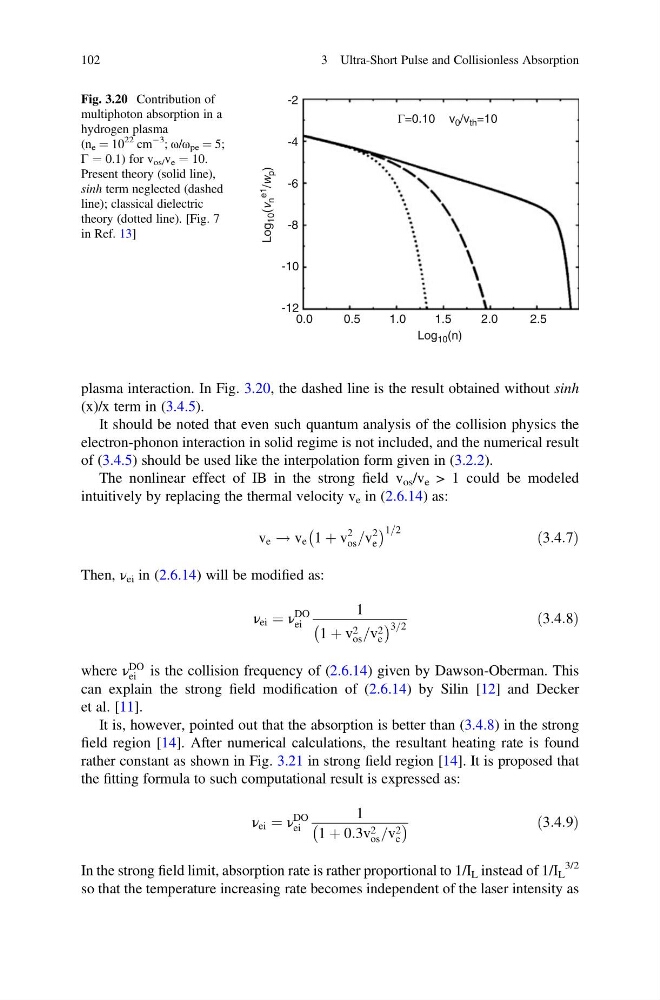
plasma interaction. In Fig. 3.20, the dashed line is the result obtained without sinh
(x)/x term in (3.4.5).
It should be noted that even such quantum analysis of the collision physics the
electron-phonon interaction in solid regime is not included, and the numerical result
of (3.4.5) should be used like the interpolation form given in (3.2.2).
The nonlinear effect of IB in the strong field v os /v e > 1 could be modeled
intuitively by replacing the thermal velocity v e in (2.6.14) as:
v e ! v e 1 þ v
2
os =v
2
e
À
Á 1=2
ð3:4:7Þ
Then, ν ei in (2.6.14) will be modified as:
ν ei ¼ ν
DO
ei
1
1 þ v 2
os =v 2
e
À
Á 3=2
ð3:4:8Þ
where ν
DO
ei is the collision frequency of (2.6.14) given by Dawson-Oberman. This
can explain the strong field modification of (2.6.14) by Silin [12] and Decker
et al. [11].
It is, however, pointed out that the absorption is better than (3.4.8) in the strong
field region [14]. After numerical calculations, the resultant heating rate is found
rather constant as shown in Fig. 3.21 in strong field region [14]. It is proposed that
the fitting formula to such computational result is expressed as:
ν ei ¼ ν
DO
ei
1
1 þ 0:3v 2
os =v 2
e
À
Á
ð3:4:9Þ
In the strong field limit, absorption rate is rather proportional to 1/I L instead of 1/I L
3/2
so that the temperature increasing rate becomes independent of the laser intensity as
-2
0.0
0.5
1.0
1.5
2.0
2.5
Log 10 (n)
Log
10 (v
n
e1
/w
p )
-4
-6
-8
v 0 /v th =10
-10
-12
Γ=0.10
Fig. 3.20 Contribution of
multiphoton absorption in a
hydrogen plasma
(n e ¼ 10
22 cm
À3
; ω/ω pe ¼ 5;
Γ ¼ 0.1) for v os/ v e ¼ 10.
Present theory (solid line),
sinh term neglected (dashed
line); classical dielectric
theory (dotted line). [Fig. 7
in Ref. 13]
102
3 Ultra-Short Pulse and Collisionless Absorption
(x)/x term in (3.4.5).
It should be noted that even such quantum analysis of the collision physics the
electron-phonon interaction in solid regime is not included, and the numerical result
of (3.4.5) should be used like the interpolation form given in (3.2.2).
The nonlinear effect of IB in the strong field v os /v e > 1 could be modeled
intuitively by replacing the thermal velocity v e in (2.6.14) as:
v e ! v e 1 þ v
2
os =v
2
e
À
Á 1=2
ð3:4:7Þ
Then, ν ei in (2.6.14) will be modified as:
ν ei ¼ ν
DO
ei
1
1 þ v 2
os =v 2
e
À
Á 3=2
ð3:4:8Þ
where ν
DO
ei is the collision frequency of (2.6.14) given by Dawson-Oberman. This
can explain the strong field modification of (2.6.14) by Silin [12] and Decker
et al. [11].
It is, however, pointed out that the absorption is better than (3.4.8) in the strong
field region [14]. After numerical calculations, the resultant heating rate is found
rather constant as shown in Fig. 3.21 in strong field region [14]. It is proposed that
the fitting formula to such computational result is expressed as:
ν ei ¼ ν
DO
ei
1
1 þ 0:3v 2
os =v 2
e
À
Á
ð3:4:9Þ
In the strong field limit, absorption rate is rather proportional to 1/I L instead of 1/I L
3/2
so that the temperature increasing rate becomes independent of the laser intensity as
-2
0.0
0.5
1.0
1.5
2.0
2.5
Log 10 (n)
Log
10 (v
n
e1
/w
p )
-4
-6
-8
v 0 /v th =10
-10
-12
Γ=0.10
Fig. 3.20 Contribution of
multiphoton absorption in a
hydrogen plasma
(n e ¼ 10
22 cm
À3
; ω/ω pe ¼ 5;
Γ ¼ 0.1) for v os/ v e ¼ 10.
Present theory (solid line),
sinh term neglected (dashed
line); classical dielectric
theory (dotted line). [Fig. 7
in Ref. 13]
102
3 Ultra-Short Pulse and Collisionless Absorption