

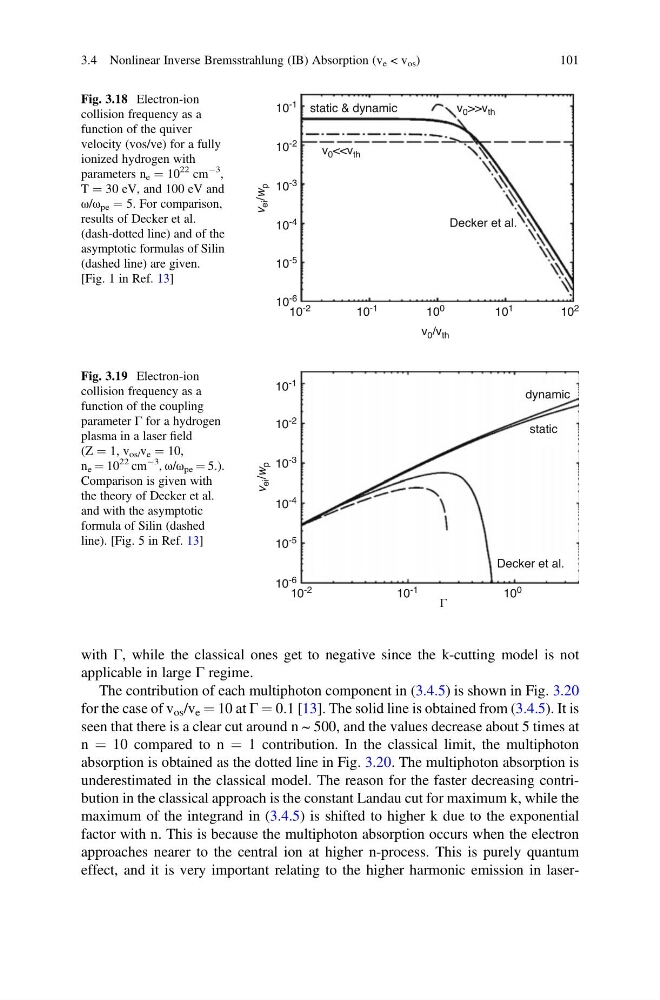
with Γ, while the classical ones get to negative since the k-cutting model is not
applicable in large Γ regime.
The contribution of each multiphoton component in (3.4.5) is shown in Fig. 3.20
for the case of v os /v e ¼ 10 at Γ ¼ 0.1 [13]. The solid line is obtained from (3.4.5). It is
seen that there is a clear cut around n ~ 500, and the values decrease about 5 times at
n ¼ 10 compared to n ¼ 1 contribution. In the classical limit, the multiphoton
absorption is obtained as the dotted line in Fig. 3.20. The multiphoton absorption is
underestimated in the classical model. The reason for the faster decreasing contribution in the classical approach is the constant Landau cut for maximum k, while the
maximum of the integrand in (3.4.5) is shifted to higher k due to the exponential
factor with n. This is because the multiphoton absorption occurs when the electron
approaches nearer to the central ion at higher n-process. This is purely quantum
effect, and it is very important relating to the higher harmonic emission in laser10
-1
10
-2
10 -3
10
-4
10
-5
10
-6
10
-2
10
-1
Decker et al.
v 0 /v th
v 0 <
ei /w
p
v 0 >>v th
static & dynamic
10
0
10
1
10
2
Fig. 3.18 Electron-ion
collision frequency as a
function of the quiver
velocity (vos/ve) for a fully
ionized hydrogen with
parameters n e ¼ 10
22 cm
À3
,
T ¼ 30 eV, and 100 eV and
ω/ω pe ¼ 5. For comparison,
results of Decker et al.
(dash-dotted line) and of the
asymptotic formulas of Silin
(dashed line) are given.
[Fig. 1 in Ref. 13]
10
-1
10
-2
10
-3
10 -4
10
-5
10
-6
10 -2
10 -1
10 0
Decker et al.
Γ
static
dynamic
v
ei /w
p
Fig. 3.19 Electron-ion
collision frequency as a
function of the coupling
parameter Γ for a hydrogen
plasma in a laser field
(Z ¼ 1, v os/ v e ¼ 10,
n e ¼ 10
22 cm
À3
, ω/ω pe ¼ 5.).
Comparison is given with
the theory of Decker et al.
and with the asymptotic
formula of Silin (dashed
line). [Fig. 5 in Ref. 13]
3.4 Nonlinear Inverse Bremsstrahlung (IB) Absorption (v e < v os )
101
applicable in large Γ regime.
The contribution of each multiphoton component in (3.4.5) is shown in Fig. 3.20
for the case of v os /v e ¼ 10 at Γ ¼ 0.1 [13]. The solid line is obtained from (3.4.5). It is
seen that there is a clear cut around n ~ 500, and the values decrease about 5 times at
n ¼ 10 compared to n ¼ 1 contribution. In the classical limit, the multiphoton
absorption is obtained as the dotted line in Fig. 3.20. The multiphoton absorption is
underestimated in the classical model. The reason for the faster decreasing contribution in the classical approach is the constant Landau cut for maximum k, while the
maximum of the integrand in (3.4.5) is shifted to higher k due to the exponential
factor with n. This is because the multiphoton absorption occurs when the electron
approaches nearer to the central ion at higher n-process. This is purely quantum
effect, and it is very important relating to the higher harmonic emission in laser10
-1
10
-2
10 -3
10
-4
10
-5
10
-6
10
-2
10
-1
Decker et al.
v 0 /v th
v 0 <
ei /w
p
v 0 >>v th
static & dynamic
10
0
10
1
10
2
Fig. 3.18 Electron-ion
collision frequency as a
function of the quiver
velocity (vos/ve) for a fully
ionized hydrogen with
parameters n e ¼ 10
22 cm
À3
,
T ¼ 30 eV, and 100 eV and
ω/ω pe ¼ 5. For comparison,
results of Decker et al.
(dash-dotted line) and of the
asymptotic formulas of Silin
(dashed line) are given.
[Fig. 1 in Ref. 13]
10
-1
10
-2
10
-3
10 -4
10
-5
10
-6
10 -2
10 -1
10 0
Decker et al.
Γ
static
dynamic
v
ei /w
p
Fig. 3.19 Electron-ion
collision frequency as a
function of the coupling
parameter Γ for a hydrogen
plasma in a laser field
(Z ¼ 1, v os/ v e ¼ 10,
n e ¼ 10
22 cm
À3
, ω/ω pe ¼ 5.).
Comparison is given with
the theory of Decker et al.
and with the asymptotic
formula of Silin (dashed
line). [Fig. 5 in Ref. 13]
3.4 Nonlinear Inverse Bremsstrahlung (IB) Absorption (v e < v os )
101