

ion scatter in over critical density is essential to study the laser-matter interaction of
sub-picosecond pulse with its peak intensity of wide range.
In the other words, laser tunneling effect into over-dense region is very essential
in such short pulse absorption, and since the tunneling is determined by the precise
properties of the dielectric constant, namely, complex form of electric conductivity,
just a simple model in Fig. 3.9 in the range of about T e < 100 eV doesn’t give us any
satisfaction in understanding the micro physics. We have to invoke to quantum
theory to obtain the collision frequency consistently as seen below.
3.3 Quantum Theory of Electric Conductivity in Dense
Plasmas
The intuitive upper limit of the collision frequency introduced in Fig. 3.9 with ν < v e /
r 0 can be consistently derived with the use of quantum mechanical analysis for
Fermi-Dirac distribution of electrons [11]. The procedure to obtain the fluctuating
electrostatic fields by ions is the same as that used in obtaining (2.6.13) (Chap. 2,
Ref. [9]). However, the Fermi-Dirac distribution function should be used, since the
low temperature and Fermi degeneracy affect the electron collision process. After
numerous mathematics, the following collision frequency of electrons by ions is
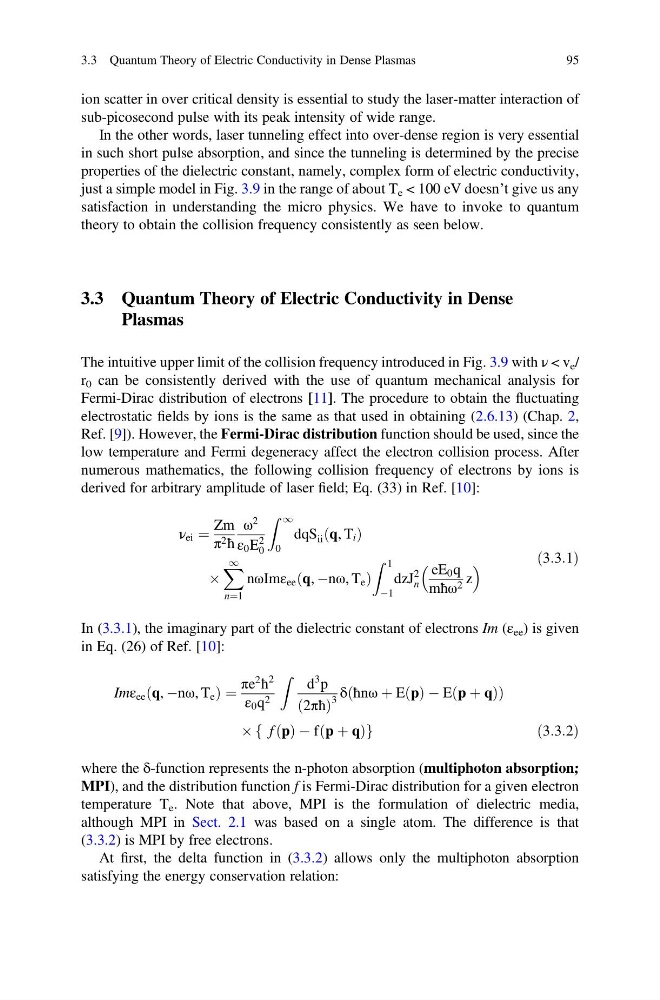
derived for arbitrary amplitude of laser field; Eq. (33) in Ref. [10]:
ν ei ¼
Zm
π 2 ħ
ω
2
ε 0 E
2
0
Z 1
0
dqS ii q, T i
ð
Þ
Â
X 1
n¼1
nωImε ee q, Ànω, T e
ð
Þ
Z 1
À1
dzJ
2
n
eE 0 q
mħω 2 z
ð3:3:1Þ
In (3.3.1), the imaginary part of the dielectric constant of electrons Im (ε ee ) is given
in Eq. (26) of Ref. [10]:
Imε ee q, Ànω, T e
ð
Þ¼
πe
2
ħ
2
ε 0 q 2
Z
d
3 p
2πħ
ð
Þ
3
δ ħnω þ E p
ð Þ À E p þ q
ð
Þ
ð
Þ
 f p
ð Þ À f p þ q
ð
Þ
f
g
ð3:3:2Þ
where the δ-function represents the n-photon absorption (multiphoton absorption;
MPI), and the distribution function f is Fermi-Dirac distribution for a given electron
temperature T e . Note that above, MPI is the formulation of dielectric media,
although MPI in Sect. 2.1 was based on a single atom. The difference is that
(3.3.2) is MPI by free electrons.
At first, the delta function in (3.3.2) allows only the multiphoton absorption
satisfying the energy conservation relation:
3.3 Quantum Theory of Electric Conductivity in Dense Plasmas
95
sub-picosecond pulse with its peak intensity of wide range.
In the other words, laser tunneling effect into over-dense region is very essential
in such short pulse absorption, and since the tunneling is determined by the precise
properties of the dielectric constant, namely, complex form of electric conductivity,
just a simple model in Fig. 3.9 in the range of about T e < 100 eV doesn’t give us any
satisfaction in understanding the micro physics. We have to invoke to quantum
theory to obtain the collision frequency consistently as seen below.
3.3 Quantum Theory of Electric Conductivity in Dense
Plasmas
The intuitive upper limit of the collision frequency introduced in Fig. 3.9 with ν < v e /
r 0 can be consistently derived with the use of quantum mechanical analysis for
Fermi-Dirac distribution of electrons [11]. The procedure to obtain the fluctuating
electrostatic fields by ions is the same as that used in obtaining (2.6.13) (Chap. 2,
Ref. [9]). However, the Fermi-Dirac distribution function should be used, since the
low temperature and Fermi degeneracy affect the electron collision process. After
numerous mathematics, the following collision frequency of electrons by ions is
derived for arbitrary amplitude of laser field; Eq. (33) in Ref. [10]:
ν ei ¼
Zm
π 2 ħ
ω
2
ε 0 E
2
0
Z 1
0
dqS ii q, T i
ð
Þ
Â
X 1
n¼1
nωImε ee q, Ànω, T e
ð
Þ
Z 1
À1
dzJ
2
n
eE 0 q
mħω 2 z
ð3:3:1Þ
In (3.3.1), the imaginary part of the dielectric constant of electrons Im (ε ee ) is given
in Eq. (26) of Ref. [10]:
Imε ee q, Ànω, T e
ð
Þ¼
πe
2
ħ
2
ε 0 q 2
Z
d
3 p
2πħ
ð
Þ
3
δ ħnω þ E p
ð Þ À E p þ q
ð
Þ
ð
Þ
 f p
ð Þ À f p þ q
ð
Þ
f
g
ð3:3:2Þ
where the δ-function represents the n-photon absorption (multiphoton absorption;
MPI), and the distribution function f is Fermi-Dirac distribution for a given electron
temperature T e . Note that above, MPI is the formulation of dielectric media,
although MPI in Sect. 2.1 was based on a single atom. The difference is that
(3.3.2) is MPI by free electrons.
At first, the delta function in (3.3.2) allows only the multiphoton absorption
satisfying the energy conservation relation:
3.3 Quantum Theory of Electric Conductivity in Dense Plasmas
95