

E p þ q
ð
Þ¼E p
ð Þ þ nħω
The electron energy after the collision has to increase the discrete value of the n times
the photon energy.
At second, it is clear that (3.3.2) is proportional to the difference of f (p) before
and after the energy increase and becomes small compared to Boltzmann distribution
near the Fermi energy. If the final state p + q is almost occupied in the Fermi
distribution, the collisional absorption is forbidden because of quantum statistical
reason. This is the real reason of the saturation of the collision frequency in the case
where T e approaches Fermi temperature. Then, the rough cut of ν < v e /r 0 condition in
Fig. 3.9 is not necessary.
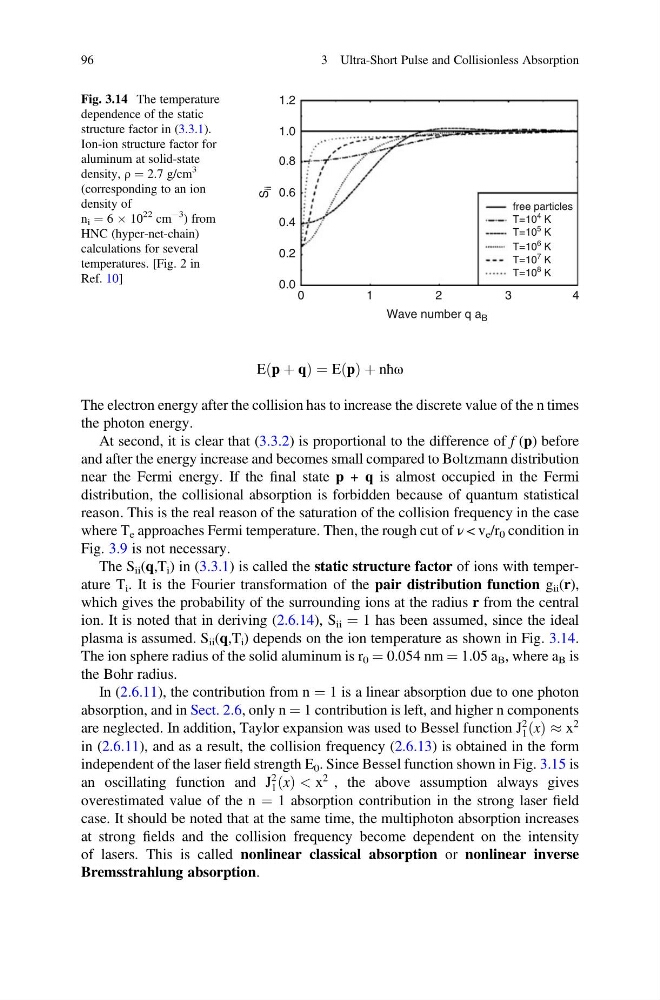
The S ii (q,T i ) in (3.3.1) is called the static structure factor of ions with temperature T i . It is the Fourier transformation of the pair distribution function g ii (r),
which gives the probability of the surrounding ions at the radius r from the central
ion. It is noted that in deriving (2.6.14), S ii ¼ 1 has been assumed, since the ideal
plasma is assumed. S ii (q,T i ) depends on the ion temperature as shown in Fig. 3.14.
The ion sphere radius of the solid aluminum is r 0 ¼ 0.054 nm ¼ 1.05 a B , where a B is
the Bohr radius.
In (2.6.11), the contribution from n ¼ 1 is a linear absorption due to one photon
absorption, and in Sect. 2.6, only n ¼ 1 contribution is left, and higher n components
are neglected. In addition, Taylor expansion was used to Bessel function J
2
1 x
ð Þ % x
2
in (2.6.11), and as a result, the collision frequency (2.6.13) is obtained in the form
independent of the laser field strength E 0 . Since Bessel function shown in Fig. 3.15 is
an oscillating function and J
2
1 x
ð Þ < x
2 , the above assumption always gives
overestimated value of the n ¼ 1 absorption contribution in the strong laser field
case. It should be noted that at the same time, the multiphoton absorption increases
at strong fields and the collision frequency become dependent on the intensity
of lasers. This is called nonlinear classical absorption or nonlinear inverse
Bremsstrahlung absorption.
1.2
1.0
0.8
free particles
T=10
4 K
T=10
5 K
T=10
6 K
T=10
7 K
T=10
8 K
0.6
S
ii
0.4
0.2
0.0
0
1
2
3
4
Wave number q a B
Fig. 3.14 The temperature
dependence of the static
structure factor in (3.3.1).
Ion-ion structure factor for
aluminum at solid-state
density, ρ ¼ 2.7 g/cm
3
(corresponding to an ion
density of
n i ¼ 6 Â 10
22 cm
À3
) from
HNC (hyper-net-chain)
calculations for several
temperatures. [Fig. 2 in
Ref. 10]
96
3 Ultra-Short Pulse and Collisionless Absorption
ð
Þ¼E p
ð Þ þ nħω
The electron energy after the collision has to increase the discrete value of the n times
the photon energy.
At second, it is clear that (3.3.2) is proportional to the difference of f (p) before
and after the energy increase and becomes small compared to Boltzmann distribution
near the Fermi energy. If the final state p + q is almost occupied in the Fermi
distribution, the collisional absorption is forbidden because of quantum statistical
reason. This is the real reason of the saturation of the collision frequency in the case
where T e approaches Fermi temperature. Then, the rough cut of ν < v e /r 0 condition in
Fig. 3.9 is not necessary.
The S ii (q,T i ) in (3.3.1) is called the static structure factor of ions with temperature T i . It is the Fourier transformation of the pair distribution function g ii (r),
which gives the probability of the surrounding ions at the radius r from the central
ion. It is noted that in deriving (2.6.14), S ii ¼ 1 has been assumed, since the ideal
plasma is assumed. S ii (q,T i ) depends on the ion temperature as shown in Fig. 3.14.
The ion sphere radius of the solid aluminum is r 0 ¼ 0.054 nm ¼ 1.05 a B , where a B is
the Bohr radius.
In (2.6.11), the contribution from n ¼ 1 is a linear absorption due to one photon
absorption, and in Sect. 2.6, only n ¼ 1 contribution is left, and higher n components
are neglected. In addition, Taylor expansion was used to Bessel function J
2
1 x
ð Þ % x
2
in (2.6.11), and as a result, the collision frequency (2.6.13) is obtained in the form
independent of the laser field strength E 0 . Since Bessel function shown in Fig. 3.15 is
an oscillating function and J
2
1 x
ð Þ < x
2 , the above assumption always gives
overestimated value of the n ¼ 1 absorption contribution in the strong laser field
case. It should be noted that at the same time, the multiphoton absorption increases
at strong fields and the collision frequency become dependent on the intensity
of lasers. This is called nonlinear classical absorption or nonlinear inverse
Bremsstrahlung absorption.
1.2
1.0
0.8
free particles
T=10
4 K
T=10
5 K
T=10
6 K
T=10
7 K
T=10
8 K
0.6
S
ii
0.4
0.2
0.0
0
1
2
3
4
Wave number q a B
Fig. 3.14 The temperature
dependence of the static
structure factor in (3.3.1).
Ion-ion structure factor for
aluminum at solid-state
density, ρ ¼ 2.7 g/cm
3
(corresponding to an ion
density of
n i ¼ 6 Â 10
22 cm
À3
) from
HNC (hyper-net-chain)
calculations for several
temperatures. [Fig. 2 in
Ref. 10]
96
3 Ultra-Short Pulse and Collisionless Absorption