

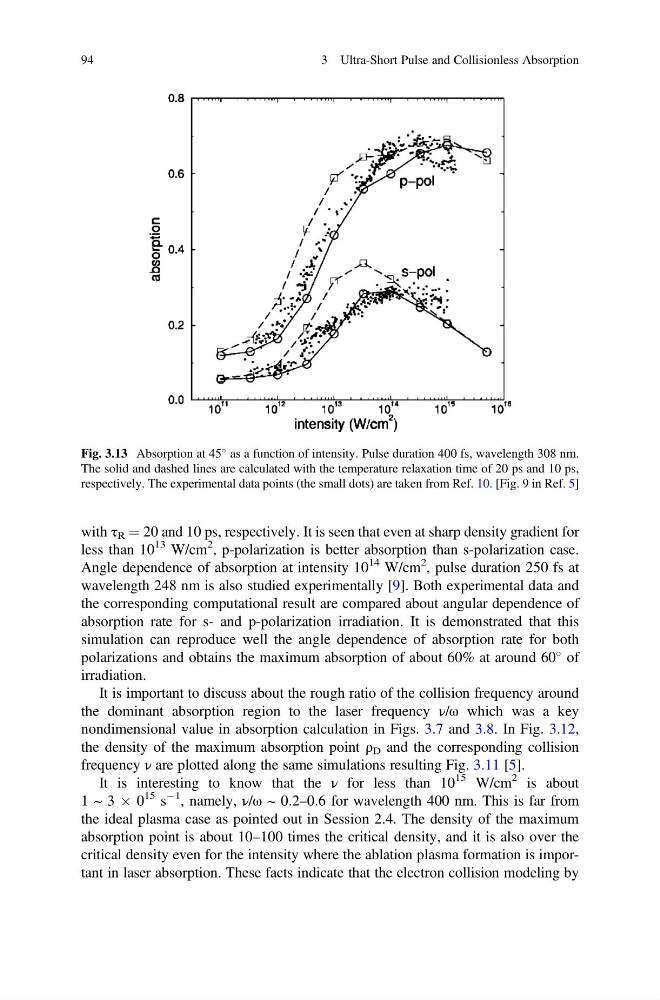
with τ R ¼ 20 and 10 ps, respectively. It is seen that even at sharp density gradient for
less than 10
13 W/cm
2 , p-polarization is better absorption than s-polarization case.
Angle dependence of absorption at intensity 10
14 W/cm
2 , pulse duration 250 fs at
wavelength 248 nm is also studied experimentally [9]. Both experimental data and
the corresponding computational result are compared about angular dependence of
absorption rate for s- and p-polarization irradiation. It is demonstrated that this
simulation can reproduce well the angle dependence of absorption rate for both
polarizations and obtains the maximum absorption of about 60% at around 60
of
irradiation.
It is important to discuss about the rough ratio of the collision frequency around
the dominant absorption region to the laser frequency ν/ω which was a key
nondimensional value in absorption calculation in Figs. 3.7 and 3.8. In Fig. 3.12,
the density of the maximum absorption point ρ D and the corresponding collision
frequency ν are plotted along the same simulations resulting Fig. 3.11 [5].
It is interesting to know that the ν for less than 10
15 W/cm
2 is about
1 ~ 3 Â 0
15 s
À1 , namely, ν/ω ~ 0.2–0.6 for wavelength 400 nm. This is far from
the ideal plasma case as pointed out in Session 2.4. The density of the maximum
absorption point is about 10–100 times the critical density, and it is also over the
critical density even for the intensity where the ablation plasma formation is important in laser absorption. These facts indicate that the electron collision modeling by
Fig. 3.13 Absorption at 45
as a function of intensity. Pulse duration 400 fs, wavelength 308 nm.
The solid and dashed lines are calculated with the temperature relaxation time of 20 ps and 10 ps,
respectively. The experimental data points (the small dots) are taken from Ref. 10. [Fig. 9 in Ref. 5]
94
3 Ultra-Short Pulse and Collisionless Absorption
less than 10
13 W/cm
2 , p-polarization is better absorption than s-polarization case.
Angle dependence of absorption at intensity 10
14 W/cm
2 , pulse duration 250 fs at
wavelength 248 nm is also studied experimentally [9]. Both experimental data and
the corresponding computational result are compared about angular dependence of
absorption rate for s- and p-polarization irradiation. It is demonstrated that this
simulation can reproduce well the angle dependence of absorption rate for both
polarizations and obtains the maximum absorption of about 60% at around 60
of
irradiation.
It is important to discuss about the rough ratio of the collision frequency around
the dominant absorption region to the laser frequency ν/ω which was a key
nondimensional value in absorption calculation in Figs. 3.7 and 3.8. In Fig. 3.12,
the density of the maximum absorption point ρ D and the corresponding collision
frequency ν are plotted along the same simulations resulting Fig. 3.11 [5].
It is interesting to know that the ν for less than 10
15 W/cm
2 is about
1 ~ 3 Â 0
15 s
À1 , namely, ν/ω ~ 0.2–0.6 for wavelength 400 nm. This is far from
the ideal plasma case as pointed out in Session 2.4. The density of the maximum
absorption point is about 10–100 times the critical density, and it is also over the
critical density even for the intensity where the ablation plasma formation is important in laser absorption. These facts indicate that the electron collision modeling by
Fig. 3.13 Absorption at 45
as a function of intensity. Pulse duration 400 fs, wavelength 308 nm.
The solid and dashed lines are calculated with the temperature relaxation time of 20 ps and 10 ps,
respectively. The experimental data points (the small dots) are taken from Ref. 10. [Fig. 9 in Ref. 5]
94
3 Ultra-Short Pulse and Collisionless Absorption