

E x x
ð Þ ¼ i
sinθ
ε x
ð Þ
B x
ð Þ
ð3:1:8Þ
It is clear that the case with small ν/ω, the electric field in x-direction is resonantly
enhanced near the critical density. Given density scale length, it is seen that there is
an optimum angle for the highest E x value.
For a given value of the dissipation ν/ω, the Eqs. (3.1.6) are solved for
s-polarization case, and the corresponding equations from (3.1.2) are also solved
for p-polarization case numerically. Since assuming sub-picosecond pulse, the
density scale length L is varied from very sharp case to 5λ, where λ is the laser
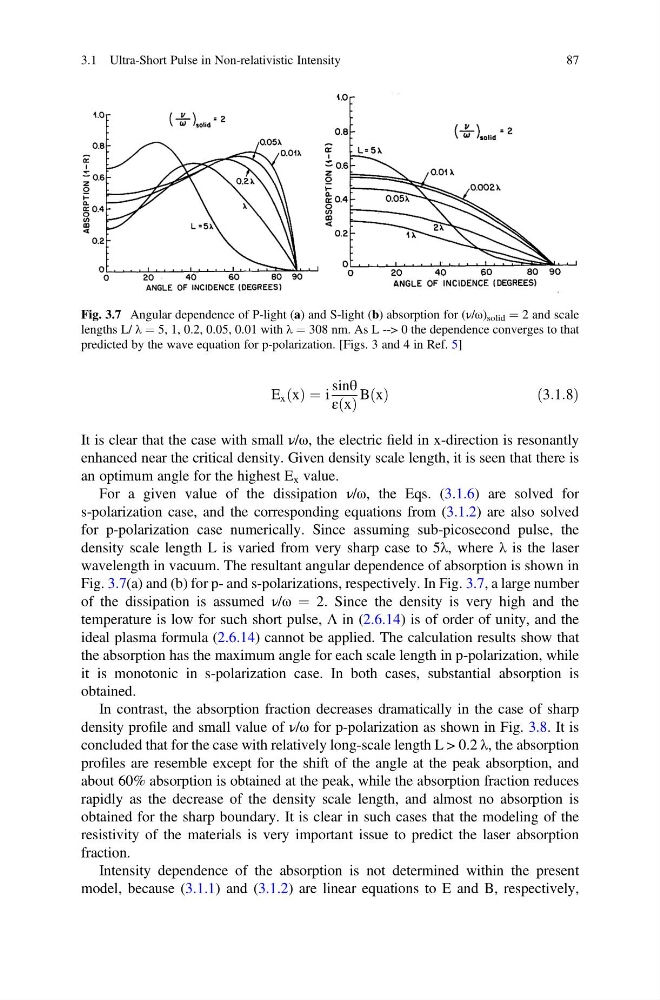
wavelength in vacuum. The resultant angular dependence of absorption is shown in
Fig. 3.7(a) and (b) for p- and s-polarizations, respectively. In Fig. 3.7, a large number
of the dissipation is assumed ν/ω ¼ 2. Since the density is very high and the
temperature is low for such short pulse, Λ in (2.6.14) is of order of unity, and the
ideal plasma formula (2.6.14) cannot be applied. The calculation results show that
the absorption has the maximum angle for each scale length in p-polarization, while
it is monotonic in s-polarization case. In both cases, substantial absorption is
obtained.
In contrast, the absorption fraction decreases dramatically in the case of sharp
density profile and small value of ν/ω for p-polarization as shown in Fig. 3.8. It is
concluded that for the case with relatively long-scale length L > 0.2 λ, the absorption
profiles are resemble except for the shift of the angle at the peak absorption, and
about 60% absorption is obtained at the peak, while the absorption fraction reduces
rapidly as the decrease of the density scale length, and almost no absorption is
obtained for the sharp boundary. It is clear in such cases that the modeling of the
resistivity of the materials is very important issue to predict the laser absorption
fraction.
Intensity dependence of the absorption is not determined within the present
model, because (3.1.1) and (3.1.2) are linear equations to E and B, respectively,
Fig. 3.7 Angular dependence of P-light (a) and S-light (b) absorption for (ν/ω) solid ¼ 2 and scale
lengths L/ λ ¼ 5, 1, 0.2, 0.05, 0.01 with λ ¼ 308 nm. As L --> 0 the dependence converges to that
predicted by the wave equation for p-polarization. [Figs. 3 and 4 in Ref. 5]
3.1 Ultra-Short Pulse in Non-relativistic Intensity
87
ð Þ ¼ i
sinθ
ε x
ð Þ
B x
ð Þ
ð3:1:8Þ
It is clear that the case with small ν/ω, the electric field in x-direction is resonantly
enhanced near the critical density. Given density scale length, it is seen that there is
an optimum angle for the highest E x value.
For a given value of the dissipation ν/ω, the Eqs. (3.1.6) are solved for
s-polarization case, and the corresponding equations from (3.1.2) are also solved
for p-polarization case numerically. Since assuming sub-picosecond pulse, the
density scale length L is varied from very sharp case to 5λ, where λ is the laser
wavelength in vacuum. The resultant angular dependence of absorption is shown in
Fig. 3.7(a) and (b) for p- and s-polarizations, respectively. In Fig. 3.7, a large number
of the dissipation is assumed ν/ω ¼ 2. Since the density is very high and the
temperature is low for such short pulse, Λ in (2.6.14) is of order of unity, and the
ideal plasma formula (2.6.14) cannot be applied. The calculation results show that
the absorption has the maximum angle for each scale length in p-polarization, while
it is monotonic in s-polarization case. In both cases, substantial absorption is
obtained.
In contrast, the absorption fraction decreases dramatically in the case of sharp
density profile and small value of ν/ω for p-polarization as shown in Fig. 3.8. It is
concluded that for the case with relatively long-scale length L > 0.2 λ, the absorption
profiles are resemble except for the shift of the angle at the peak absorption, and
about 60% absorption is obtained at the peak, while the absorption fraction reduces
rapidly as the decrease of the density scale length, and almost no absorption is
obtained for the sharp boundary. It is clear in such cases that the modeling of the
resistivity of the materials is very important issue to predict the laser absorption
fraction.
Intensity dependence of the absorption is not determined within the present
model, because (3.1.1) and (3.1.2) are linear equations to E and B, respectively,
Fig. 3.7 Angular dependence of P-light (a) and S-light (b) absorption for (ν/ω) solid ¼ 2 and scale
lengths L/ λ ¼ 5, 1, 0.2, 0.05, 0.01 with λ ¼ 308 nm. As L --> 0 the dependence converges to that
predicted by the wave equation for p-polarization. [Figs. 3 and 4 in Ref. 5]
3.1 Ultra-Short Pulse in Non-relativistic Intensity
87