

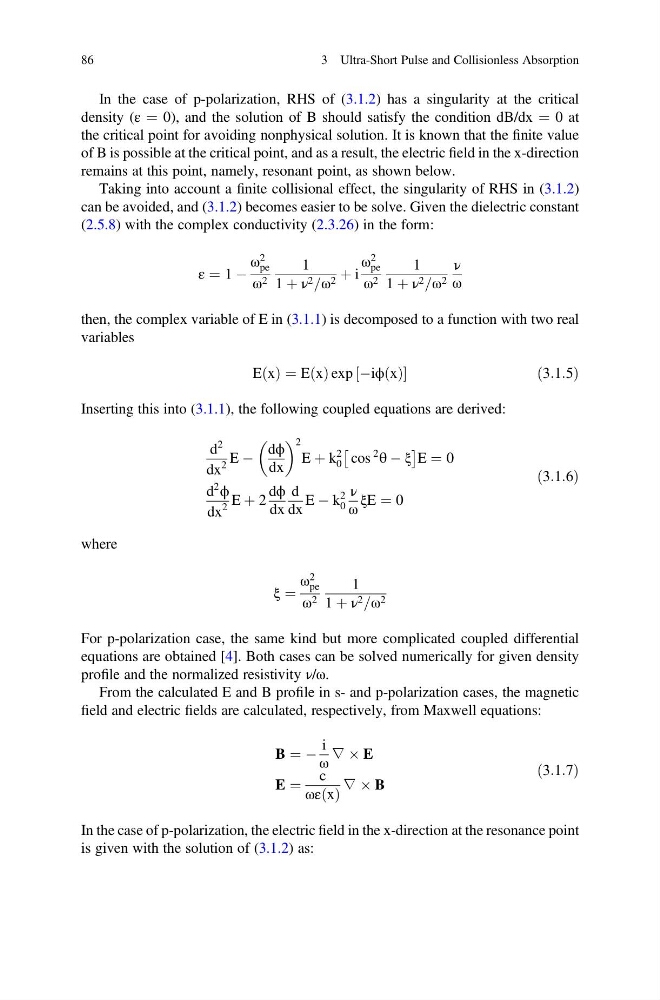
In the case of p-polarization, RHS of (3.1.2) has a singularity at the critical
density (ε ¼ 0), and the solution of B should satisfy the condition dB/dx ¼ 0 at
the critical point for avoiding nonphysical solution. It is known that the finite value
of B is possible at the critical point, and as a result, the electric field in the x-direction
remains at this point, namely, resonant point, as shown below.
Taking into account a finite collisional effect, the singularity of RHS in (3.1.2)
can be avoided, and (3.1.2) becomes easier to be solve. Given the dielectric constant
(2.5.8) with the complex conductivity (2.3.26) in the form:
ε ¼ 1 À
ω
2
pe
ω 2
1
1 þ ν 2 =ω 2 þ i
ω
2
pe
ω 2
1
1 þ ν 2 =ω 2
ν
ω
then, the complex variable of E in (3.1.1) is decomposed to a function with two real
variables
E x
ð Þ ¼ E x
ð Þ exp Àiϕ x
ð Þ
½
ð3:1:5Þ
Inserting this into (3.1.1), the following coupled equations are derived:
d
2
dx
2
E À
dϕ
dx
2
E þ k
2
0 cos
2
θ À ξ
Â
Ã
E ¼ 0
d
2
ϕ
dx
2
E þ 2
dϕ
dx
d
dx
E À k
2
0
ν
ω
ξE ¼ 0
ð3:1:6Þ
where
ξ ¼
ω
2
pe
ω 2
1
1 þ ν 2 =ω 2
For p-polarization case, the same kind but more complicated coupled differential
equations are obtained [4]. Both cases can be solved numerically for given density
profile and the normalized resistivity ν/ω.
From the calculated E and B profile in s- and p-polarization cases, the magnetic
field and electric fields are calculated, respectively, from Maxwell equations:
B ¼ À
i
ω
∇ Â E
E ¼
c
ωε x
ð Þ
∇ Â B
ð3:1:7Þ
In the case of p-polarization, the electric field in the x-direction at the resonance point
is given with the solution of (3.1.2) as:
86
3 Ultra-Short Pulse and Collisionless Absorption
density (ε ¼ 0), and the solution of B should satisfy the condition dB/dx ¼ 0 at
the critical point for avoiding nonphysical solution. It is known that the finite value
of B is possible at the critical point, and as a result, the electric field in the x-direction
remains at this point, namely, resonant point, as shown below.
Taking into account a finite collisional effect, the singularity of RHS in (3.1.2)
can be avoided, and (3.1.2) becomes easier to be solve. Given the dielectric constant
(2.5.8) with the complex conductivity (2.3.26) in the form:
ε ¼ 1 À
ω
2
pe
ω 2
1
1 þ ν 2 =ω 2 þ i
ω
2
pe
ω 2
1
1 þ ν 2 =ω 2
ν
ω
then, the complex variable of E in (3.1.1) is decomposed to a function with two real
variables
E x
ð Þ ¼ E x
ð Þ exp Àiϕ x
ð Þ
½
ð3:1:5Þ
Inserting this into (3.1.1), the following coupled equations are derived:
d
2
dx
2
E À
dϕ
dx
2
E þ k
2
0 cos
2
θ À ξ
Â
Ã
E ¼ 0
d
2
ϕ
dx
2
E þ 2
dϕ
dx
d
dx
E À k
2
0
ν
ω
ξE ¼ 0
ð3:1:6Þ
where
ξ ¼
ω
2
pe
ω 2
1
1 þ ν 2 =ω 2
For p-polarization case, the same kind but more complicated coupled differential
equations are obtained [4]. Both cases can be solved numerically for given density
profile and the normalized resistivity ν/ω.
From the calculated E and B profile in s- and p-polarization cases, the magnetic
field and electric fields are calculated, respectively, from Maxwell equations:
B ¼ À
i
ω
∇ Â E
E ¼
c
ωε x
ð Þ
∇ Â B
ð3:1:7Þ
In the case of p-polarization, the electric field in the x-direction at the resonance point
is given with the solution of (3.1.2) as:
86
3 Ultra-Short Pulse and Collisionless Absorption