

In the case of p-polarization since the magnetic field is always in z-direction, the
Helmholtz equation to B is given as:
d
2
dx
2
B þ k
2
0 ε x
ð Þ À sin
2
θ
Â
Ã
B ¼ À
1
ε
dε
dx
dB
dx
ð3:1:2Þ
In (3.1.1) and (3.1.2), the location of the density satisfying the following condition is the turning point:
ε x
ð Þ À sin
2
θ ¼ 0
ð3:1:3Þ
In the case of a linear density profile, assume the turning point is at x ¼ 0, (3.1.1)
has the following form after stretching x-coordinate properly to a dimensionless
coordinate ζ:
d
2
dζ
2
E þ ζE ¼ 0
ð3:1:4Þ
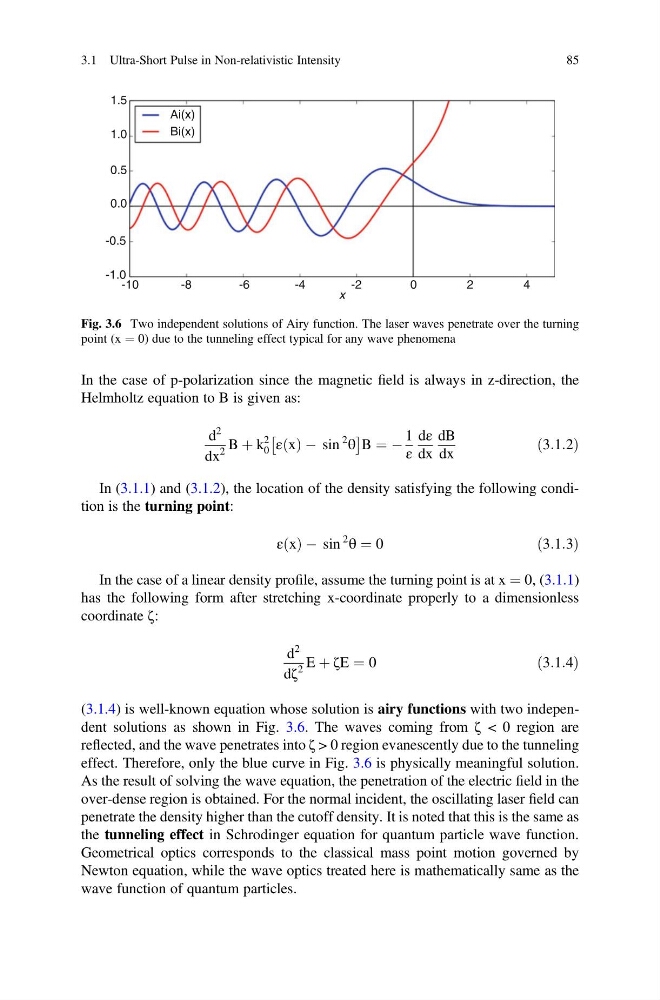
(3.1.4) is well-known equation whose solution is airy functions with two independent solutions as shown in Fig. 3.6. The waves coming from ζ < 0 region are
reflected, and the wave penetrates into ζ > 0 region evanescently due to the tunneling
effect. Therefore, only the blue curve in Fig. 3.6 is physically meaningful solution.
As the result of solving the wave equation, the penetration of the electric field in the
over-dense region is obtained. For the normal incident, the oscillating laser field can
penetrate the density higher than the cutoff density. It is noted that this is the same as
the tunneling effect in Schrodinger equation for quantum particle wave function.
Geometrical optics corresponds to the classical mass point motion governed by
Newton equation, while the wave optics treated here is mathematically same as the
wave function of quantum particles.
1.5
Ai(x)
Bi(x)
1.0
0.5
0.0
-0.5
-1.0
-10
-8
-6
-4
-2
0
x
2
4
Fig. 3.6 Two independent solutions of Airy function. The laser waves penetrate over the turning
point (x ¼ 0) due to the tunneling effect typical for any wave phenomena
3.1 Ultra-Short Pulse in Non-relativistic Intensity
85
Helmholtz equation to B is given as:
d
2
dx
2
B þ k
2
0 ε x
ð Þ À sin
2
θ
Â
Ã
B ¼ À
1
ε
dε
dx
dB
dx
ð3:1:2Þ
In (3.1.1) and (3.1.2), the location of the density satisfying the following condition is the turning point:
ε x
ð Þ À sin
2
θ ¼ 0
ð3:1:3Þ
In the case of a linear density profile, assume the turning point is at x ¼ 0, (3.1.1)
has the following form after stretching x-coordinate properly to a dimensionless
coordinate ζ:
d
2
dζ
2
E þ ζE ¼ 0
ð3:1:4Þ
(3.1.4) is well-known equation whose solution is airy functions with two independent solutions as shown in Fig. 3.6. The waves coming from ζ < 0 region are
reflected, and the wave penetrates into ζ > 0 region evanescently due to the tunneling
effect. Therefore, only the blue curve in Fig. 3.6 is physically meaningful solution.
As the result of solving the wave equation, the penetration of the electric field in the
over-dense region is obtained. For the normal incident, the oscillating laser field can
penetrate the density higher than the cutoff density. It is noted that this is the same as
the tunneling effect in Schrodinger equation for quantum particle wave function.
Geometrical optics corresponds to the classical mass point motion governed by
Newton equation, while the wave optics treated here is mathematically same as the
wave function of quantum particles.
1.5
Ai(x)
Bi(x)
1.0
0.5
0.0
-0.5
-1.0
-10
-8
-6
-4
-2
0
x
2
4
Fig. 3.6 Two independent solutions of Airy function. The laser waves penetrate over the turning
point (x ¼ 0) due to the tunneling effect typical for any wave phenomena
3.1 Ultra-Short Pulse in Non-relativistic Intensity
85