

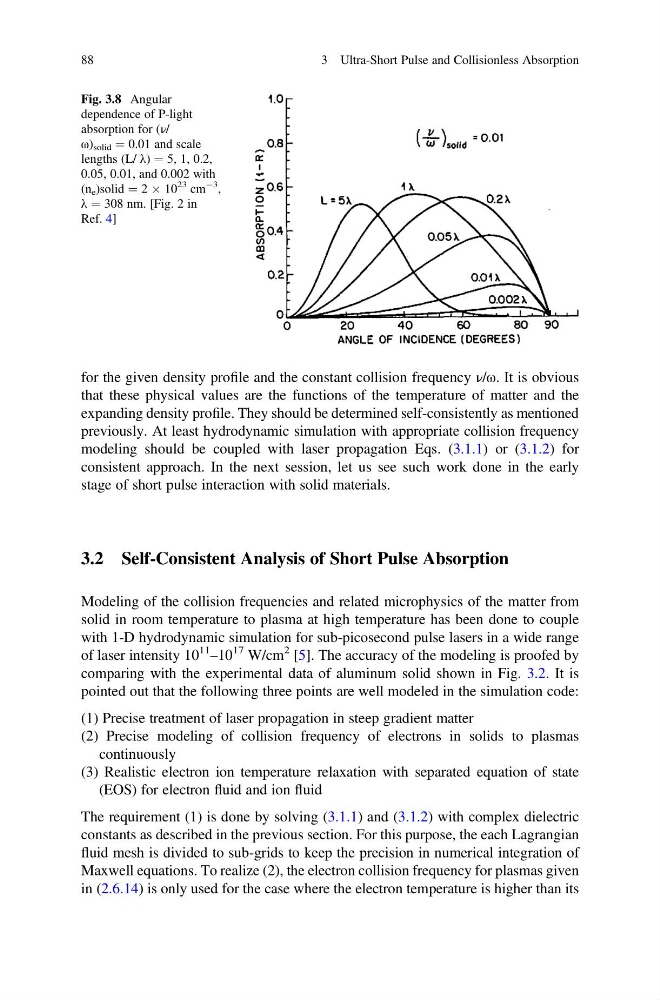
for the given density profile and the constant collision frequency ν/ω. It is obvious
that these physical values are the functions of the temperature of matter and the
expanding density profile. They should be determined self-consistently as mentioned
previously. At least hydrodynamic simulation with appropriate collision frequency
modeling should be coupled with laser propagation Eqs. (3.1.1) or (3.1.2) for
consistent approach. In the next session, let us see such work done in the early
stage of short pulse interaction with solid materials.
3.2 Self-Consistent Analysis of Short Pulse Absorption
Modeling of the collision frequencies and related microphysics of the matter from
solid in room temperature to plasma at high temperature has been done to couple
with 1-D hydrodynamic simulation for sub-picosecond pulse lasers in a wide range
of laser intensity 10
11
–10
17 W/cm
2 [5]. The accuracy of the modeling is proofed by
comparing with the experimental data of aluminum solid shown in Fig. 3.2. It is
pointed out that the following three points are well modeled in the simulation code:
(1) Precise treatment of laser propagation in steep gradient matter
(2) Precise modeling of collision frequency of electrons in solids to plasmas
continuously
(3) Realistic electron ion temperature relaxation with separated equation of state
(EOS) for electron fluid and ion fluid
The requirement (1) is done by solving (3.1.1) and (3.1.2) with complex dielectric
constants as described in the previous section. For this purpose, the each Lagrangian
fluid mesh is divided to sub-grids to keep the precision in numerical integration of
Maxwell equations. To realize (2), the electron collision frequency for plasmas given
in (2.6.14) is only used for the case where the electron temperature is higher than its
Fig. 3.8 Angular
dependence of P-light
absorption for (ν/
ω) solid ¼ 0.01 and scale
lengths (L/ λ) ¼ 5, 1, 0.2,
0.05, 0.01, and 0.002 with
(n e )solid ¼ 2 Â 10
23 cm
À3
,
λ ¼ 308 nm. [Fig. 2 in
Ref. 4]
88
3 Ultra-Short Pulse and Collisionless Absorption
that these physical values are the functions of the temperature of matter and the
expanding density profile. They should be determined self-consistently as mentioned
previously. At least hydrodynamic simulation with appropriate collision frequency
modeling should be coupled with laser propagation Eqs. (3.1.1) or (3.1.2) for
consistent approach. In the next session, let us see such work done in the early
stage of short pulse interaction with solid materials.
3.2 Self-Consistent Analysis of Short Pulse Absorption
Modeling of the collision frequencies and related microphysics of the matter from
solid in room temperature to plasma at high temperature has been done to couple
with 1-D hydrodynamic simulation for sub-picosecond pulse lasers in a wide range
of laser intensity 10
11
–10
17 W/cm
2 [5]. The accuracy of the modeling is proofed by
comparing with the experimental data of aluminum solid shown in Fig. 3.2. It is
pointed out that the following three points are well modeled in the simulation code:
(1) Precise treatment of laser propagation in steep gradient matter
(2) Precise modeling of collision frequency of electrons in solids to plasmas
continuously
(3) Realistic electron ion temperature relaxation with separated equation of state
(EOS) for electron fluid and ion fluid
The requirement (1) is done by solving (3.1.1) and (3.1.2) with complex dielectric
constants as described in the previous section. For this purpose, the each Lagrangian
fluid mesh is divided to sub-grids to keep the precision in numerical integration of
Maxwell equations. To realize (2), the electron collision frequency for plasmas given
in (2.6.14) is only used for the case where the electron temperature is higher than its
Fig. 3.8 Angular
dependence of P-light
absorption for (ν/
ω) solid ¼ 0.01 and scale
lengths (L/ λ) ¼ 5, 1, 0.2,
0.05, 0.01, and 0.002 with
(n e )solid ¼ 2 Â 10
23 cm
À3
,
λ ¼ 308 nm. [Fig. 2 in
Ref. 4]
88
3 Ultra-Short Pulse and Collisionless Absorption