

Topics in Current Chemistry (2019) 377:35
1 3
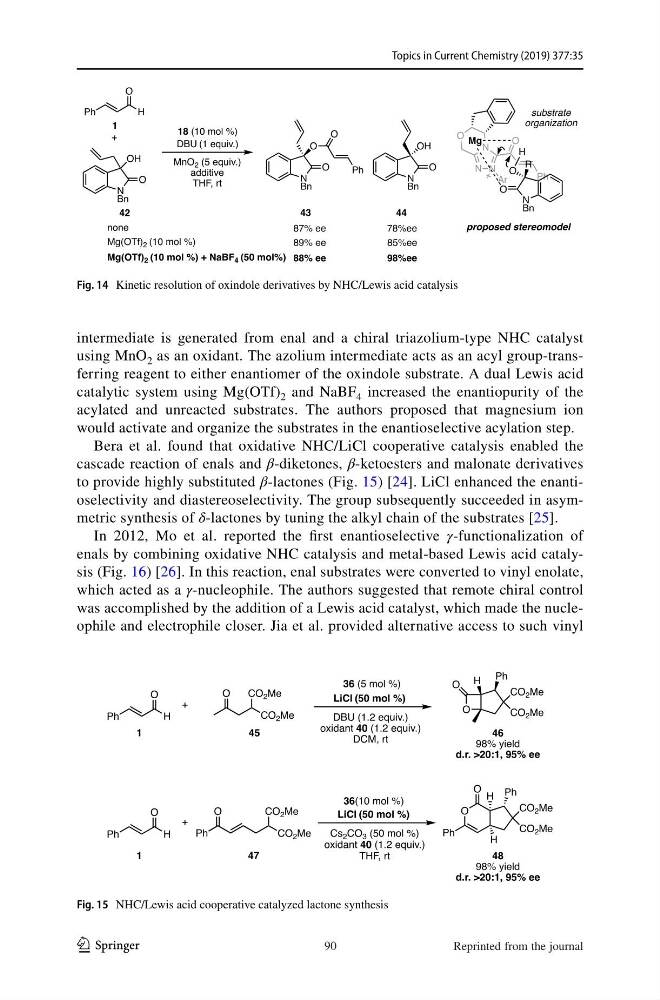
intermediate is generated from enal and a chiral triazolium-type NHC catalyst
using MnO 2 as an oxidant. The azolium intermediate acts as an acyl group-transferring reagent to either enantiomer of the oxindole substrate. A dual Lewis acid
catalytic system using Mg(OTf) 2 and NaBF 4 increased the enantiopurity of the
acylated and unreacted substrates. The authors proposed that magnesium ion
would activate and organize the substrates in the enantioselective acylation step.
Bera et al. found that oxidative NHC/LiCl cooperative catalysis enabled the
cascade reaction of enals and β-diketones, β-ketoesters and malonate derivatives
to provide highly substituted β-lactones (Fig. 15) [24]. LiCl enhanced the enantioselectivity and diastereoselectivity. The group subsequently succeeded in asymmetric synthesis of δ-lactones by tuning the alkyl chain of the substrates [25].
In 2012, Mo et al. reported the first enantioselective γ-functionalization of
enals by combining oxidative NHC catalysis and metal-based Lewis acid catalysis (Fig. 16) [26]. In this reaction, enal substrates were converted to vinyl enolate,
which acted as a γ-nucleophile. The authors suggested that remote chiral control
was accomplished by the addition of a Lewis acid catalyst, which made the nucleophile and electrophile closer. Jia et al. provided alternative access to such vinyl
Fig. 14 Kinetic resolution of oxindole derivatives by NHC/Lewis acid catalysis
Fig. 15 NHC/Lewis acid cooperative catalyzed lactone synthesis
Reprinted from the journal
90
1 3
intermediate is generated from enal and a chiral triazolium-type NHC catalyst
using MnO 2 as an oxidant. The azolium intermediate acts as an acyl group-transferring reagent to either enantiomer of the oxindole substrate. A dual Lewis acid
catalytic system using Mg(OTf) 2 and NaBF 4 increased the enantiopurity of the
acylated and unreacted substrates. The authors proposed that magnesium ion
would activate and organize the substrates in the enantioselective acylation step.
Bera et al. found that oxidative NHC/LiCl cooperative catalysis enabled the
cascade reaction of enals and β-diketones, β-ketoesters and malonate derivatives
to provide highly substituted β-lactones (Fig. 15) [24]. LiCl enhanced the enantioselectivity and diastereoselectivity. The group subsequently succeeded in asymmetric synthesis of δ-lactones by tuning the alkyl chain of the substrates [25].
In 2012, Mo et al. reported the first enantioselective γ-functionalization of
enals by combining oxidative NHC catalysis and metal-based Lewis acid catalysis (Fig. 16) [26]. In this reaction, enal substrates were converted to vinyl enolate,
which acted as a γ-nucleophile. The authors suggested that remote chiral control
was accomplished by the addition of a Lewis acid catalyst, which made the nucleophile and electrophile closer. Jia et al. provided alternative access to such vinyl
Fig. 14 Kinetic resolution of oxindole derivatives by NHC/Lewis acid catalysis
Fig. 15 NHC/Lewis acid cooperative catalyzed lactone synthesis
Reprinted from the journal
90