

1 3
Topics in Current Chemistry (2019) 377:35
[19]. A copper salt acts as a Lewis acid, coordinating with both a Breslow intermediate and thiol to induce efficient enantioselective protonation.
Considerable progress has been made recently in NHC oxidative catalysis [20].
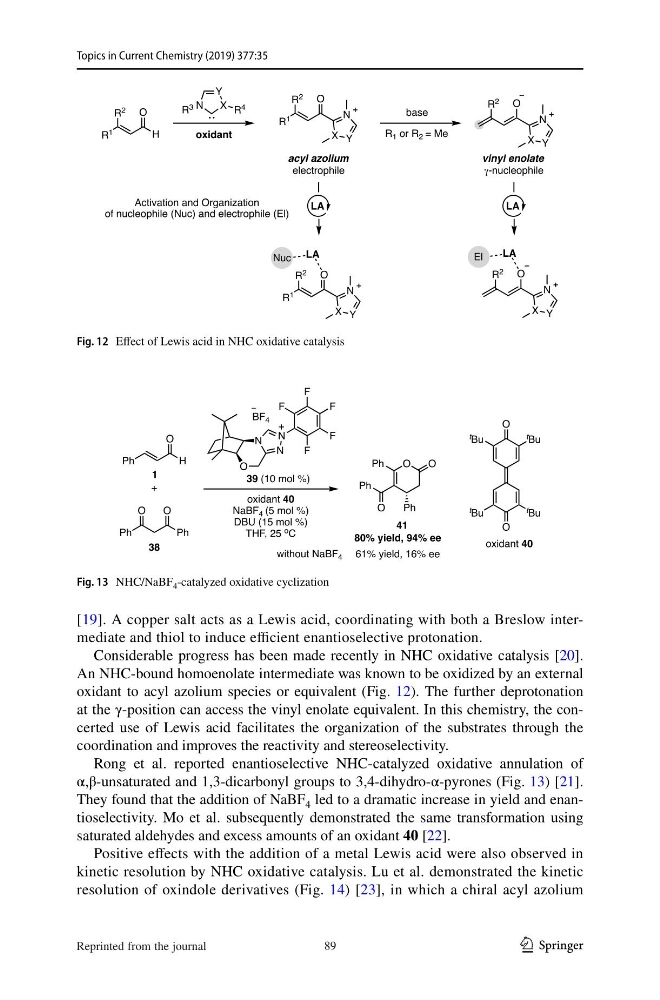
An NHC-bound homoenolate intermediate was known to be oxidized by an external
oxidant to acyl azolium species or equivalent (Fig. 12). The further deprotonation
at the γ-position can access the vinyl enolate equivalent. In this chemistry, the concerted use of Lewis acid facilitates the organization of the substrates through the
coordination and improves the reactivity and stereoselectivity.
Rong et al. reported enantioselective NHC-catalyzed oxidative annulation of
α,β-unsaturated and 1,3-dicarbonyl groups to 3,4-dihydro-α-pyrones (Fig. 13) [21].
They found that the addition of NaBF 4 led to a dramatic increase in yield and enantioselectivity. Mo et al. subsequently demonstrated the same transformation using
saturated aldehydes and excess amounts of an oxidant 40 [22].
Positive effects with the addition of a metal Lewis acid were also observed in
kinetic resolution by NHC oxidative catalysis. Lu et al. demonstrated the kinetic
resolution of oxindole derivatives (Fig. 14) [23], in which a chiral acyl azolium
Fig. 12 Effect of Lewis acid in NHC oxidative catalysis
Fig. 13 NHC/NaBF 4 -catalyzed oxidative cyclization
Reprinted from the journal
89
Topics in Current Chemistry (2019) 377:35
[19]. A copper salt acts as a Lewis acid, coordinating with both a Breslow intermediate and thiol to induce efficient enantioselective protonation.
Considerable progress has been made recently in NHC oxidative catalysis [20].
An NHC-bound homoenolate intermediate was known to be oxidized by an external
oxidant to acyl azolium species or equivalent (Fig. 12). The further deprotonation
at the γ-position can access the vinyl enolate equivalent. In this chemistry, the concerted use of Lewis acid facilitates the organization of the substrates through the
coordination and improves the reactivity and stereoselectivity.
Rong et al. reported enantioselective NHC-catalyzed oxidative annulation of
α,β-unsaturated and 1,3-dicarbonyl groups to 3,4-dihydro-α-pyrones (Fig. 13) [21].
They found that the addition of NaBF 4 led to a dramatic increase in yield and enantioselectivity. Mo et al. subsequently demonstrated the same transformation using
saturated aldehydes and excess amounts of an oxidant 40 [22].
Positive effects with the addition of a metal Lewis acid were also observed in
kinetic resolution by NHC oxidative catalysis. Lu et al. demonstrated the kinetic
resolution of oxindole derivatives (Fig. 14) [23], in which a chiral acyl azolium
Fig. 12 Effect of Lewis acid in NHC oxidative catalysis
Fig. 13 NHC/NaBF 4 -catalyzed oxidative cyclization
Reprinted from the journal
89