

1 3
Topics in Current Chemistry (2019) 377:35
enolate species from free α,β-unsaturated carboxylic acids and pivaloyl chloride
[27].
3 NHC/Late‑Transition‑Metal Cooperative Catalysis
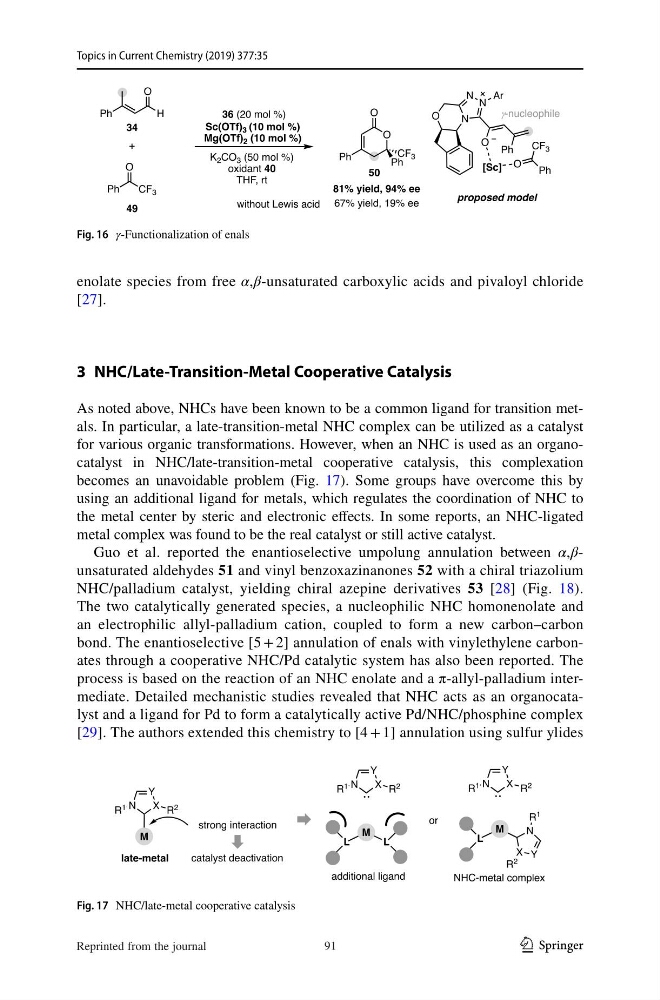
As noted above, NHCs have been known to be a common ligand for transition metals. In particular, a late-transition-metal NHC complex can be utilized as a catalyst
for various organic transformations. However, when an NHC is used as an organocatalyst in NHC/late-transition-metal cooperative catalysis, this complexation
becomes an unavoidable problem (Fig. 17). Some groups have overcome this by
using an additional ligand for metals, which regulates the coordination of NHC to
the metal center by steric and electronic effects. In some reports, an NHC-ligated
metal complex was found to be the real catalyst or still active catalyst.
Guo et al. reported the enantioselective umpolung annulation between α,βunsaturated aldehydes 51 and vinyl benzoxazinanones 52 with a chiral triazolium
NHC/palladium catalyst, yielding chiral azepine derivatives 53 [28] (Fig. 18).
The two catalytically generated species, a nucleophilic NHC homonenolate and
an electrophilic allyl-palladium cation, coupled to form a new carbon–carbon
bond. The enantioselective [5 + 2] annulation of enals with vinylethylene carbonates through a cooperative NHC/Pd catalytic system has also been reported. The
process is based on the reaction of an NHC enolate and a π-allyl-palladium intermediate. Detailed mechanistic studies revealed that NHC acts as an organocatalyst and a ligand for Pd to form a catalytically active Pd/NHC/phosphine complex
[29]. The authors extended this chemistry to [4 + 1] annulation using sulfur ylides
Fig. 16 γ-Functionalization of enals
Fig. 17 NHC/late-metal cooperative catalysis
Reprinted from the journal
91
Topics in Current Chemistry (2019) 377:35
enolate species from free α,β-unsaturated carboxylic acids and pivaloyl chloride
[27].
3 NHC/Late‑Transition‑Metal Cooperative Catalysis
As noted above, NHCs have been known to be a common ligand for transition metals. In particular, a late-transition-metal NHC complex can be utilized as a catalyst
for various organic transformations. However, when an NHC is used as an organocatalyst in NHC/late-transition-metal cooperative catalysis, this complexation
becomes an unavoidable problem (Fig. 17). Some groups have overcome this by
using an additional ligand for metals, which regulates the coordination of NHC to
the metal center by steric and electronic effects. In some reports, an NHC-ligated
metal complex was found to be the real catalyst or still active catalyst.
Guo et al. reported the enantioselective umpolung annulation between α,βunsaturated aldehydes 51 and vinyl benzoxazinanones 52 with a chiral triazolium
NHC/palladium catalyst, yielding chiral azepine derivatives 53 [28] (Fig. 18).
The two catalytically generated species, a nucleophilic NHC homonenolate and
an electrophilic allyl-palladium cation, coupled to form a new carbon–carbon
bond. The enantioselective [5 + 2] annulation of enals with vinylethylene carbonates through a cooperative NHC/Pd catalytic system has also been reported. The
process is based on the reaction of an NHC enolate and a π-allyl-palladium intermediate. Detailed mechanistic studies revealed that NHC acts as an organocatalyst and a ligand for Pd to form a catalytically active Pd/NHC/phosphine complex
[29]. The authors extended this chemistry to [4 + 1] annulation using sulfur ylides
Fig. 16 γ-Functionalization of enals
Fig. 17 NHC/late-metal cooperative catalysis
Reprinted from the journal
91