

1 3
Topics in Current Chemistry (2019) 377:35
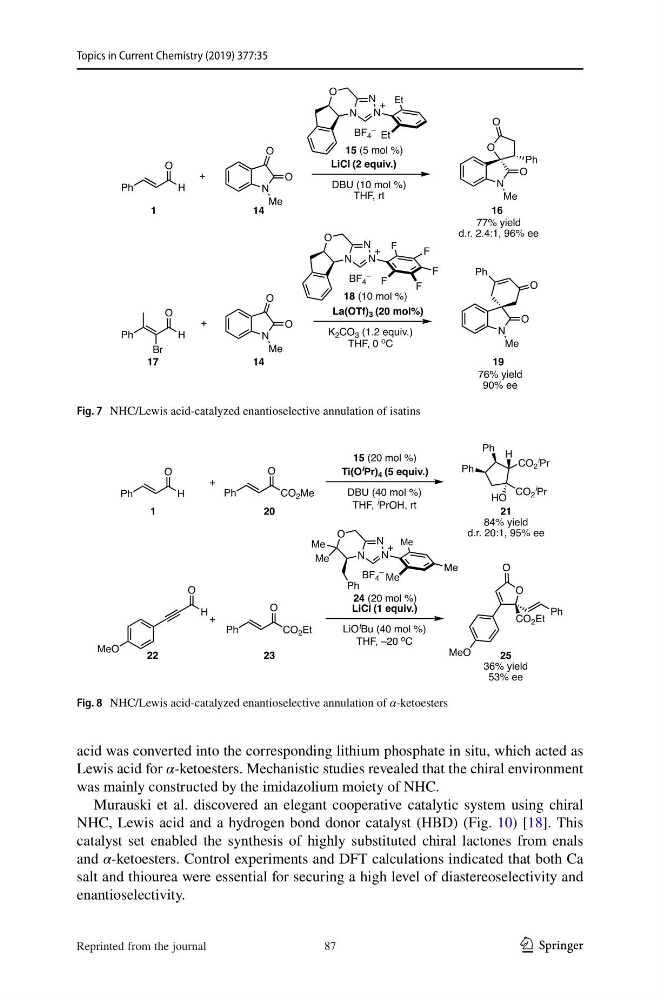
acid was converted into the corresponding lithium phosphate in situ, which acted as
Lewis acid for α-ketoesters. Mechanistic studies revealed that the chiral environment
was mainly constructed by the imidazolium moiety of NHC.
Murauski et al. discovered an elegant cooperative catalytic system using chiral
NHC, Lewis acid and a hydrogen bond donor catalyst (HBD) (Fig. 10) [18]. This
catalyst set enabled the synthesis of highly substituted chiral lactones from enals
and α-ketoesters. Control experiments and DFT calculations indicated that both Ca
salt and thiourea were essential for securing a high level of diastereoselectivity and
enantioselectivity.
Fig. 7 NHC/Lewis acid-catalyzed enantioselective annulation of isatins
Fig. 8 NHC/Lewis acid-catalyzed enantioselective annulation of α-ketoesters
Reprinted from the journal
87
Topics in Current Chemistry (2019) 377:35
acid was converted into the corresponding lithium phosphate in situ, which acted as
Lewis acid for α-ketoesters. Mechanistic studies revealed that the chiral environment
was mainly constructed by the imidazolium moiety of NHC.
Murauski et al. discovered an elegant cooperative catalytic system using chiral
NHC, Lewis acid and a hydrogen bond donor catalyst (HBD) (Fig. 10) [18]. This
catalyst set enabled the synthesis of highly substituted chiral lactones from enals
and α-ketoesters. Control experiments and DFT calculations indicated that both Ca
salt and thiourea were essential for securing a high level of diastereoselectivity and
enantioselectivity.
Fig. 7 NHC/Lewis acid-catalyzed enantioselective annulation of isatins
Fig. 8 NHC/Lewis acid-catalyzed enantioselective annulation of α-ketoesters
Reprinted from the journal
87