

Topics in Current Chemistry (2019) 377:35
1 3
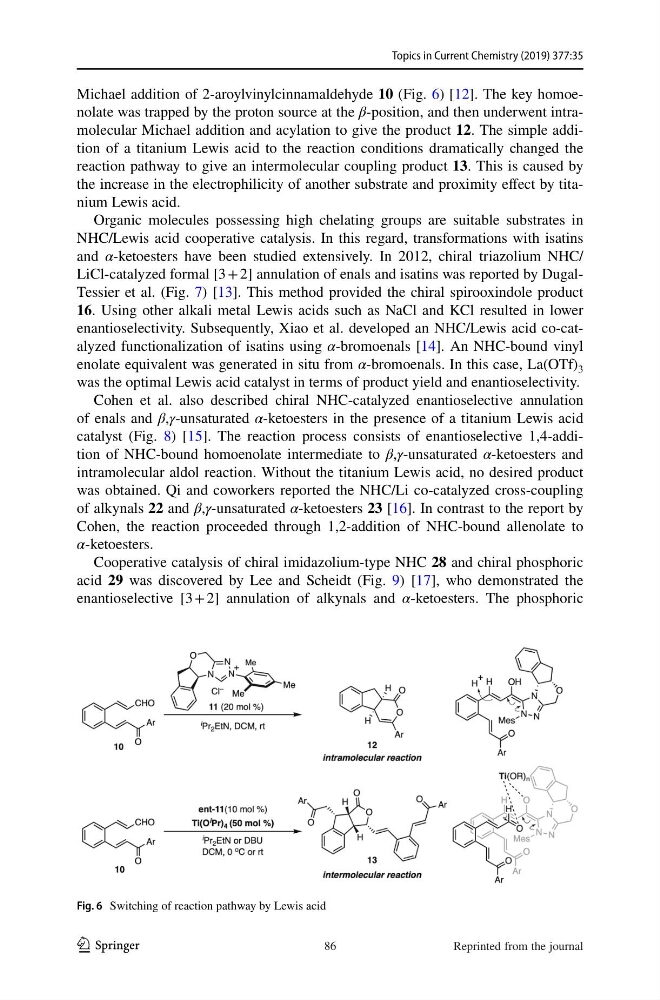
Michael addition of 2-aroylvinylcinnamaldehyde 10 (Fig. 6) [12]. The key homoenolate was trapped by the proton source at the β-position, and then underwent intramolecular Michael addition and acylation to give the product 12. The simple addition of a titanium Lewis acid to the reaction conditions dramatically changed the
reaction pathway to give an intermolecular coupling product 13. This is caused by
the increase in the electrophilicity of another substrate and proximity effect by titanium Lewis acid.
Organic molecules possessing high chelating groups are suitable substrates in
NHC/Lewis acid cooperative catalysis. In this regard, transformations with isatins
and α-ketoesters have been studied extensively. In 2012, chiral triazolium NHC/
LiCl-catalyzed formal [3 + 2] annulation of enals and isatins was reported by DugalTessier et al. (Fig. 7) [13]. This method provided the chiral spirooxindole product
16. Using other alkali metal Lewis acids such as NaCl and KCl resulted in lower
enantioselectivity. Subsequently, Xiao et al. developed an NHC/Lewis acid co-catalyzed functionalization of isatins using α-bromoenals [14]. An NHC-bound vinyl
enolate equivalent was generated in situ from α-bromoenals. In this case, La(OTf) 3
was the optimal Lewis acid catalyst in terms of product yield and enantioselectivity.
Cohen et al. also described chiral NHC-catalyzed enantioselective annulation
of enals and β,γ-unsaturated α-ketoesters in the presence of a titanium Lewis acid
catalyst (Fig. 8) [15]. The reaction process consists of enantioselective 1,4-addition of NHC-bound homoenolate intermediate to β,γ-unsaturated α-ketoesters and
intramolecular aldol reaction. Without the titanium Lewis acid, no desired product
was obtained. Qi and coworkers reported the NHC/Li co-catalyzed cross-coupling
of alkynals 22 and β,γ-unsaturated α-ketoesters 23 [16]. In contrast to the report by
Cohen, the reaction proceeded through 1,2-addition of NHC-bound allenolate to
α-ketoesters.
Cooperative catalysis of chiral imidazolium-type NHC 28 and chiral phosphoric
acid 29 was discovered by Lee and Scheidt (Fig. 9) [17], who demonstrated the
enantioselective [3 + 2] annulation of alkynals and α-ketoesters. The phosphoric
Fig. 6 Switching of reaction pathway by Lewis acid
Reprinted from the journal
86
1 3
Michael addition of 2-aroylvinylcinnamaldehyde 10 (Fig. 6) [12]. The key homoenolate was trapped by the proton source at the β-position, and then underwent intramolecular Michael addition and acylation to give the product 12. The simple addition of a titanium Lewis acid to the reaction conditions dramatically changed the
reaction pathway to give an intermolecular coupling product 13. This is caused by
the increase in the electrophilicity of another substrate and proximity effect by titanium Lewis acid.
Organic molecules possessing high chelating groups are suitable substrates in
NHC/Lewis acid cooperative catalysis. In this regard, transformations with isatins
and α-ketoesters have been studied extensively. In 2012, chiral triazolium NHC/
LiCl-catalyzed formal [3 + 2] annulation of enals and isatins was reported by DugalTessier et al. (Fig. 7) [13]. This method provided the chiral spirooxindole product
16. Using other alkali metal Lewis acids such as NaCl and KCl resulted in lower
enantioselectivity. Subsequently, Xiao et al. developed an NHC/Lewis acid co-catalyzed functionalization of isatins using α-bromoenals [14]. An NHC-bound vinyl
enolate equivalent was generated in situ from α-bromoenals. In this case, La(OTf) 3
was the optimal Lewis acid catalyst in terms of product yield and enantioselectivity.
Cohen et al. also described chiral NHC-catalyzed enantioselective annulation
of enals and β,γ-unsaturated α-ketoesters in the presence of a titanium Lewis acid
catalyst (Fig. 8) [15]. The reaction process consists of enantioselective 1,4-addition of NHC-bound homoenolate intermediate to β,γ-unsaturated α-ketoesters and
intramolecular aldol reaction. Without the titanium Lewis acid, no desired product
was obtained. Qi and coworkers reported the NHC/Li co-catalyzed cross-coupling
of alkynals 22 and β,γ-unsaturated α-ketoesters 23 [16]. In contrast to the report by
Cohen, the reaction proceeded through 1,2-addition of NHC-bound allenolate to
α-ketoesters.
Cooperative catalysis of chiral imidazolium-type NHC 28 and chiral phosphoric
acid 29 was discovered by Lee and Scheidt (Fig. 9) [17], who demonstrated the
enantioselective [3 + 2] annulation of alkynals and α-ketoesters. The phosphoric
Fig. 6 Switching of reaction pathway by Lewis acid
Reprinted from the journal
86