

Topics in Current Chemistry (2019) 377:37
1 3
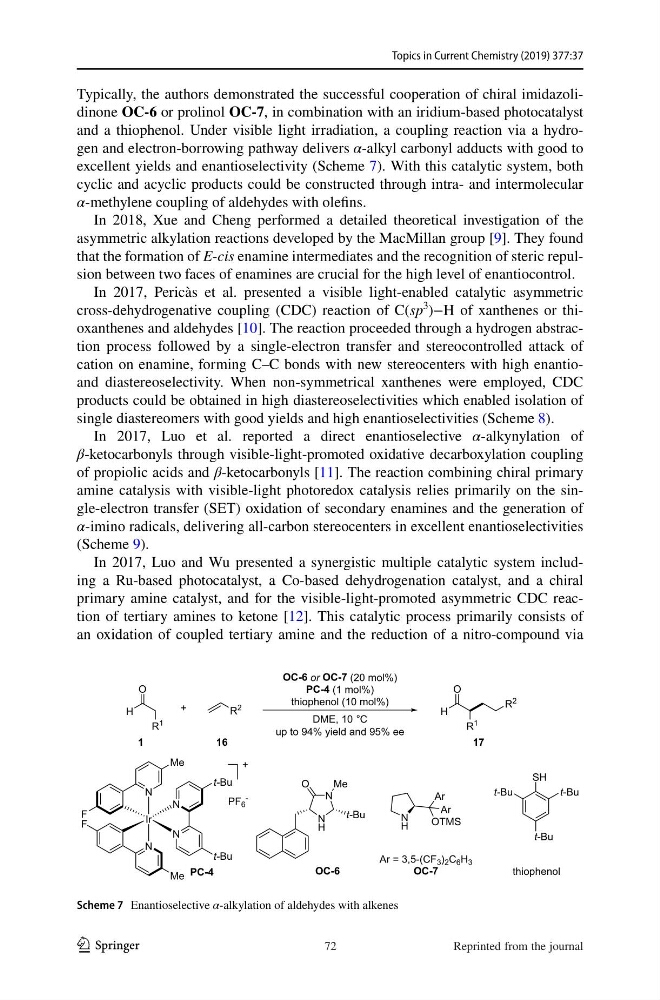
Typically, the authors demonstrated the successful cooperation of chiral imidazolidinone OC-6 or prolinol OC-7, in combination with an iridium-based photocatalyst
and a thiophenol. Under visible light irradiation, a coupling reaction via a hydrogen and electron-borrowing pathway delivers α-alkyl carbonyl adducts with good to
excellent yields and enantioselectivity (Scheme 7). With this catalytic system, both
cyclic and acyclic products could be constructed through intra- and intermolecular
α-methylene coupling of aldehydes with olefins.
In 2018, Xue and Cheng performed a detailed theoretical investigation of the
asymmetric alkylation reactions developed by the MacMillan group [9]. They found
that the formation of E-cis enamine intermediates and the recognition of steric repulsion between two faces of enamines are crucial for the high level of enantiocontrol.
In 2017, Pericàs et al. presented a visible light-enabled catalytic asymmetric
cross-dehydrogenative coupling (CDC) reaction of C(sp
3
)−H of xanthenes or thioxanthenes and aldehydes [10]. The reaction proceeded through a hydrogen abstraction process followed by a single-electron transfer and stereocontrolled attack of
cation on enamine, forming C–C bonds with new stereocenters with high enantioand diastereoselectivity. When non-symmetrical xanthenes were employed, CDC
products could be obtained in high diastereoselectivities which enabled isolation of
single diastereomers with good yields and high enantioselectivities (Scheme 8).
In 2017, Luo et al. reported a direct enantioselective α-alkynylation of
β-ketocarbonyls through visible-light-promoted oxidative decarboxylation coupling
of propiolic acids and β-ketocarbonyls [11]. The reaction combining chiral primary
amine catalysis with visible-light photoredox catalysis relies primarily on the single-electron transfer (SET) oxidation of secondary enamines and the generation of
α-imino radicals, delivering all-carbon stereocenters in excellent enantioselectivities
(Scheme 9).
In 2017, Luo and Wu presented a synergistic multiple catalytic system including a Ru-based photocatalyst, a Co-based dehydrogenation catalyst, and a chiral
primary amine catalyst, and for the visible-light-promoted asymmetric CDC reaction of tertiary amines to ketone [12]. This catalytic process primarily consists of
an oxidation of coupled tertiary amine and the reduction of a nitro-compound via
H
O
R
1
R
2
OC-6 or OC-7 (20 mol%)
PC-4 (1 mol%)
thiophenol (10 mol%)
DME, 10 °C
up to 94% yield and 95% ee
H
O
R
1
R
2
+
OC-6
t-Bu
SH
t-Bu
t-Bu
thiophenol
1
1 6
N
N
H
O
Me
t-Bu
+
N
N
N
N
Ir
t-Bu
t-Bu
PC-4
PF 6
-
17
Me
Me
F
F
N
H
Ar
Ar
OTMS
Ar = 3,5-(CF 3 ) 2 C 6 H 3
OC-7
Scheme 7 Enantioselective α-alkylation of aldehydes with alkenes
Reprinted from the journal
72
1 3
Typically, the authors demonstrated the successful cooperation of chiral imidazolidinone OC-6 or prolinol OC-7, in combination with an iridium-based photocatalyst
and a thiophenol. Under visible light irradiation, a coupling reaction via a hydrogen and electron-borrowing pathway delivers α-alkyl carbonyl adducts with good to
excellent yields and enantioselectivity (Scheme 7). With this catalytic system, both
cyclic and acyclic products could be constructed through intra- and intermolecular
α-methylene coupling of aldehydes with olefins.
In 2018, Xue and Cheng performed a detailed theoretical investigation of the
asymmetric alkylation reactions developed by the MacMillan group [9]. They found
that the formation of E-cis enamine intermediates and the recognition of steric repulsion between two faces of enamines are crucial for the high level of enantiocontrol.
In 2017, Pericàs et al. presented a visible light-enabled catalytic asymmetric
cross-dehydrogenative coupling (CDC) reaction of C(sp
3
)−H of xanthenes or thioxanthenes and aldehydes [10]. The reaction proceeded through a hydrogen abstraction process followed by a single-electron transfer and stereocontrolled attack of
cation on enamine, forming C–C bonds with new stereocenters with high enantioand diastereoselectivity. When non-symmetrical xanthenes were employed, CDC
products could be obtained in high diastereoselectivities which enabled isolation of
single diastereomers with good yields and high enantioselectivities (Scheme 8).
In 2017, Luo et al. reported a direct enantioselective α-alkynylation of
β-ketocarbonyls through visible-light-promoted oxidative decarboxylation coupling
of propiolic acids and β-ketocarbonyls [11]. The reaction combining chiral primary
amine catalysis with visible-light photoredox catalysis relies primarily on the single-electron transfer (SET) oxidation of secondary enamines and the generation of
α-imino radicals, delivering all-carbon stereocenters in excellent enantioselectivities
(Scheme 9).
In 2017, Luo and Wu presented a synergistic multiple catalytic system including a Ru-based photocatalyst, a Co-based dehydrogenation catalyst, and a chiral
primary amine catalyst, and for the visible-light-promoted asymmetric CDC reaction of tertiary amines to ketone [12]. This catalytic process primarily consists of
an oxidation of coupled tertiary amine and the reduction of a nitro-compound via
H
O
R
1
R
2
OC-6 or OC-7 (20 mol%)
PC-4 (1 mol%)
thiophenol (10 mol%)
DME, 10 °C
up to 94% yield and 95% ee
H
O
R
1
R
2
+
OC-6
t-Bu
SH
t-Bu
t-Bu
thiophenol
1
1 6
N
N
H
O
Me
t-Bu
+
N
N
N
N
Ir
t-Bu
t-Bu
PC-4
PF 6
-
17
Me
Me
F
F
N
H
Ar
Ar
OTMS
Ar = 3,5-(CF 3 ) 2 C 6 H 3
OC-7
Scheme 7 Enantioselective α-alkylation of aldehydes with alkenes
Reprinted from the journal
72