

1 3
Topics in Current Chemistry (2019) 377:37
reaction could also give a similar result in the absence of photoredox catalyst by
simply increasing the reaction concentration [6].
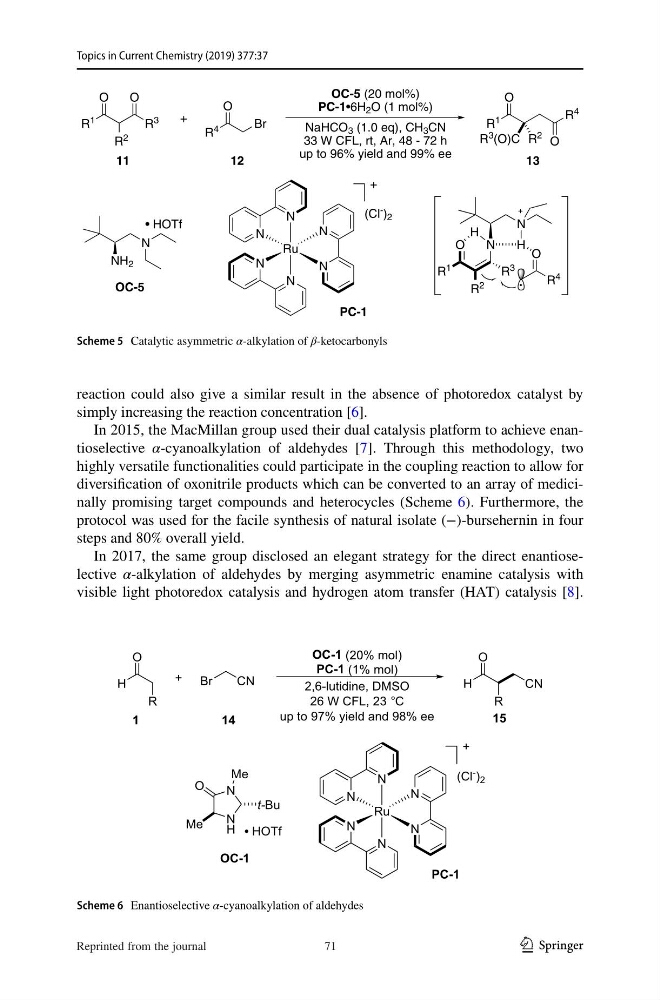
In 2015, the MacMillan group used their dual catalysis platform to achieve enantioselective α-cyanoalkylation of aldehydes [7]. Through this methodology, two
highly versatile functionalities could participate in the coupling reaction to allow for
diversification of oxonitrile products which can be converted to an array of medicinally promising target compounds and heterocycles (Scheme 6). Furthermore, the
protocol was used for the facile synthesis of natural isolate (−)-bursehernin in four
steps and 80% overall yield.
In 2017, the same group disclosed an elegant strategy for the direct enantioselective α-alkylation of aldehydes by merging asymmetric enamine catalysis with
visible light photoredox catalysis and hydrogen atom transfer (HAT) catalysis [8].
R
1
R
3
O
O
R
2
R 4
NaHCO 3 (1.0 eq), CH 3 CN
33 W CFL, rt, Ar, 48 - 72 h
up to 96% yield and 99% ee
R
1
O
R
3
(O)C R
2
R
4
O
+
OC-5 (20 mol%)
PC-1•6H 2 O (1 mol%)
O
Br
11
12
13
+
N
N
N
N
N
N
Ru
PC-1
(Cl
- ) 2
N
NH 2
• HOTf
OC-5
N
N
H
R
2
O
R 1
H
O
R
4
R 3
Scheme 5 Catalytic asymmetric α-alkylation of β-ketocarbonyls
H
O
R
OC-1 (20% mol)
PC-1 (1% mol)
2,6-lutidine, DMSO
26 W CFL, 23 °C
up to 97% yield and 98% ee
H
O
R
+ Br
CN
CN
1
1 4
15
N
H
N
O
Me
t-Bu
Me
+
OC-1
N
N
N
N
N
N
Ru
PC-1
(Cl
- ) 2
• HOTf
Scheme 6 Enantioselective α-cyanoalkylation of aldehydes
Reprinted from the journal
71
Topics in Current Chemistry (2019) 377:37
reaction could also give a similar result in the absence of photoredox catalyst by
simply increasing the reaction concentration [6].
In 2015, the MacMillan group used their dual catalysis platform to achieve enantioselective α-cyanoalkylation of aldehydes [7]. Through this methodology, two
highly versatile functionalities could participate in the coupling reaction to allow for
diversification of oxonitrile products which can be converted to an array of medicinally promising target compounds and heterocycles (Scheme 6). Furthermore, the
protocol was used for the facile synthesis of natural isolate (−)-bursehernin in four
steps and 80% overall yield.
In 2017, the same group disclosed an elegant strategy for the direct enantioselective α-alkylation of aldehydes by merging asymmetric enamine catalysis with
visible light photoredox catalysis and hydrogen atom transfer (HAT) catalysis [8].
R
1
R
3
O
O
R
2
R 4
NaHCO 3 (1.0 eq), CH 3 CN
33 W CFL, rt, Ar, 48 - 72 h
up to 96% yield and 99% ee
R
1
O
R
3
(O)C R
2
R
4
O
+
OC-5 (20 mol%)
PC-1•6H 2 O (1 mol%)
O
Br
11
12
13
+
N
N
N
N
N
N
Ru
PC-1
(Cl
- ) 2
N
NH 2
• HOTf
OC-5
N
N
H
R
2
O
R 1
H
O
R
4
R 3
Scheme 5 Catalytic asymmetric α-alkylation of β-ketocarbonyls
H
O
R
OC-1 (20% mol)
PC-1 (1% mol)
2,6-lutidine, DMSO
26 W CFL, 23 °C
up to 97% yield and 98% ee
H
O
R
+ Br
CN
CN
1
1 4
15
N
H
N
O
Me
t-Bu
Me
+
OC-1
N
N
N
N
N
N
Ru
PC-1
(Cl
- ) 2
• HOTf
Scheme 6 Enantioselective α-cyanoalkylation of aldehydes
Reprinted from the journal
71