

Topics in Current Chemistry (2019) 377:37
1 3
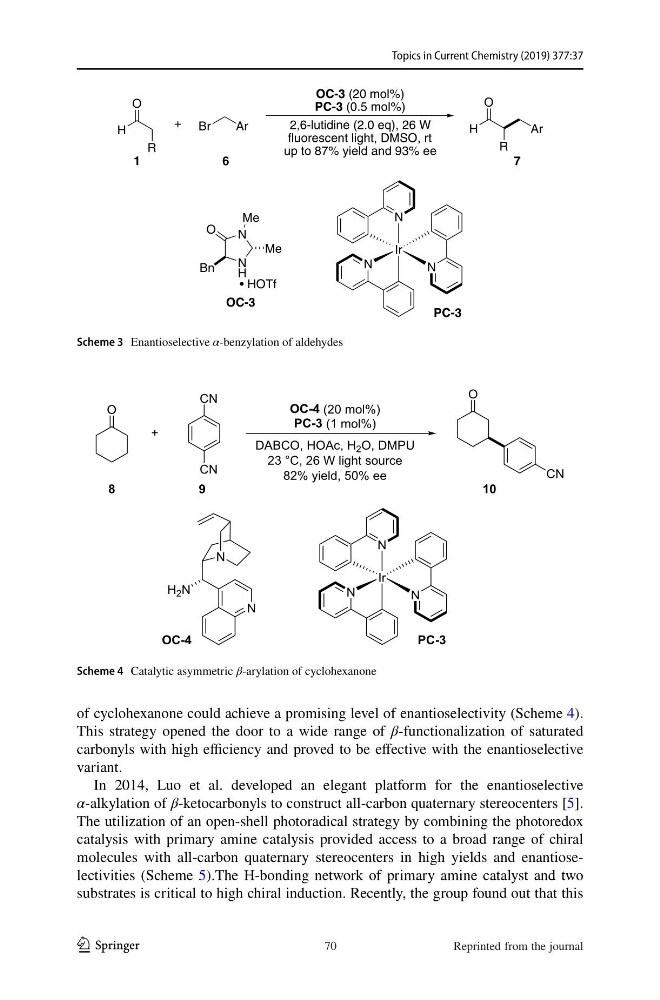
of cyclohexanone could achieve a promising level of enantioselectivity (Scheme 4).
This strategy opened the door to a wide range of β-functionalization of saturated
carbonyls with high efficiency and proved to be effective with the enantioselective
variant.
In 2014, Luo et al. developed an elegant platform for the enantioselective
α-alkylation of β-ketocarbonyls to construct all-carbon quaternary stereocenters [5].
The utilization of an open-shell photoradical strategy by combining the photoredox
catalysis with primary amine catalysis provided access to a broad range of chiral
molecules with all-carbon quaternary stereocenters in high yields and enantioselectivities (Scheme 5).The H-bonding network of primary amine catalyst and two
substrates is critical to high chiral induction. Recently, the group found out that this
H
O
R
OC-3 (20 mol%)
PC-3 (0.5 mol%)
2,6-lutidine (2.0 eq), 26 W
fluorescent light, DMSO, rt
up to 87% yield and 93% ee
H
O
R
+ Br
Ar
Ar
N
H
N
O
Me
Me
Bn
OC-3
1
6
7
N
N
N
Ir
PC-3
• HOTf
Scheme 3 Enantioselective α-benzylation of aldehydes
CN
OC-4 (20 mol%)
PC-3 (1 mol%)
DABCO, HOAc, H 2 O, DMPU
23 °C, 26 W light source
82% yield, 50% ee
+
9
N
N
H 2 N
8
1 0
OC-4
CN
O
O
CN
N
N
N
Ir
PC-3
Scheme 4 Catalytic asymmetric β-arylation of cyclohexanone
Reprinted from the journal
70
1 3
of cyclohexanone could achieve a promising level of enantioselectivity (Scheme 4).
This strategy opened the door to a wide range of β-functionalization of saturated
carbonyls with high efficiency and proved to be effective with the enantioselective
variant.
In 2014, Luo et al. developed an elegant platform for the enantioselective
α-alkylation of β-ketocarbonyls to construct all-carbon quaternary stereocenters [5].
The utilization of an open-shell photoradical strategy by combining the photoredox
catalysis with primary amine catalysis provided access to a broad range of chiral
molecules with all-carbon quaternary stereocenters in high yields and enantioselectivities (Scheme 5).The H-bonding network of primary amine catalyst and two
substrates is critical to high chiral induction. Recently, the group found out that this
H
O
R
OC-3 (20 mol%)
PC-3 (0.5 mol%)
2,6-lutidine (2.0 eq), 26 W
fluorescent light, DMSO, rt
up to 87% yield and 93% ee
H
O
R
+ Br
Ar
Ar
N
H
N
O
Me
Me
Bn
OC-3
1
6
7
N
N
N
Ir
PC-3
• HOTf
Scheme 3 Enantioselective α-benzylation of aldehydes
CN
OC-4 (20 mol%)
PC-3 (1 mol%)
DABCO, HOAc, H 2 O, DMPU
23 °C, 26 W light source
82% yield, 50% ee
+
9
N
N
H 2 N
8
1 0
OC-4
CN
O
O
CN
N
N
N
Ir
PC-3
Scheme 4 Catalytic asymmetric β-arylation of cyclohexanone
Reprinted from the journal
70