

Topics in Current Chemistry (2020) 378:1
1 3
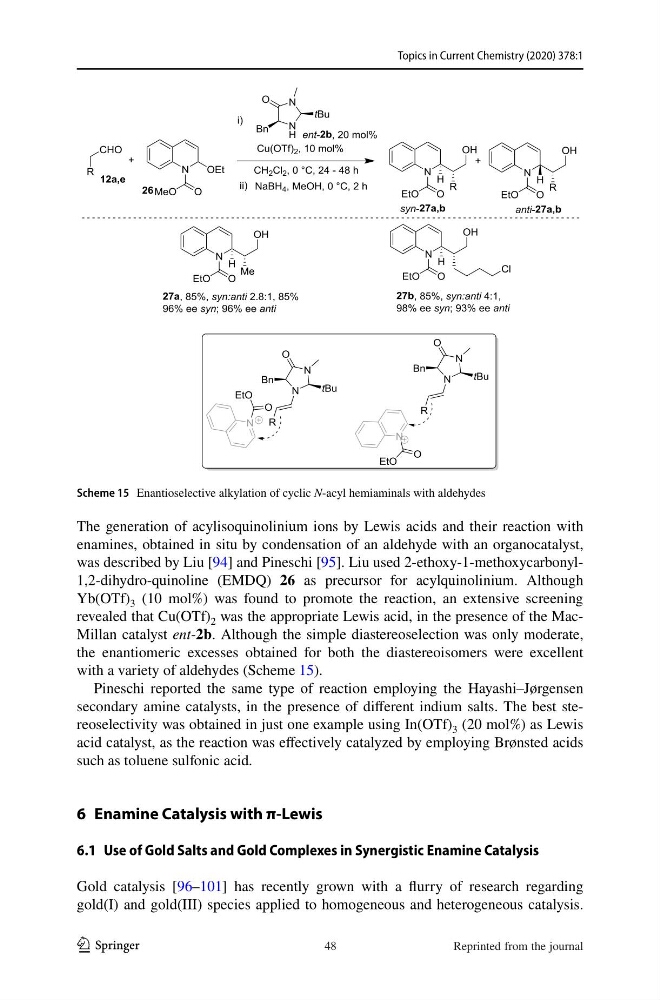
The generation of acylisoquinolinium ions by Lewis acids and their reaction with
enamines, obtained in situ by condensation of an aldehyde with an organocatalyst,
was described by Liu [94] and Pineschi [95]. Liu used 2-ethoxy-1-methoxycarbonyl1,2-dihydro-quinoline (EMDQ) 26 as precursor for acylquinolinium. Although
Yb(OTf) 3 (10 mol%) was found to promote the reaction, an extensive screening
revealed that Cu(OTf) 2 was the appropriate Lewis acid, in the presence of the MacMillan catalyst ent-2b. Although the simple diastereoselection was only moderate,
the enantiomeric excesses obtained for both the diastereoisomers were excellent
with a variety of aldehydes (Scheme 15).
Pineschi reported the same type of reaction employing the Hayashi–Jørgensen
secondary amine catalysts, in the presence of different indium salts. The best stereoselectivity was obtained in just one example using In(OTf) 3 (20 mol%) as Lewis
acid catalyst, as the reaction was effectively catalyzed by employing Brønsted acids
such as toluene sulfonic acid.
6 Enamine Catalysis with π‑Lewis
6.1 Use of Gold Salts and Gold Complexes in Synergistic Enamine Catalysis
Gold catalysis [96–101] has recently grown with a flurry of research regarding
gold(I) and gold(III) species applied to homogeneous and heterogeneous catalysis.
Scheme 15 Enantioselective alkylation of cyclic N-acyl hemiaminals with aldehydes
Reprinted from the journal
48
1 3
The generation of acylisoquinolinium ions by Lewis acids and their reaction with
enamines, obtained in situ by condensation of an aldehyde with an organocatalyst,
was described by Liu [94] and Pineschi [95]. Liu used 2-ethoxy-1-methoxycarbonyl1,2-dihydro-quinoline (EMDQ) 26 as precursor for acylquinolinium. Although
Yb(OTf) 3 (10 mol%) was found to promote the reaction, an extensive screening
revealed that Cu(OTf) 2 was the appropriate Lewis acid, in the presence of the MacMillan catalyst ent-2b. Although the simple diastereoselection was only moderate,
the enantiomeric excesses obtained for both the diastereoisomers were excellent
with a variety of aldehydes (Scheme 15).
Pineschi reported the same type of reaction employing the Hayashi–Jørgensen
secondary amine catalysts, in the presence of different indium salts. The best stereoselectivity was obtained in just one example using In(OTf) 3 (20 mol%) as Lewis
acid catalyst, as the reaction was effectively catalyzed by employing Brønsted acids
such as toluene sulfonic acid.
6 Enamine Catalysis with π‑Lewis
6.1 Use of Gold Salts and Gold Complexes in Synergistic Enamine Catalysis
Gold catalysis [96–101] has recently grown with a flurry of research regarding
gold(I) and gold(III) species applied to homogeneous and heterogeneous catalysis.
Scheme 15 Enantioselective alkylation of cyclic N-acyl hemiaminals with aldehydes
Reprinted from the journal
48