

1 3
Topics in Current Chemistry (2020) 378:1
The gold catalysis is essentially based on the ability of gold complexes to interact
with alkene and alkynes and to behave as a carbophilic Lewis acid. The peculiar
π-affinity, the tolerance for several functional groups and oxygen, and the possibility to tailor achiral or chiral ligands for specific transformations have contributed
to the large number of published studies. In addition, ligands surrounding gold are
able to differentiate the nature of gold carbenoid intermediates, and they can modify
the reactivity, changing the character of the organogold intermediate from a goldstabilized carbocation towards a gold carbene. The key character—allowing the
marriage between gold catalysis and organocatalysis—is the general tolerance of the
gold catalytic system towards moisture and air. In the activation performed by gold
complexes, a stable organometallic gold species is formed after the addition of the
nucleophile (enamine, in organocatalytic dual reactions). The successive protodeauration makes the gold complex available for further reactions. Taking advantage of
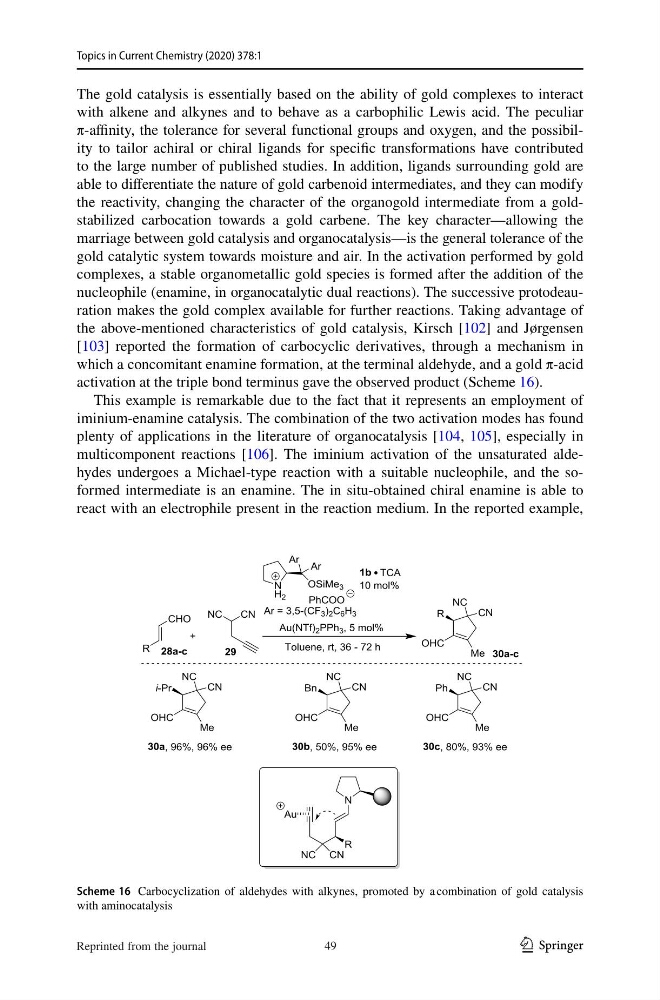
the above-mentioned characteristics of gold catalysis, Kirsch [102] and Jørgensen
[103] reported the formation of carbocyclic derivatives, through a mechanism in
which a concomitant enamine formation, at the terminal aldehyde, and a gold π-acid
activation at the triple bond terminus gave the observed product (Scheme 16).
This example is remarkable due to the fact that it represents an employment of
iminium-enamine catalysis. The combination of the two activation modes has found
plenty of applications in the literature of organocatalysis [104, 105], especially in
multicomponent reactions [106]. The iminium activation of the unsaturated aldehydes undergoes a Michael-type reaction with a suitable nucleophile, and the soformed intermediate is an enamine. The in situ-obtained chiral enamine is able to
react with an electrophile present in the reaction medium. In the reported example,
Scheme 16 Carbocyclization of aldehydes with alkynes, promoted by a combination of gold catalysis
with aminocatalysis
Reprinted from the journal
49
Topics in Current Chemistry (2020) 378:1
The gold catalysis is essentially based on the ability of gold complexes to interact
with alkene and alkynes and to behave as a carbophilic Lewis acid. The peculiar
π-affinity, the tolerance for several functional groups and oxygen, and the possibility to tailor achiral or chiral ligands for specific transformations have contributed
to the large number of published studies. In addition, ligands surrounding gold are
able to differentiate the nature of gold carbenoid intermediates, and they can modify
the reactivity, changing the character of the organogold intermediate from a goldstabilized carbocation towards a gold carbene. The key character—allowing the
marriage between gold catalysis and organocatalysis—is the general tolerance of the
gold catalytic system towards moisture and air. In the activation performed by gold
complexes, a stable organometallic gold species is formed after the addition of the
nucleophile (enamine, in organocatalytic dual reactions). The successive protodeauration makes the gold complex available for further reactions. Taking advantage of
the above-mentioned characteristics of gold catalysis, Kirsch [102] and Jørgensen
[103] reported the formation of carbocyclic derivatives, through a mechanism in
which a concomitant enamine formation, at the terminal aldehyde, and a gold π-acid
activation at the triple bond terminus gave the observed product (Scheme 16).
This example is remarkable due to the fact that it represents an employment of
iminium-enamine catalysis. The combination of the two activation modes has found
plenty of applications in the literature of organocatalysis [104, 105], especially in
multicomponent reactions [106]. The iminium activation of the unsaturated aldehydes undergoes a Michael-type reaction with a suitable nucleophile, and the soformed intermediate is an enamine. The in situ-obtained chiral enamine is able to
react with an electrophile present in the reaction medium. In the reported example,
Scheme 16 Carbocyclization of aldehydes with alkynes, promoted by a combination of gold catalysis
with aminocatalysis
Reprinted from the journal
49