

1 3
Topics in Current Chemistry (2020) 378:1
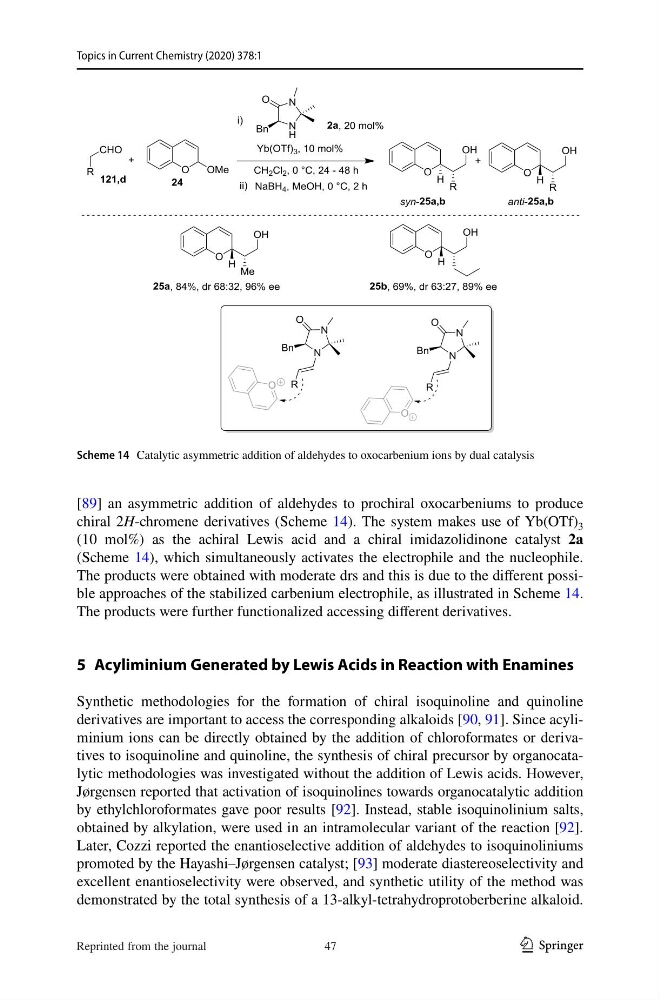
[89] an asymmetric addition of aldehydes to prochiral oxocarbeniums to produce
chiral 2H-chromene derivatives (Scheme 14). The system makes use of Yb(OTf) 3
(10 mol%) as the achiral Lewis acid and a chiral imidazolidinone catalyst 2a
(Scheme 14), which simultaneously activates the electrophile and the nucleophile.
The products were obtained with moderate drs and this is due to the different possible approaches of the stabilized carbenium electrophile, as illustrated in Scheme 14.
The products were further functionalized accessing different derivatives.
5 Acyliminium Generated by Lewis Acids in Reaction with Enamines
Synthetic methodologies for the formation of chiral isoquinoline and quinoline
derivatives are important to access the corresponding alkaloids [90, 91]. Since acyliminium ions can be directly obtained by the addition of chloroformates or derivatives to isoquinoline and quinoline, the synthesis of chiral precursor by organocatalytic methodologies was investigated without the addition of Lewis acids. However,
Jørgensen reported that activation of isoquinolines towards organocatalytic addition
by ethylchloroformates gave poor results [92]. Instead, stable isoquinolinium salts,
obtained by alkylation, were used in an intramolecular variant of the reaction [92].
Later, Cozzi reported the enantioselective addition of aldehydes to isoquinoliniums
promoted by the Hayashi–Jørgensen catalyst; [93] moderate diastereoselectivity and
excellent enantioselectivity were observed, and synthetic utility of the method was
demonstrated by the total synthesis of a 13-alkyl-tetrahydroprotoberberine alkaloid.
Scheme 14 Catalytic asymmetric addition of aldehydes to oxocarbenium ions by dual catalysis
Reprinted from the journal
47
Topics in Current Chemistry (2020) 378:1
[89] an asymmetric addition of aldehydes to prochiral oxocarbeniums to produce
chiral 2H-chromene derivatives (Scheme 14). The system makes use of Yb(OTf) 3
(10 mol%) as the achiral Lewis acid and a chiral imidazolidinone catalyst 2a
(Scheme 14), which simultaneously activates the electrophile and the nucleophile.
The products were obtained with moderate drs and this is due to the different possible approaches of the stabilized carbenium electrophile, as illustrated in Scheme 14.
The products were further functionalized accessing different derivatives.
5 Acyliminium Generated by Lewis Acids in Reaction with Enamines
Synthetic methodologies for the formation of chiral isoquinoline and quinoline
derivatives are important to access the corresponding alkaloids [90, 91]. Since acyliminium ions can be directly obtained by the addition of chloroformates or derivatives to isoquinoline and quinoline, the synthesis of chiral precursor by organocatalytic methodologies was investigated without the addition of Lewis acids. However,
Jørgensen reported that activation of isoquinolines towards organocatalytic addition
by ethylchloroformates gave poor results [92]. Instead, stable isoquinolinium salts,
obtained by alkylation, were used in an intramolecular variant of the reaction [92].
Later, Cozzi reported the enantioselective addition of aldehydes to isoquinoliniums
promoted by the Hayashi–Jørgensen catalyst; [93] moderate diastereoselectivity and
excellent enantioselectivity were observed, and synthetic utility of the method was
demonstrated by the total synthesis of a 13-alkyl-tetrahydroprotoberberine alkaloid.
Scheme 14 Catalytic asymmetric addition of aldehydes to oxocarbenium ions by dual catalysis
Reprinted from the journal
47