

1 3
Topics in Current Chemistry (2020) 378:1
redox-active and stable ferrocene/ferrocenium moiety also served as phase-tag to
allow recovery and reuse of the catalyst. The selective oxidation of ferrocene moiety was possible by employing ferrocenium tetrafluoroborate. What is peculiar with
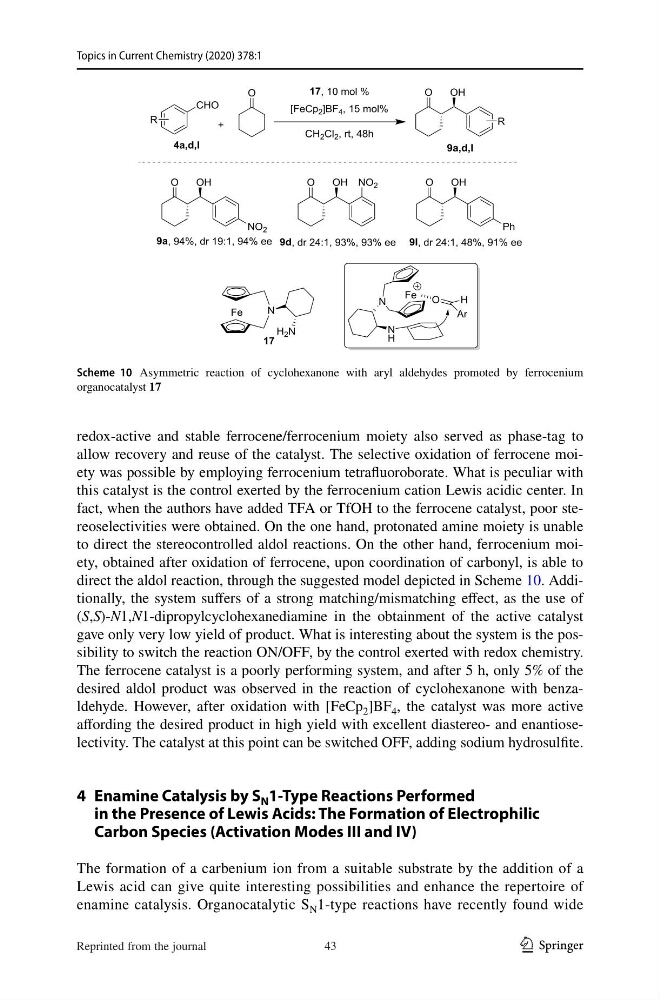
this catalyst is the control exerted by the ferrocenium cation Lewis acidic center. In
fact, when the authors have added TFA or TfOH to the ferrocene catalyst, poor stereoselectivities were obtained. On the one hand, protonated amine moiety is unable
to direct the stereocontrolled aldol reactions. On the other hand, ferrocenium moiety, obtained after oxidation of ferrocene, upon coordination of carbonyl, is able to
direct the aldol reaction, through the suggested model depicted in Scheme 10. Additionally, the system suffers of a strong matching/mismatching effect, as the use of
(S,S)-N1,N1-dipropylcyclohexanediamine in the obtainment of the active catalyst
gave only very low yield of product. What is interesting about the system is the possibility to switch the reaction ON/OFF, by the control exerted with redox chemistry.
The ferrocene catalyst is a poorly performing system, and after 5 h, only 5% of the
desired aldol product was observed in the reaction of cyclohexanone with benzaldehyde. However, after oxidation with [FeCp 2 ]BF 4 , the catalyst was more active
affording the desired product in high yield with excellent diastereo- and enantioselectivity. The catalyst at this point can be switched OFF, adding sodium hydrosulfite.
4 Enamine Catalysis by S N 1‑Type Reactions Performed
in the Presence of Lewis Acids: The Formation of Electrophilic
Carbon Species (Activation Modes III and IV)
The formation of a carbenium ion from a suitable substrate by the addition of a
Lewis acid can give quite interesting possibilities and enhance the repertoire of
enamine catalysis. Organocatalytic S N 1-type reactions have recently found wide
Scheme 10 Asymmetric reaction of cyclohexanone with aryl aldehydes promoted by ferrocenium
organocatalyst 17
Reprinted from the journal
43
Topics in Current Chemistry (2020) 378:1
redox-active and stable ferrocene/ferrocenium moiety also served as phase-tag to
allow recovery and reuse of the catalyst. The selective oxidation of ferrocene moiety was possible by employing ferrocenium tetrafluoroborate. What is peculiar with
this catalyst is the control exerted by the ferrocenium cation Lewis acidic center. In
fact, when the authors have added TFA or TfOH to the ferrocene catalyst, poor stereoselectivities were obtained. On the one hand, protonated amine moiety is unable
to direct the stereocontrolled aldol reactions. On the other hand, ferrocenium moiety, obtained after oxidation of ferrocene, upon coordination of carbonyl, is able to
direct the aldol reaction, through the suggested model depicted in Scheme 10. Additionally, the system suffers of a strong matching/mismatching effect, as the use of
(S,S)-N1,N1-dipropylcyclohexanediamine in the obtainment of the active catalyst
gave only very low yield of product. What is interesting about the system is the possibility to switch the reaction ON/OFF, by the control exerted with redox chemistry.
The ferrocene catalyst is a poorly performing system, and after 5 h, only 5% of the
desired aldol product was observed in the reaction of cyclohexanone with benzaldehyde. However, after oxidation with [FeCp 2 ]BF 4 , the catalyst was more active
affording the desired product in high yield with excellent diastereo- and enantioselectivity. The catalyst at this point can be switched OFF, adding sodium hydrosulfite.
4 Enamine Catalysis by S N 1‑Type Reactions Performed
in the Presence of Lewis Acids: The Formation of Electrophilic
Carbon Species (Activation Modes III and IV)
The formation of a carbenium ion from a suitable substrate by the addition of a
Lewis acid can give quite interesting possibilities and enhance the repertoire of
enamine catalysis. Organocatalytic S N 1-type reactions have recently found wide
Scheme 10 Asymmetric reaction of cyclohexanone with aryl aldehydes promoted by ferrocenium
organocatalyst 17
Reprinted from the journal
43