

Topics in Current Chemistry (2020) 378:1
1 3
use in organocatalysis [20, 78–81]. Reactions with stable carbenium ions and
enamines were used by Mayr to establish the general nucleophilicity of enamines [82]. As previously discussed, the carbenium ions generated in the reaction
conditions need to have the proper electrophilicity to react faster with the most
nucleophilic species, i.e., the enamine, present in the reaction mixture. Looking
at the Mayr scale, a limit of electrophilicity can be settled toward − 1.5. Generally, electrophiles do not undergo the desired reactivity whenever their electrophilicity parameters are above the aforementioned limit. This is due to the lifetime of the carbenium ion, and its reversible reaction with water, which is present
in the organocatalytic reaction environment. A typical example of this limitation
is observed when allylic alcohols are used as reaction partners for organocatalytic
alkylation. On the one hand, other substituted alcohols, less electrophilic in terms
of Mayr scale, can form a reactive carbenium ion as suitable partner for organocatalytic reactions [83]. On the other hand, phenyl-substituted allylic alcohols
form carbenium ions above the 0 of the Mayr scale, and no reaction is observed.
However, the combination of a Lewis acid with the alcohol in organocatalytic
reactions was found indispensable to generate these carbenium ions and to allow
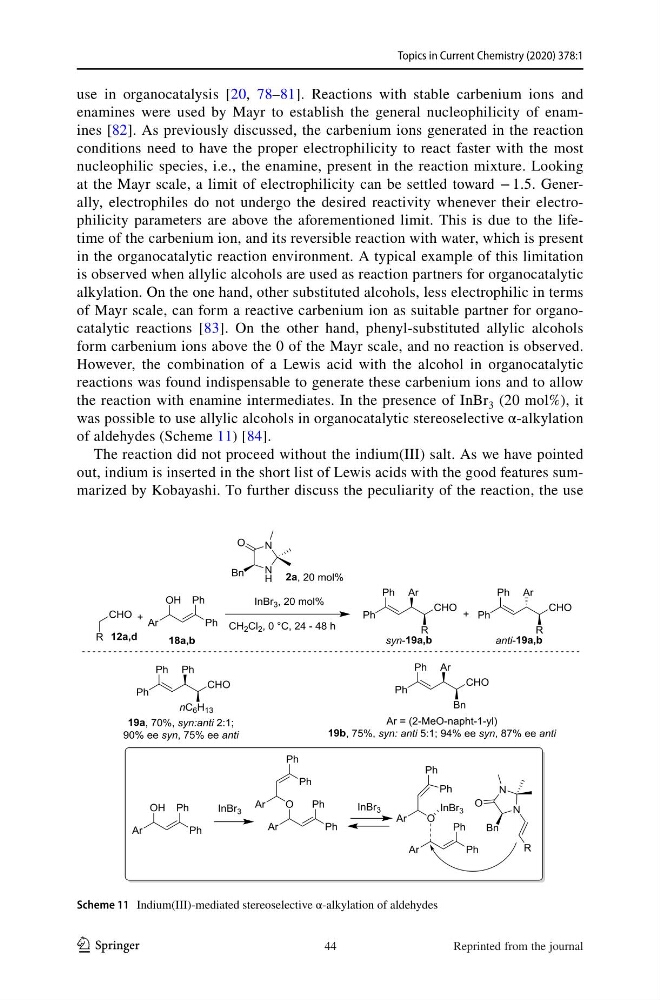
the reaction with enamine intermediates. In the presence of InBr 3 (20 mol%), it
was possible to use allylic alcohols in organocatalytic stereoselective α-alkylation
of aldehydes (Scheme 11) [84].
The reaction did not proceed without the indium(III) salt. As we have pointed
out, indium is inserted in the short list of Lewis acids with the good features summarized by Kobayashi. To further discuss the peculiarity of the reaction, the use
Scheme 11 Indium(III)-mediated stereoselective α-alkylation of aldehydes
Reprinted from the journal
44
1 3
use in organocatalysis [20, 78–81]. Reactions with stable carbenium ions and
enamines were used by Mayr to establish the general nucleophilicity of enamines [82]. As previously discussed, the carbenium ions generated in the reaction
conditions need to have the proper electrophilicity to react faster with the most
nucleophilic species, i.e., the enamine, present in the reaction mixture. Looking
at the Mayr scale, a limit of electrophilicity can be settled toward − 1.5. Generally, electrophiles do not undergo the desired reactivity whenever their electrophilicity parameters are above the aforementioned limit. This is due to the lifetime of the carbenium ion, and its reversible reaction with water, which is present
in the organocatalytic reaction environment. A typical example of this limitation
is observed when allylic alcohols are used as reaction partners for organocatalytic
alkylation. On the one hand, other substituted alcohols, less electrophilic in terms
of Mayr scale, can form a reactive carbenium ion as suitable partner for organocatalytic reactions [83]. On the other hand, phenyl-substituted allylic alcohols
form carbenium ions above the 0 of the Mayr scale, and no reaction is observed.
However, the combination of a Lewis acid with the alcohol in organocatalytic
reactions was found indispensable to generate these carbenium ions and to allow
the reaction with enamine intermediates. In the presence of InBr 3 (20 mol%), it
was possible to use allylic alcohols in organocatalytic stereoselective α-alkylation
of aldehydes (Scheme 11) [84].
The reaction did not proceed without the indium(III) salt. As we have pointed
out, indium is inserted in the short list of Lewis acids with the good features summarized by Kobayashi. To further discuss the peculiarity of the reaction, the use
Scheme 11 Indium(III)-mediated stereoselective α-alkylation of aldehydes
Reprinted from the journal
44