

Topics in Current Chemistry (2020) 378:1
1 3
cyclen (cyclen = 1,4,7,10-tetraazacyclododecane) is a good model for the naturally
occurring Zn(II) [75]. Therefore, Zn(II) cyclen derivatives may constitute effective
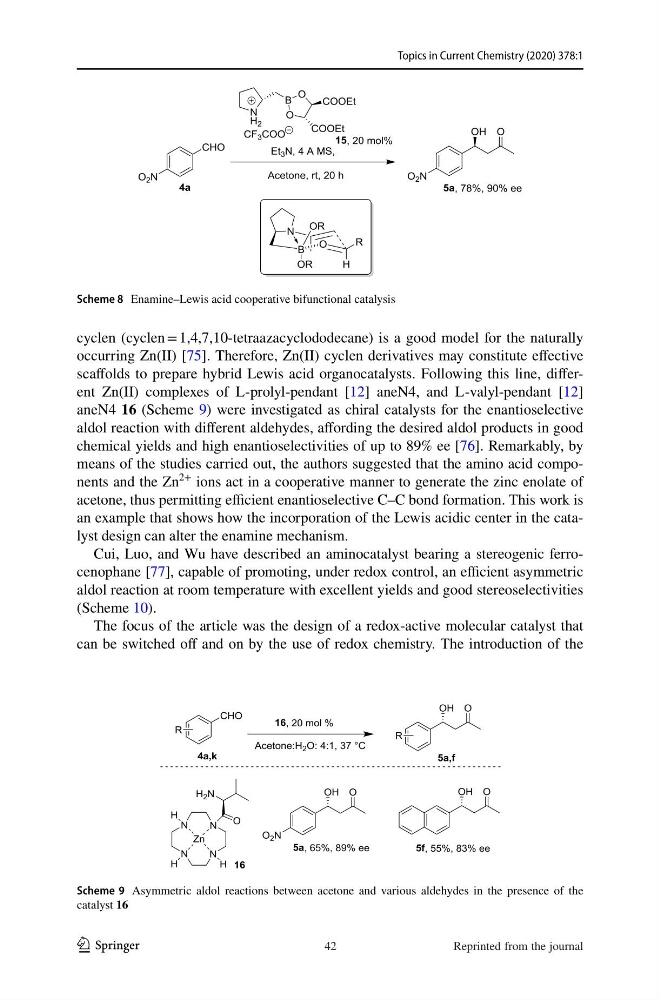
scaffolds to prepare hybrid Lewis acid organocatalysts. Following this line, different Zn(II) complexes of l-prolyl-pendant [12] aneN4, and l-valyl-pendant [12]
aneN4 16 (Scheme 9) were investigated as chiral catalysts for the enantioselective
aldol reaction with different aldehydes, affording the desired aldol products in good
chemical yields and high enantioselectivities of up to 89% ee [76]. Remarkably, by
means of the studies carried out, the authors suggested that the amino acid components and the Zn
2+
ions act in a cooperative manner to generate the zinc enolate of
acetone, thus permitting efficient enantioselective C–C bond formation. This work is
an example that shows how the incorporation of the Lewis acidic center in the catalyst design can alter the enamine mechanism.
Cui, Luo, and Wu have described an aminocatalyst bearing a stereogenic ferrocenophane [77], capable of promoting, under redox control, an efficient asymmetric
aldol reaction at room temperature with excellent yields and good stereoselectivities
(Scheme 10).
The focus of the article was the design of a redox-active molecular catalyst that
can be switched off and on by the use of redox chemistry. The introduction of the
Scheme 8 Enamine–Lewis acid cooperative bifunctional catalysis
Scheme 9 Asymmetric aldol reactions between acetone and various aldehydes in the presence of the
catalyst 16
Reprinted from the journal
42
1 3
cyclen (cyclen = 1,4,7,10-tetraazacyclododecane) is a good model for the naturally
occurring Zn(II) [75]. Therefore, Zn(II) cyclen derivatives may constitute effective
scaffolds to prepare hybrid Lewis acid organocatalysts. Following this line, different Zn(II) complexes of l-prolyl-pendant [12] aneN4, and l-valyl-pendant [12]
aneN4 16 (Scheme 9) were investigated as chiral catalysts for the enantioselective
aldol reaction with different aldehydes, affording the desired aldol products in good
chemical yields and high enantioselectivities of up to 89% ee [76]. Remarkably, by
means of the studies carried out, the authors suggested that the amino acid components and the Zn
2+
ions act in a cooperative manner to generate the zinc enolate of
acetone, thus permitting efficient enantioselective C–C bond formation. This work is
an example that shows how the incorporation of the Lewis acidic center in the catalyst design can alter the enamine mechanism.
Cui, Luo, and Wu have described an aminocatalyst bearing a stereogenic ferrocenophane [77], capable of promoting, under redox control, an efficient asymmetric
aldol reaction at room temperature with excellent yields and good stereoselectivities
(Scheme 10).
The focus of the article was the design of a redox-active molecular catalyst that
can be switched off and on by the use of redox chemistry. The introduction of the
Scheme 8 Enamine–Lewis acid cooperative bifunctional catalysis
Scheme 9 Asymmetric aldol reactions between acetone and various aldehydes in the presence of the
catalyst 16
Reprinted from the journal
42