

1 3
Topics in Current Chemistry (2020) 378:1
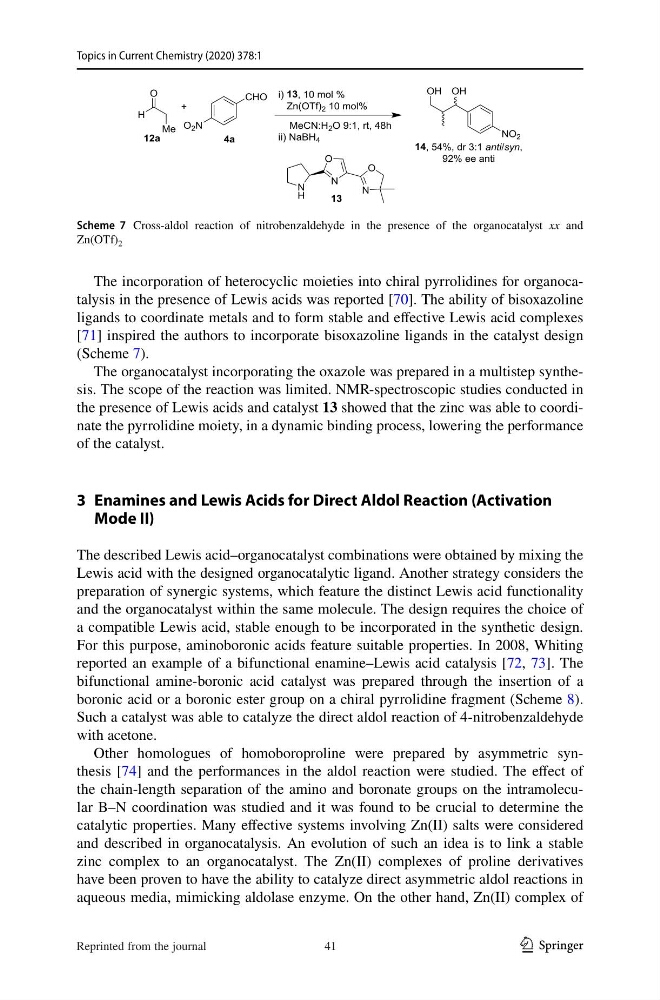
The incorporation of heterocyclic moieties into chiral pyrrolidines for organocatalysis in the presence of Lewis acids was reported [70]. The ability of bisoxazoline
ligands to coordinate metals and to form stable and effective Lewis acid complexes
[71] inspired the authors to incorporate bisoxazoline ligands in the catalyst design
(Scheme 7).
The organocatalyst incorporating the oxazole was prepared in a multistep synthesis. The scope of the reaction was limited. NMR-spectroscopic studies conducted in
the presence of Lewis acids and catalyst 13 showed that the zinc was able to coordinate the pyrrolidine moiety, in a dynamic binding process, lowering the performance
of the catalyst.
3 Enamines and Lewis Acids for Direct Aldol Reaction (Activation
Mode II)
The described Lewis acid–organocatalyst combinations were obtained by mixing the
Lewis acid with the designed organocatalytic ligand. Another strategy considers the
preparation of synergic systems, which feature the distinct Lewis acid functionality
and the organocatalyst within the same molecule. The design requires the choice of
a compatible Lewis acid, stable enough to be incorporated in the synthetic design.
For this purpose, aminoboronic acids feature suitable properties. In 2008, Whiting
reported an example of a bifunctional enamine–Lewis acid catalysis [72, 73]. The
bifunctional amine-boronic acid catalyst was prepared through the insertion of a
boronic acid or a boronic ester group on a chiral pyrrolidine fragment (Scheme 8).
Such a catalyst was able to catalyze the direct aldol reaction of 4-nitrobenzaldehyde
with acetone.
Other homologues of homoboroproline were prepared by asymmetric synthesis [74] and the performances in the aldol reaction were studied. The effect of
the chain-length separation of the amino and boronate groups on the intramolecular B–N coordination was studied and it was found to be crucial to determine the
catalytic properties. Many effective systems involving Zn(II) salts were considered
and described in organocatalysis. An evolution of such an idea is to link a stable
zinc complex to an organocatalyst. The Zn(II) complexes of proline derivatives
have been proven to have the ability to catalyze direct asymmetric aldol reactions in
aqueous media, mimicking aldolase enzyme. On the other hand, Zn(II) complex of
Scheme 7 Cross-aldol reaction of nitrobenzaldehyde in the presence of the organocatalyst xx and
Zn(OTf) 2
Reprinted from the journal
41
Topics in Current Chemistry (2020) 378:1
The incorporation of heterocyclic moieties into chiral pyrrolidines for organocatalysis in the presence of Lewis acids was reported [70]. The ability of bisoxazoline
ligands to coordinate metals and to form stable and effective Lewis acid complexes
[71] inspired the authors to incorporate bisoxazoline ligands in the catalyst design
(Scheme 7).
The organocatalyst incorporating the oxazole was prepared in a multistep synthesis. The scope of the reaction was limited. NMR-spectroscopic studies conducted in
the presence of Lewis acids and catalyst 13 showed that the zinc was able to coordinate the pyrrolidine moiety, in a dynamic binding process, lowering the performance
of the catalyst.
3 Enamines and Lewis Acids for Direct Aldol Reaction (Activation
Mode II)
The described Lewis acid–organocatalyst combinations were obtained by mixing the
Lewis acid with the designed organocatalytic ligand. Another strategy considers the
preparation of synergic systems, which feature the distinct Lewis acid functionality
and the organocatalyst within the same molecule. The design requires the choice of
a compatible Lewis acid, stable enough to be incorporated in the synthetic design.
For this purpose, aminoboronic acids feature suitable properties. In 2008, Whiting
reported an example of a bifunctional enamine–Lewis acid catalysis [72, 73]. The
bifunctional amine-boronic acid catalyst was prepared through the insertion of a
boronic acid or a boronic ester group on a chiral pyrrolidine fragment (Scheme 8).
Such a catalyst was able to catalyze the direct aldol reaction of 4-nitrobenzaldehyde
with acetone.
Other homologues of homoboroproline were prepared by asymmetric synthesis [74] and the performances in the aldol reaction were studied. The effect of
the chain-length separation of the amino and boronate groups on the intramolecular B–N coordination was studied and it was found to be crucial to determine the
catalytic properties. Many effective systems involving Zn(II) salts were considered
and described in organocatalysis. An evolution of such an idea is to link a stable
zinc complex to an organocatalyst. The Zn(II) complexes of proline derivatives
have been proven to have the ability to catalyze direct asymmetric aldol reactions in
aqueous media, mimicking aldolase enzyme. On the other hand, Zn(II) complex of
Scheme 7 Cross-aldol reaction of nitrobenzaldehyde in the presence of the organocatalyst xx and
Zn(OTf) 2
Reprinted from the journal
41