

1 3
Topics in Current Chemistry (2020) 378:1
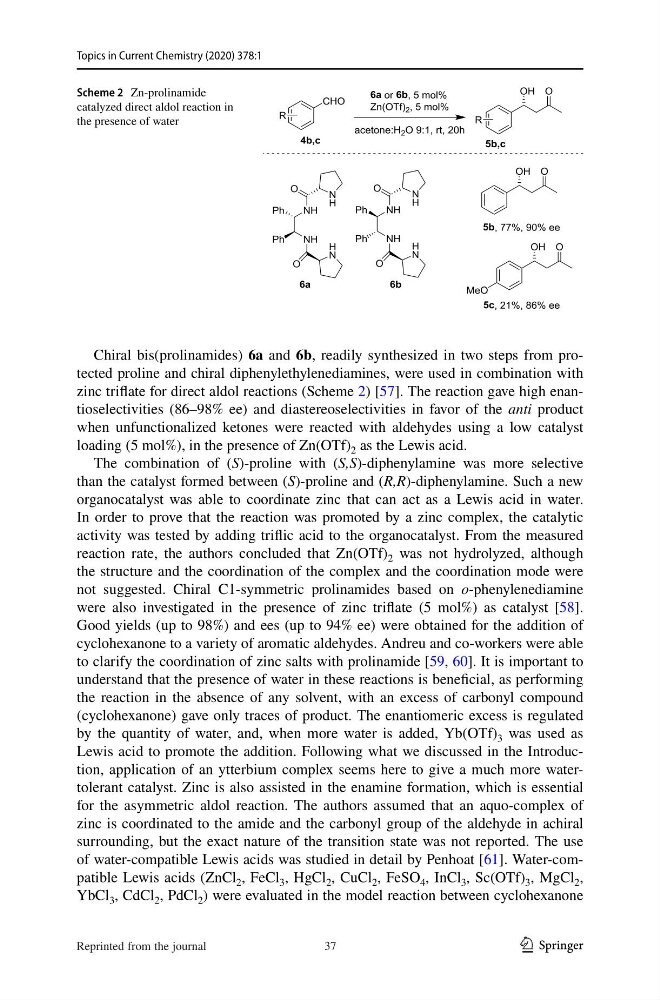
Chiral bis(prolinamides) 6a and 6b, readily synthesized in two steps from protected proline and chiral diphenylethylenediamines, were used in combination with
zinc triflate for direct aldol reactions (Scheme 2) [57]. The reaction gave high enantioselectivities (86–98% ee) and diastereoselectivities in favor of the anti product
when unfunctionalized ketones were reacted with aldehydes using a low catalyst
loading (5 mol%), in the presence of Zn(OTf) 2 as the Lewis acid.
The combination of (S)-proline with (S,S)-diphenylamine was more selective
than the catalyst formed between (S)-proline and (R,R)-diphenylamine. Such a new
organocatalyst was able to coordinate zinc that can act as a Lewis acid in water.
In order to prove that the reaction was promoted by a zinc complex, the catalytic
activity was tested by adding triflic acid to the organocatalyst. From the measured
reaction rate, the authors concluded that Zn(OTf) 2 was not hydrolyzed, although
the structure and the coordination of the complex and the coordination mode were
not suggested. Chiral C1-symmetric prolinamides based on o-phenylenediamine
were also investigated in the presence of zinc triflate (5 mol%) as catalyst [58].
Good yields (up to 98%) and ees (up to 94% ee) were obtained for the addition of
cyclohexanone to a variety of aromatic aldehydes. Andreu and co-workers were able
to clarify the coordination of zinc salts with prolinamide [59, 60]. It is important to
understand that the presence of water in these reactions is beneficial, as performing
the reaction in the absence of any solvent, with an excess of carbonyl compound
(cyclohexanone) gave only traces of product. The enantiomeric excess is regulated
by the quantity of water, and, when more water is added, Yb(OTf) 3 was used as
Lewis acid to promote the addition. Following what we discussed in the Introduction, application of an ytterbium complex seems here to give a much more watertolerant catalyst. Zinc is also assisted in the enamine formation, which is essential
for the asymmetric aldol reaction. The authors assumed that an aquo-complex of
zinc is coordinated to the amide and the carbonyl group of the aldehyde in achiral
surrounding, but the exact nature of the transition state was not reported. The use
of water-compatible Lewis acids was studied in detail by Penhoat [61]. Water-compatible Lewis acids (ZnCl 2 , FeCl 3 , HgCl 2 , CuCl 2 , FeSO 4 , InCl 3 , Sc(OTf) 3 , MgCl 2 ,
YbCl 3 , CdCl 2 , PdCl 2 ) were evaluated in the model reaction between cyclohexanone
Scheme 2 Zn-prolinamide
catalyzed direct aldol reaction in
the presence of water
Reprinted from the journal
37
Topics in Current Chemistry (2020) 378:1
Chiral bis(prolinamides) 6a and 6b, readily synthesized in two steps from protected proline and chiral diphenylethylenediamines, were used in combination with
zinc triflate for direct aldol reactions (Scheme 2) [57]. The reaction gave high enantioselectivities (86–98% ee) and diastereoselectivities in favor of the anti product
when unfunctionalized ketones were reacted with aldehydes using a low catalyst
loading (5 mol%), in the presence of Zn(OTf) 2 as the Lewis acid.
The combination of (S)-proline with (S,S)-diphenylamine was more selective
than the catalyst formed between (S)-proline and (R,R)-diphenylamine. Such a new
organocatalyst was able to coordinate zinc that can act as a Lewis acid in water.
In order to prove that the reaction was promoted by a zinc complex, the catalytic
activity was tested by adding triflic acid to the organocatalyst. From the measured
reaction rate, the authors concluded that Zn(OTf) 2 was not hydrolyzed, although
the structure and the coordination of the complex and the coordination mode were
not suggested. Chiral C1-symmetric prolinamides based on o-phenylenediamine
were also investigated in the presence of zinc triflate (5 mol%) as catalyst [58].
Good yields (up to 98%) and ees (up to 94% ee) were obtained for the addition of
cyclohexanone to a variety of aromatic aldehydes. Andreu and co-workers were able
to clarify the coordination of zinc salts with prolinamide [59, 60]. It is important to
understand that the presence of water in these reactions is beneficial, as performing
the reaction in the absence of any solvent, with an excess of carbonyl compound
(cyclohexanone) gave only traces of product. The enantiomeric excess is regulated
by the quantity of water, and, when more water is added, Yb(OTf) 3 was used as
Lewis acid to promote the addition. Following what we discussed in the Introduction, application of an ytterbium complex seems here to give a much more watertolerant catalyst. Zinc is also assisted in the enamine formation, which is essential
for the asymmetric aldol reaction. The authors assumed that an aquo-complex of
zinc is coordinated to the amide and the carbonyl group of the aldehyde in achiral
surrounding, but the exact nature of the transition state was not reported. The use
of water-compatible Lewis acids was studied in detail by Penhoat [61]. Water-compatible Lewis acids (ZnCl 2 , FeCl 3 , HgCl 2 , CuCl 2 , FeSO 4 , InCl 3 , Sc(OTf) 3 , MgCl 2 ,
YbCl 3 , CdCl 2 , PdCl 2 ) were evaluated in the model reaction between cyclohexanone
Scheme 2 Zn-prolinamide
catalyzed direct aldol reaction in
the presence of water
Reprinted from the journal
37