

Topics in Current Chemistry (2020) 378:1
1 3
and p-nitrobenzaldehyde catalyzed by l-proline, using DMSO/water solvent mixtures. Although different Lewis acids were able to improve both enantiomeric excess
and diastereoselection compared to the use of proline alone, the researchers selected
the use of inexpensive and non-toxic ZnCl 2 for the reaction scope. Replacement of
chloride anions by other counterions (such as triflates) led to a lower stereoselectivity. While the identity of the complex formed in the reaction conditions was not
disclosed, the results obtained in terms of conversion and stereoselectivity were suggesting a formation of a complex 2:1 of the type [(L-Pro) 2 ZnCl 2 ] complex. In similar solvent mixtures, Lutz and Bakker were able to isolate and characterize by X-ray
analysis such a complex [62]. As in nature, where natural enzymatic processes occur
through bifunctional catalysis [63], several examples mimicking such behavior have
been designed in asymmetric synthesis. Several examples of proline/pyrrolidine
molecules tailored with a structure able to coordinate a Lewis acid to form the bi/
multifunctional catalytic system were reported. Not only proline but dipeptides and
tripeptides were studied as catalysts for aldol reaction in the presence of Lewis acids.
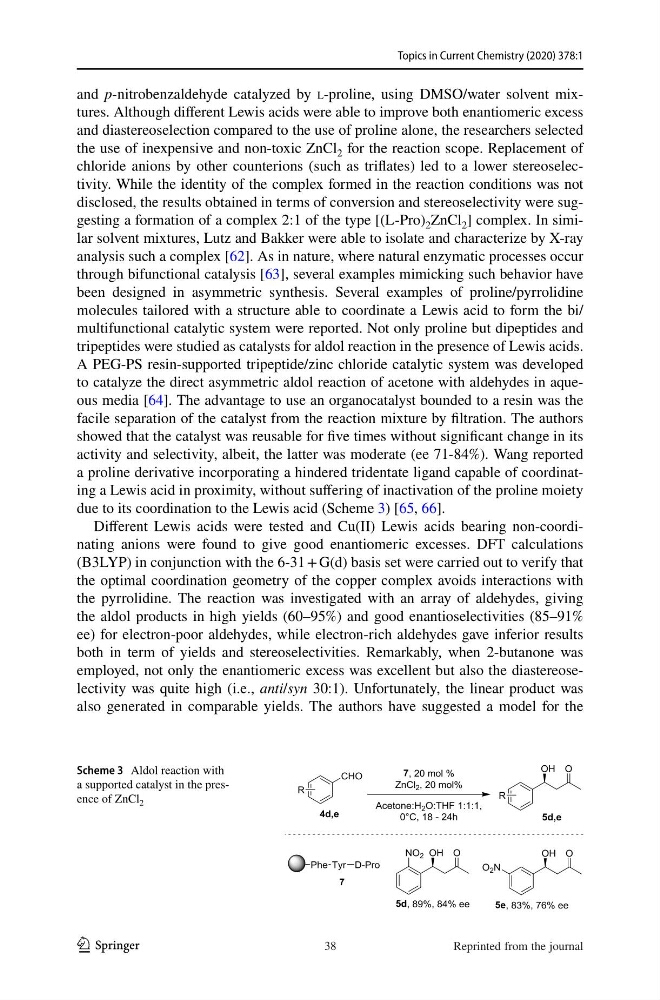
A PEG-PS resin-supported tripeptide/zinc chloride catalytic system was developed
to catalyze the direct asymmetric aldol reaction of acetone with aldehydes in aqueous media [64]. The advantage to use an organocatalyst bounded to a resin was the
facile separation of the catalyst from the reaction mixture by filtration. The authors
showed that the catalyst was reusable for five times without significant change in its
activity and selectivity, albeit, the latter was moderate (ee 71-84%). Wang reported
a proline derivative incorporating a hindered tridentate ligand capable of coordinating a Lewis acid in proximity, without suffering of inactivation of the proline moiety
due to its coordination to the Lewis acid (Scheme 3) [65, 66].
Different Lewis acids were tested and Cu(II) Lewis acids bearing non-coordinating anions were found to give good enantiomeric excesses. DFT calculations
(B3LYP) in conjunction with the 6-31 + G(d) basis set were carried out to verify that
the optimal coordination geometry of the copper complex avoids interactions with
the pyrrolidine. The reaction was investigated with an array of aldehydes, giving
the aldol products in high yields (60–95%) and good enantioselectivities (85–91%
ee) for electron-poor aldehydes, while electron-rich aldehydes gave inferior results
both in term of yields and stereoselectivities. Remarkably, when 2-butanone was
employed, not only the enantiomeric excess was excellent but also the diastereoselectivity was quite high (i.e., anti/syn 30:1). Unfortunately, the linear product was
also generated in comparable yields. The authors have suggested a model for the
Scheme 3 Aldol reaction with
a supported catalyst in the presence of ZnCl 2
Reprinted from the journal
38
1 3
and p-nitrobenzaldehyde catalyzed by l-proline, using DMSO/water solvent mixtures. Although different Lewis acids were able to improve both enantiomeric excess
and diastereoselection compared to the use of proline alone, the researchers selected
the use of inexpensive and non-toxic ZnCl 2 for the reaction scope. Replacement of
chloride anions by other counterions (such as triflates) led to a lower stereoselectivity. While the identity of the complex formed in the reaction conditions was not
disclosed, the results obtained in terms of conversion and stereoselectivity were suggesting a formation of a complex 2:1 of the type [(L-Pro) 2 ZnCl 2 ] complex. In similar solvent mixtures, Lutz and Bakker were able to isolate and characterize by X-ray
analysis such a complex [62]. As in nature, where natural enzymatic processes occur
through bifunctional catalysis [63], several examples mimicking such behavior have
been designed in asymmetric synthesis. Several examples of proline/pyrrolidine
molecules tailored with a structure able to coordinate a Lewis acid to form the bi/
multifunctional catalytic system were reported. Not only proline but dipeptides and
tripeptides were studied as catalysts for aldol reaction in the presence of Lewis acids.
A PEG-PS resin-supported tripeptide/zinc chloride catalytic system was developed
to catalyze the direct asymmetric aldol reaction of acetone with aldehydes in aqueous media [64]. The advantage to use an organocatalyst bounded to a resin was the
facile separation of the catalyst from the reaction mixture by filtration. The authors
showed that the catalyst was reusable for five times without significant change in its
activity and selectivity, albeit, the latter was moderate (ee 71-84%). Wang reported
a proline derivative incorporating a hindered tridentate ligand capable of coordinating a Lewis acid in proximity, without suffering of inactivation of the proline moiety
due to its coordination to the Lewis acid (Scheme 3) [65, 66].
Different Lewis acids were tested and Cu(II) Lewis acids bearing non-coordinating anions were found to give good enantiomeric excesses. DFT calculations
(B3LYP) in conjunction with the 6-31 + G(d) basis set were carried out to verify that
the optimal coordination geometry of the copper complex avoids interactions with
the pyrrolidine. The reaction was investigated with an array of aldehydes, giving
the aldol products in high yields (60–95%) and good enantioselectivities (85–91%
ee) for electron-poor aldehydes, while electron-rich aldehydes gave inferior results
both in term of yields and stereoselectivities. Remarkably, when 2-butanone was
employed, not only the enantiomeric excess was excellent but also the diastereoselectivity was quite high (i.e., anti/syn 30:1). Unfortunately, the linear product was
also generated in comparable yields. The authors have suggested a model for the
Scheme 3 Aldol reaction with
a supported catalyst in the presence of ZnCl 2
Reprinted from the journal
38