

Topics in Current Chemistry (2020) 378:1
1 3
catalytic loading, while, in the presence of methyl vinyl ketone, a higher catalytic
loading (i.e., 30 mol%) is compulsory [46]. As we said, enamines derived from MacMillan catalysts are 3-5 orders of magnitude less nucleophilic than the ones arising
from the Hayashi–Jørgensen catalysts. Starting from this statement, it is possible to
understand that electrophilic fluorinating reagents such fluorobenzensulfonimide
(NFSI) [47, 48] and electrophilic chlorinating reagents such as 2,3,4,5,6,6-hexachlorocyclohexa-2,4-dien-1-one [49] are suitable reagents for imidazolidinone-catalyzed
α-halogenations of aldehydes.
2 Enamines and Lewis Acids for Direct Aldol Reaction (Activation
Mode I)
The rediscovery of organocatalysis started with the proline asymmetric direct aldol
reaction, and as soon as the activation mode was clarified, asymmetric cross-aldol
reactions were studied [50]. In general, only a very limited combination of aldehydes was found to give good reactivity. Although MacMillan reported the capability of proline to catalyze asymmetric cross-aldol reactions between nonequivalent
aldehydes by slow addition of reagent using a syringe pump [51], the addition times
must be optimized for each aldehyde–aldehyde combination. Thioacetal aldehydes
were then selected because they are sterically and electronically deactivated towards
enamine formation [52]. The proline acts as a bifunctional organocatalyst activating
a “donor” aldehyde or ketone, via enamine formation with its amine functionality,
for addition to a suitable acceptor, that is activated by the carboxylic acid. In order to
improve yields, compatibility, and the possibility to enhance the scope of cross-aldol
reactions, a new design of the organocatalysts was investigated. Many studies have
been directed to mimic the mode of action of aldolase(II), an enzyme that is able to
catalyze aldol reactions through an active zinc center. Amino acid-Lewis acid salts
(e.g., Zn, Rb, or Li prolinate salts) were used as catalysts for C–C bond-forming
reactions [53–56]. Using a metal salt able to directly link the carboxylate group of
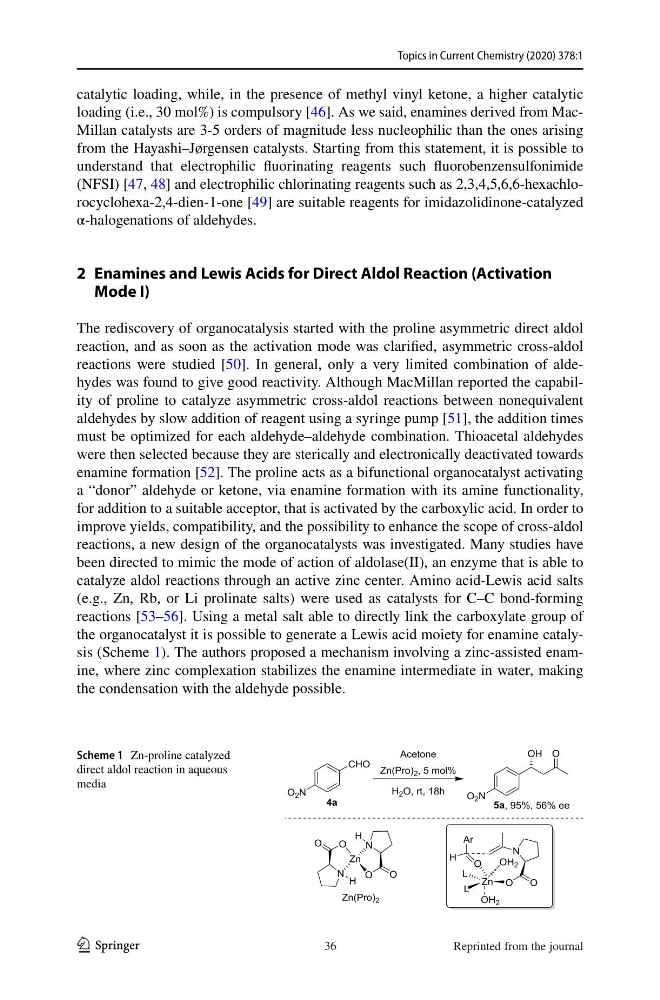
the organocatalyst it is possible to generate a Lewis acid moiety for enamine catalysis (Scheme 1). The authors proposed a mechanism involving a zinc-assisted enamine, where zinc complexation stabilizes the enamine intermediate in water, making
the condensation with the aldehyde possible.
Scheme 1 Zn-proline catalyzed
direct aldol reaction in aqueous
media
Reprinted from the journal
36
1 3
catalytic loading, while, in the presence of methyl vinyl ketone, a higher catalytic
loading (i.e., 30 mol%) is compulsory [46]. As we said, enamines derived from MacMillan catalysts are 3-5 orders of magnitude less nucleophilic than the ones arising
from the Hayashi–Jørgensen catalysts. Starting from this statement, it is possible to
understand that electrophilic fluorinating reagents such fluorobenzensulfonimide
(NFSI) [47, 48] and electrophilic chlorinating reagents such as 2,3,4,5,6,6-hexachlorocyclohexa-2,4-dien-1-one [49] are suitable reagents for imidazolidinone-catalyzed
α-halogenations of aldehydes.
2 Enamines and Lewis Acids for Direct Aldol Reaction (Activation
Mode I)
The rediscovery of organocatalysis started with the proline asymmetric direct aldol
reaction, and as soon as the activation mode was clarified, asymmetric cross-aldol
reactions were studied [50]. In general, only a very limited combination of aldehydes was found to give good reactivity. Although MacMillan reported the capability of proline to catalyze asymmetric cross-aldol reactions between nonequivalent
aldehydes by slow addition of reagent using a syringe pump [51], the addition times
must be optimized for each aldehyde–aldehyde combination. Thioacetal aldehydes
were then selected because they are sterically and electronically deactivated towards
enamine formation [52]. The proline acts as a bifunctional organocatalyst activating
a “donor” aldehyde or ketone, via enamine formation with its amine functionality,
for addition to a suitable acceptor, that is activated by the carboxylic acid. In order to
improve yields, compatibility, and the possibility to enhance the scope of cross-aldol
reactions, a new design of the organocatalysts was investigated. Many studies have
been directed to mimic the mode of action of aldolase(II), an enzyme that is able to
catalyze aldol reactions through an active zinc center. Amino acid-Lewis acid salts
(e.g., Zn, Rb, or Li prolinate salts) were used as catalysts for C–C bond-forming
reactions [53–56]. Using a metal salt able to directly link the carboxylate group of
the organocatalyst it is possible to generate a Lewis acid moiety for enamine catalysis (Scheme 1). The authors proposed a mechanism involving a zinc-assisted enamine, where zinc complexation stabilizes the enamine intermediate in water, making
the condensation with the aldehyde possible.
Scheme 1 Zn-proline catalyzed
direct aldol reaction in aqueous
media
Reprinted from the journal
36