

1 3
Topics in Current Chemistry (2020) 378:1
diastereoisomers (cis, trans) needs to be performed [40], because the cis or trans
imidazolidinone can have entirely different behaviors and catalytic abilities in the
reactions [41]. It is also important that the stereochemical integrity of the organocatalyst is maintained during the reactions. Trans to cis equilibration can occur, especially if the reaction is performed under irradiation (photoredox catalysis) [42] and
this can cause deactivation of the catalytic system. Although hundreds of organocatalysts were prepared and tested [43], and in some cases improved results were
found concerning some aspect, i.e., “low catalytic loadings” [44], the commercially
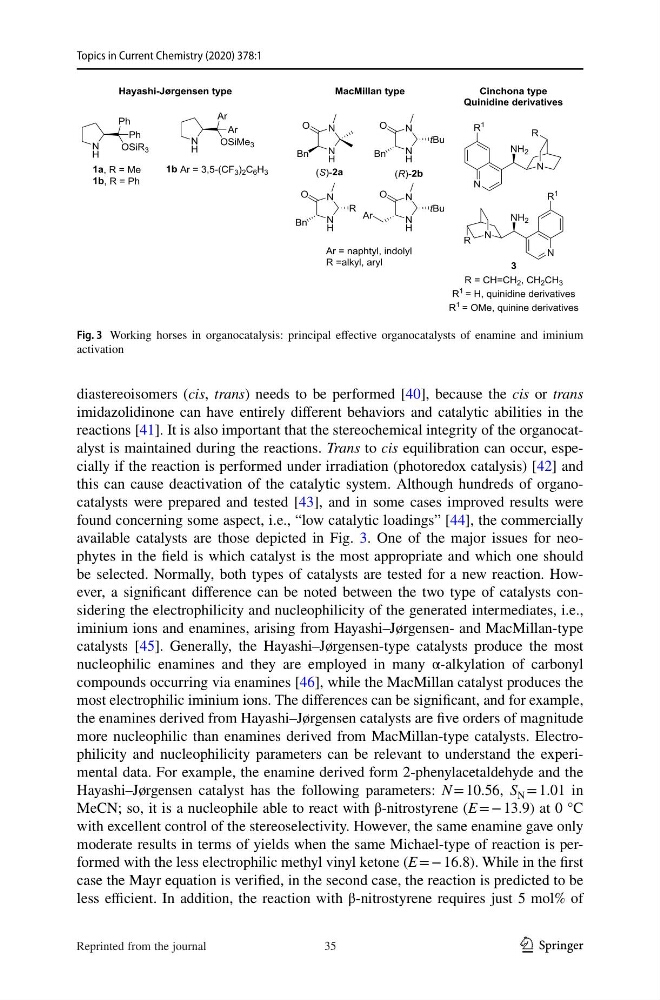
available catalysts are those depicted in Fig. 3. One of the major issues for neophytes in the field is which catalyst is the most appropriate and which one should
be selected. Normally, both types of catalysts are tested for a new reaction. However, a significant difference can be noted between the two type of catalysts considering the electrophilicity and nucleophilicity of the generated intermediates, i.e.,
iminium ions and enamines, arising from Hayashi–Jørgensen- and MacMillan-type
catalysts [45]. Generally, the Hayashi–Jørgensen-type catalysts produce the most
nucleophilic enamines and they are employed in many α-alkylation of carbonyl
compounds occurring via enamines [46], while the MacMillan catalyst produces the
most electrophilic iminium ions. The differences can be significant, and for example,
the enamines derived from Hayashi–Jørgensen catalysts are five orders of magnitude
more nucleophilic than enamines derived from MacMillan-type catalysts. Electrophilicity and nucleophilicity parameters can be relevant to understand the experimental data. For example, the enamine derived form 2-phenylacetaldehyde and the
Hayashi–Jørgensen catalyst has the following parameters: N = 10.56, S N = 1.01 in
MeCN; so, it is a nucleophile able to react with β-nitrostyrene (E = − 13.9) at 0 °C
with excellent control of the stereoselectivity. However, the same enamine gave only
moderate results in terms of yields when the same Michael-type of reaction is performed with the less electrophilic methyl vinyl ketone (E = − 16.8). While in the first
case the Mayr equation is verified, in the second case, the reaction is predicted to be
less efficient. In addition, the reaction with β-nitrostyrene requires just 5 mol% of
Fig. 3 Working horses in organocatalysis: principal effective organocatalysts of enamine and iminium
activation
Reprinted from the journal
35
Topics in Current Chemistry (2020) 378:1
diastereoisomers (cis, trans) needs to be performed [40], because the cis or trans
imidazolidinone can have entirely different behaviors and catalytic abilities in the
reactions [41]. It is also important that the stereochemical integrity of the organocatalyst is maintained during the reactions. Trans to cis equilibration can occur, especially if the reaction is performed under irradiation (photoredox catalysis) [42] and
this can cause deactivation of the catalytic system. Although hundreds of organocatalysts were prepared and tested [43], and in some cases improved results were
found concerning some aspect, i.e., “low catalytic loadings” [44], the commercially
available catalysts are those depicted in Fig. 3. One of the major issues for neophytes in the field is which catalyst is the most appropriate and which one should
be selected. Normally, both types of catalysts are tested for a new reaction. However, a significant difference can be noted between the two type of catalysts considering the electrophilicity and nucleophilicity of the generated intermediates, i.e.,
iminium ions and enamines, arising from Hayashi–Jørgensen- and MacMillan-type
catalysts [45]. Generally, the Hayashi–Jørgensen-type catalysts produce the most
nucleophilic enamines and they are employed in many α-alkylation of carbonyl
compounds occurring via enamines [46], while the MacMillan catalyst produces the
most electrophilic iminium ions. The differences can be significant, and for example,
the enamines derived from Hayashi–Jørgensen catalysts are five orders of magnitude
more nucleophilic than enamines derived from MacMillan-type catalysts. Electrophilicity and nucleophilicity parameters can be relevant to understand the experimental data. For example, the enamine derived form 2-phenylacetaldehyde and the
Hayashi–Jørgensen catalyst has the following parameters: N = 10.56, S N = 1.01 in
MeCN; so, it is a nucleophile able to react with β-nitrostyrene (E = − 13.9) at 0 °C
with excellent control of the stereoselectivity. However, the same enamine gave only
moderate results in terms of yields when the same Michael-type of reaction is performed with the less electrophilic methyl vinyl ketone (E = − 16.8). While in the first
case the Mayr equation is verified, in the second case, the reaction is predicted to be
less efficient. In addition, the reaction with β-nitrostyrene requires just 5 mol% of
Fig. 3 Working horses in organocatalysis: principal effective organocatalysts of enamine and iminium
activation
Reprinted from the journal
35