

1 3
Topics in Current Chemistry (2020) 378:9
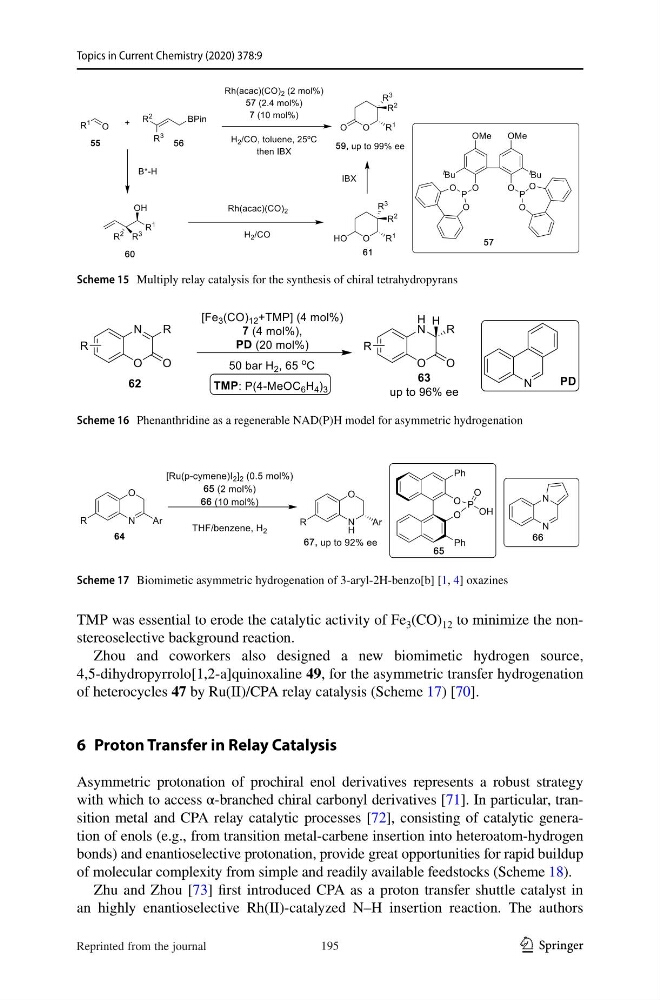
TMP was essential to erode the catalytic activity of Fe 3 (CO) 12 to minimize the nonstereoselective background reaction.
Zhou and coworkers also designed a new biomimetic hydrogen source,
4,5-dihydropyrrolo[1,2-a]quinoxaline 49, for the asymmetric transfer hydrogenation
of heterocycles 47 by Ru(II)/CPA relay catalysis (Scheme 17) [70].
6 Proton Transfer in Relay Catalysis
Asymmetric protonation of prochiral enol derivatives represents a robust strategy
with which to access α-branched chiral carbonyl derivatives [71]. In particular, transition metal and CPA relay catalytic processes [72], consisting of catalytic generation of enols (e.g., from transition metal-carbene insertion into heteroatom-hydrogen
bonds) and enantioselective protonation, provide great opportunities for rapid buildup
of molecular complexity from simple and readily available feedstocks (Scheme 18).
Zhu and Zhou [73] first introduced CPA as a proton transfer shuttle catalyst in
an highly enantioselective Rh(II)-catalyzed N–H insertion reaction. The authors
Scheme 15 Multiply relay catalysis for the synthesis of chiral tetrahydropyrans
Scheme 16 Phenanthridine as a regenerable NAD(P)H model for asymmetric hydrogenation
Scheme 17 Biomimetic asymmetric hydrogenation of 3-aryl-2H-benzo[b] [1, 4] oxazines
Reprinted from the journal
195
Topics in Current Chemistry (2020) 378:9
TMP was essential to erode the catalytic activity of Fe 3 (CO) 12 to minimize the nonstereoselective background reaction.
Zhou and coworkers also designed a new biomimetic hydrogen source,
4,5-dihydropyrrolo[1,2-a]quinoxaline 49, for the asymmetric transfer hydrogenation
of heterocycles 47 by Ru(II)/CPA relay catalysis (Scheme 17) [70].
6 Proton Transfer in Relay Catalysis
Asymmetric protonation of prochiral enol derivatives represents a robust strategy
with which to access α-branched chiral carbonyl derivatives [71]. In particular, transition metal and CPA relay catalytic processes [72], consisting of catalytic generation of enols (e.g., from transition metal-carbene insertion into heteroatom-hydrogen
bonds) and enantioselective protonation, provide great opportunities for rapid buildup
of molecular complexity from simple and readily available feedstocks (Scheme 18).
Zhu and Zhou [73] first introduced CPA as a proton transfer shuttle catalyst in
an highly enantioselective Rh(II)-catalyzed N–H insertion reaction. The authors
Scheme 15 Multiply relay catalysis for the synthesis of chiral tetrahydropyrans
Scheme 16 Phenanthridine as a regenerable NAD(P)H model for asymmetric hydrogenation
Scheme 17 Biomimetic asymmetric hydrogenation of 3-aryl-2H-benzo[b] [1, 4] oxazines
Reprinted from the journal
195