

Topics in Current Chemistry (2020) 378:9
1 3
5 Transfer Hydrogenation in Relay Catalysis
Zhou and coworkers first developed a triple catalyst system consisting of Ru(II) complex, Hantzsch esters and CPA, enabling the asymmetric hydrogenation of N-heterocycles to proceed by using hydrogen as the terminal reductant [66, 67]. Inspired by
Zhou’s work of using 9,10-dihydrophenanthridine (DHPD) as regenerable NAD(P)
H model [68], Beller and coworkers accomplished an asymmetric hydrogenation
reaction of benzoxazinones via an iron/phenanthridine (PD)/chiral Brønsted acid
relay catalysis (Scheme 16) [69]. Notably, the presence of achiral phosphine ligand
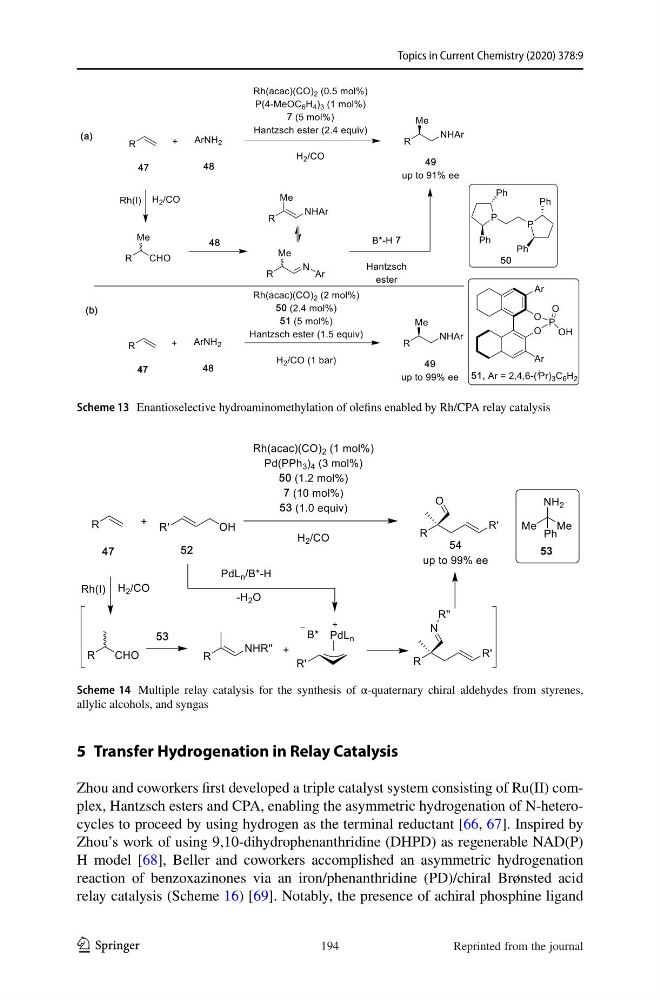
Scheme 13 Enantioselective hydroaminomethylation of olefins enabled by Rh/CPA relay catalysis
Scheme 14 Multiple relay catalysis for the synthesis of α-quaternary chiral aldehydes from styrenes,
allylic alcohols, and syngas
Reprinted from the journal
194
1 3
5 Transfer Hydrogenation in Relay Catalysis
Zhou and coworkers first developed a triple catalyst system consisting of Ru(II) complex, Hantzsch esters and CPA, enabling the asymmetric hydrogenation of N-heterocycles to proceed by using hydrogen as the terminal reductant [66, 67]. Inspired by
Zhou’s work of using 9,10-dihydrophenanthridine (DHPD) as regenerable NAD(P)
H model [68], Beller and coworkers accomplished an asymmetric hydrogenation
reaction of benzoxazinones via an iron/phenanthridine (PD)/chiral Brønsted acid
relay catalysis (Scheme 16) [69]. Notably, the presence of achiral phosphine ligand
Scheme 13 Enantioselective hydroaminomethylation of olefins enabled by Rh/CPA relay catalysis
Scheme 14 Multiple relay catalysis for the synthesis of α-quaternary chiral aldehydes from styrenes,
allylic alcohols, and syngas
Reprinted from the journal
194