

Topics in Current Chemistry (2020) 378:9
1 3
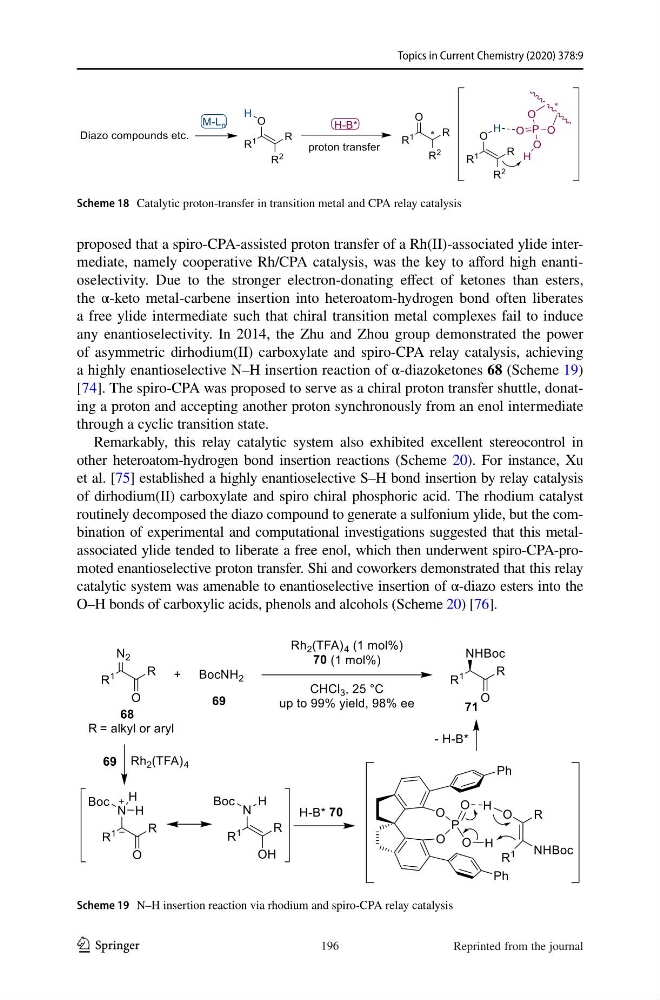
proposed that a spiro-CPA-assisted proton transfer of a Rh(II)-associated ylide intermediate, namely cooperative Rh/CPA catalysis, was the key to afford high enantioselectivity. Due to the stronger electron-donating effect of ketones than esters,
the α-keto metal-carbene insertion into heteroatom-hydrogen bond often liberates
a free ylide intermediate such that chiral transition metal complexes fail to induce
any enantioselectivity. In 2014, the Zhu and Zhou group demonstrated the power
of asymmetric dirhodium(II) carboxylate and spiro-CPA relay catalysis, achieving
a highly enantioselective N–H insertion reaction of α-diazoketones 68 (Scheme 19)
[74]. The spiro-CPA was proposed to serve as a chiral proton transfer shuttle, donating a proton and accepting another proton synchronously from an enol intermediate
through a cyclic transition state.
Remarkably, this relay catalytic system also exhibited excellent stereocontrol in
other heteroatom-hydrogen bond insertion reactions (Scheme 20). For instance, Xu
et al. [75] established a highly enantioselective S–H bond insertion by relay catalysis
of dirhodium(II) carboxylate and spiro chiral phosphoric acid. The rhodium catalyst
routinely decomposed the diazo compound to generate a sulfonium ylide, but the combination of experimental and computational investigations suggested that this metalassociated ylide tended to liberate a free enol, which then underwent spiro-CPA-promoted enantioselective proton transfer. Shi and coworkers demonstrated that this relay
catalytic system was amenable to enantioselective insertion of α-diazo esters into the
O–H bonds of carboxylic acids, phenols and alcohols (Scheme 20) [76].
Scheme 18 Catalytic proton-transfer in transition metal and CPA relay catalysis
Scheme 19 N–H insertion reaction via rhodium and spiro-CPA relay catalysis
Reprinted from the journal
196
1 3
proposed that a spiro-CPA-assisted proton transfer of a Rh(II)-associated ylide intermediate, namely cooperative Rh/CPA catalysis, was the key to afford high enantioselectivity. Due to the stronger electron-donating effect of ketones than esters,
the α-keto metal-carbene insertion into heteroatom-hydrogen bond often liberates
a free ylide intermediate such that chiral transition metal complexes fail to induce
any enantioselectivity. In 2014, the Zhu and Zhou group demonstrated the power
of asymmetric dirhodium(II) carboxylate and spiro-CPA relay catalysis, achieving
a highly enantioselective N–H insertion reaction of α-diazoketones 68 (Scheme 19)
[74]. The spiro-CPA was proposed to serve as a chiral proton transfer shuttle, donating a proton and accepting another proton synchronously from an enol intermediate
through a cyclic transition state.
Remarkably, this relay catalytic system also exhibited excellent stereocontrol in
other heteroatom-hydrogen bond insertion reactions (Scheme 20). For instance, Xu
et al. [75] established a highly enantioselective S–H bond insertion by relay catalysis
of dirhodium(II) carboxylate and spiro chiral phosphoric acid. The rhodium catalyst
routinely decomposed the diazo compound to generate a sulfonium ylide, but the combination of experimental and computational investigations suggested that this metalassociated ylide tended to liberate a free enol, which then underwent spiro-CPA-promoted enantioselective proton transfer. Shi and coworkers demonstrated that this relay
catalytic system was amenable to enantioselective insertion of α-diazo esters into the
O–H bonds of carboxylic acids, phenols and alcohols (Scheme 20) [76].
Scheme 18 Catalytic proton-transfer in transition metal and CPA relay catalysis
Scheme 19 N–H insertion reaction via rhodium and spiro-CPA relay catalysis
Reprinted from the journal
196