

1 3
Topics in Current Chemistry (2020) 378:9
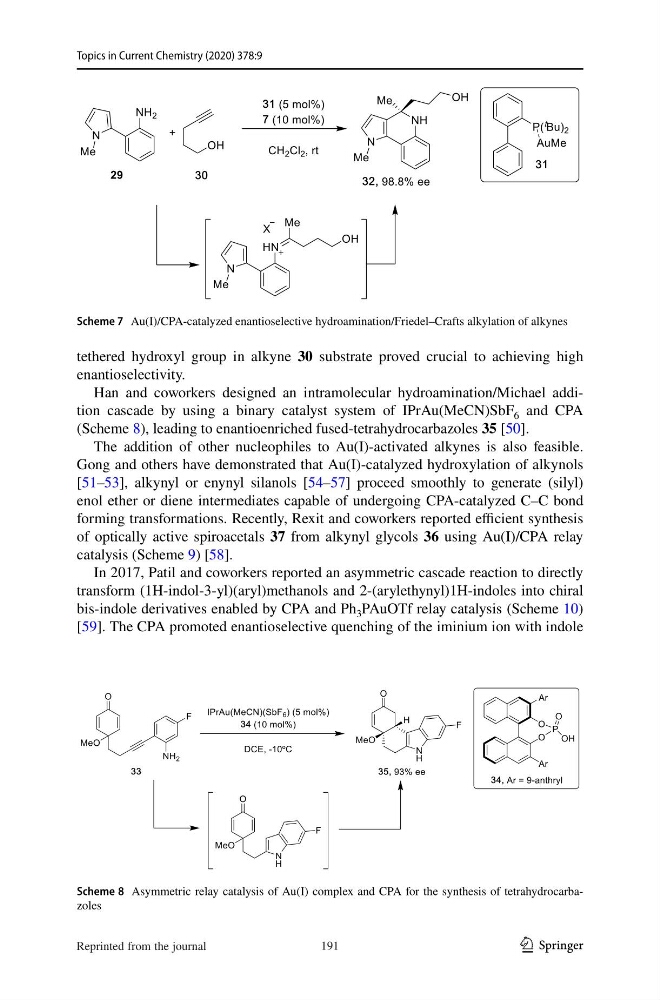
tethered hydroxyl group in alkyne 30 substrate proved crucial to achieving high
enantioselectivity.
Han and coworkers designed an intramolecular hydroamination/Michael addition cascade by using a binary catalyst system of IPrAu(MeCN)SbF 6 and CPA
(Scheme 8), leading to enantioenriched fused-tetrahydrocarbazoles 35 [50].
The addition of other nucleophiles to Au(I)-activated alkynes is also feasible.
Gong and others have demonstrated that Au(I)-catalyzed hydroxylation of alkynols
[51–53], alkynyl or enynyl silanols [54–57] proceed smoothly to generate (silyl)
enol ether or diene intermediates capable of undergoing CPA-catalyzed C–C bond
forming transformations. Recently, Rexit and coworkers reported efficient synthesis
of optically active spiroacetals 37 from alkynyl glycols 36 using Au(I)/CPA relay
catalysis (Scheme 9) [58].
In 2017, Patil and coworkers reported an asymmetric cascade reaction to directly
transform (1H-indol-3-yl)(aryl)methanols and 2-(arylethynyl)1H-indoles into chiral
bis-indole derivatives enabled by CPA and Ph 3 PAuOTf relay catalysis (Scheme 10)
[59]. The CPA promoted enantioselective quenching of the iminium ion with indole
Scheme 7 Au(I)/CPA-catalyzed enantioselective hydroamination/Friedel–Crafts alkylation of alkynes
Scheme 8 Asymmetric relay catalysis of Au(I) complex and CPA for the synthesis of tetrahydrocarbazoles
Reprinted from the journal
191
Topics in Current Chemistry (2020) 378:9
tethered hydroxyl group in alkyne 30 substrate proved crucial to achieving high
enantioselectivity.
Han and coworkers designed an intramolecular hydroamination/Michael addition cascade by using a binary catalyst system of IPrAu(MeCN)SbF 6 and CPA
(Scheme 8), leading to enantioenriched fused-tetrahydrocarbazoles 35 [50].
The addition of other nucleophiles to Au(I)-activated alkynes is also feasible.
Gong and others have demonstrated that Au(I)-catalyzed hydroxylation of alkynols
[51–53], alkynyl or enynyl silanols [54–57] proceed smoothly to generate (silyl)
enol ether or diene intermediates capable of undergoing CPA-catalyzed C–C bond
forming transformations. Recently, Rexit and coworkers reported efficient synthesis
of optically active spiroacetals 37 from alkynyl glycols 36 using Au(I)/CPA relay
catalysis (Scheme 9) [58].
In 2017, Patil and coworkers reported an asymmetric cascade reaction to directly
transform (1H-indol-3-yl)(aryl)methanols and 2-(arylethynyl)1H-indoles into chiral
bis-indole derivatives enabled by CPA and Ph 3 PAuOTf relay catalysis (Scheme 10)
[59]. The CPA promoted enantioselective quenching of the iminium ion with indole
Scheme 7 Au(I)/CPA-catalyzed enantioselective hydroamination/Friedel–Crafts alkylation of alkynes
Scheme 8 Asymmetric relay catalysis of Au(I) complex and CPA for the synthesis of tetrahydrocarbazoles
Reprinted from the journal
191