

Topics in Current Chemistry (2020) 378:9
1 3
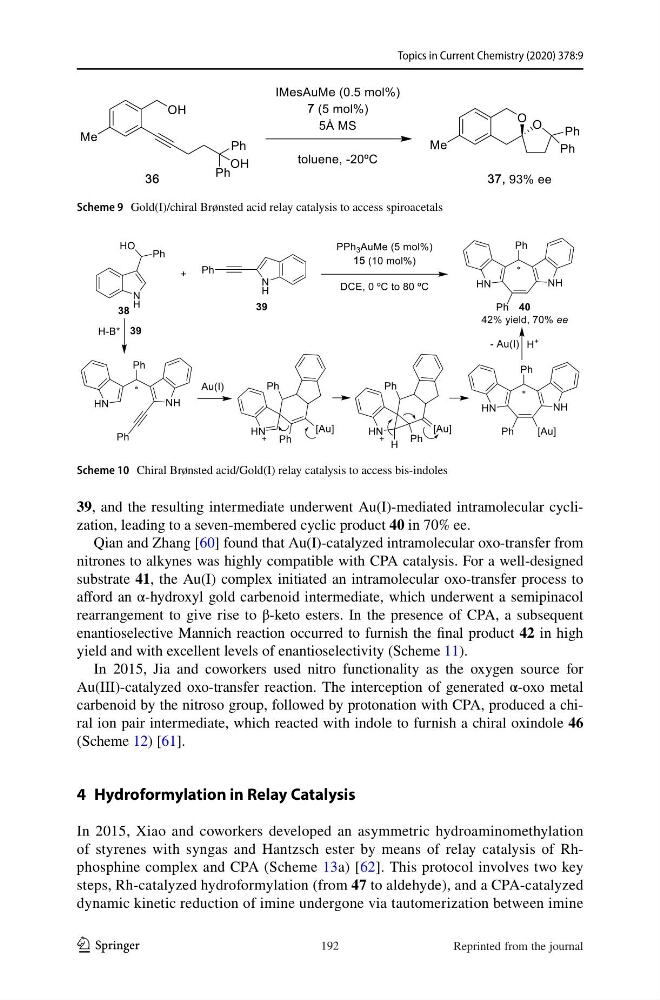
39, and the resulting intermediate underwent Au(I)-mediated intramolecular cyclization, leading to a seven-membered cyclic product 40 in 70% ee.
Qian and Zhang [60] found that Au(I)-catalyzed intramolecular oxo-transfer from
nitrones to alkynes was highly compatible with CPA catalysis. For a well-designed
substrate 41, the Au(I) complex initiated an intramolecular oxo-transfer process to
afford an α-hydroxyl gold carbenoid intermediate, which underwent a semipinacol
rearrangement to give rise to β-keto esters. In the presence of CPA, a subsequent
enantioselective Mannich reaction occurred to furnish the final product 42 in high
yield and with excellent levels of enantioselectivity (Scheme 11).
In 2015, Jia and coworkers used nitro functionality as the oxygen source for
Au(III)-catalyzed oxo-transfer reaction. The interception of generated α-oxo metal
carbenoid by the nitroso group, followed by protonation with CPA, produced a chiral ion pair intermediate, which reacted with indole to furnish a chiral oxindole 46
(Scheme 12) [61].
4 Hydroformylation in Relay Catalysis
In 2015, Xiao and coworkers developed an asymmetric hydroaminomethylation
of styrenes with syngas and Hantzsch ester by means of relay catalysis of Rhphosphine complex and CPA (Scheme 13a) [62]. This protocol involves two key
steps, Rh-catalyzed hydroformylation (from 47 to aldehyde), and a CPA-catalyzed
dynamic kinetic reduction of imine undergone via tautomerization between imine
Scheme 9 Gold(I)/chiral Brønsted acid relay catalysis to access spiroacetals
Scheme 10 Chiral Brønsted acid/Gold(I) relay catalysis to access bis-indoles
Reprinted from the journal
192
1 3
39, and the resulting intermediate underwent Au(I)-mediated intramolecular cyclization, leading to a seven-membered cyclic product 40 in 70% ee.
Qian and Zhang [60] found that Au(I)-catalyzed intramolecular oxo-transfer from
nitrones to alkynes was highly compatible with CPA catalysis. For a well-designed
substrate 41, the Au(I) complex initiated an intramolecular oxo-transfer process to
afford an α-hydroxyl gold carbenoid intermediate, which underwent a semipinacol
rearrangement to give rise to β-keto esters. In the presence of CPA, a subsequent
enantioselective Mannich reaction occurred to furnish the final product 42 in high
yield and with excellent levels of enantioselectivity (Scheme 11).
In 2015, Jia and coworkers used nitro functionality as the oxygen source for
Au(III)-catalyzed oxo-transfer reaction. The interception of generated α-oxo metal
carbenoid by the nitroso group, followed by protonation with CPA, produced a chiral ion pair intermediate, which reacted with indole to furnish a chiral oxindole 46
(Scheme 12) [61].
4 Hydroformylation in Relay Catalysis
In 2015, Xiao and coworkers developed an asymmetric hydroaminomethylation
of styrenes with syngas and Hantzsch ester by means of relay catalysis of Rhphosphine complex and CPA (Scheme 13a) [62]. This protocol involves two key
steps, Rh-catalyzed hydroformylation (from 47 to aldehyde), and a CPA-catalyzed
dynamic kinetic reduction of imine undergone via tautomerization between imine
Scheme 9 Gold(I)/chiral Brønsted acid relay catalysis to access spiroacetals
Scheme 10 Chiral Brønsted acid/Gold(I) relay catalysis to access bis-indoles
Reprinted from the journal
192