

1 3
Topics in Current Chemistry (2019) 377:23
including allylic alcohols and their derivatives, styrenic substrates with electrondonating or electron-withdrawing substituents on the aromatic ring, and even
unfunctionalized alkenes were applicable to afford the desired cyclopropanes in
excellent yields (72–99%).
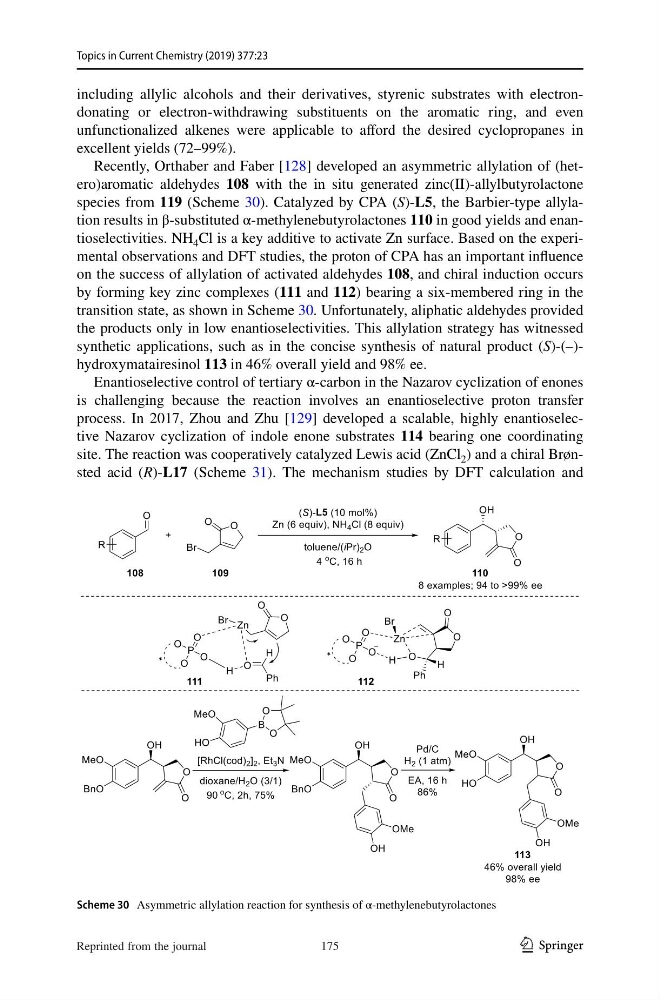
Recently, Orthaber and Faber [128] developed an asymmetric allylation of (hetero)aromatic aldehydes 108 with the in situ generated zinc(II)-allylbutyrolactone
species from 119 (Scheme 30). Catalyzed by CPA (S)-L5, the Barbier-type allylation results in β-substituted α-methylenebutyrolactones 110 in good yields and enantioselectivities. NH 4 Cl is a key additive to activate Zn surface. Based on the experimental observations and DFT studies, the proton of CPA has an important influence
on the success of allylation of activated aldehydes 108, and chiral induction occurs
by forming key zinc complexes (111 and 112) bearing a six-membered ring in the
transition state, as shown in Scheme 30. Unfortunately, aliphatic aldehydes provided
the products only in low enantioselectivities. This allylation strategy has witnessed
synthetic applications, such as in the concise synthesis of natural product (S)-(–)hydroxymatairesinol 113 in 46% overall yield and 98% ee.
Enantioselective control of tertiary α-carbon in the Nazarov cyclization of enones
is challenging because the reaction involves an enantioselective proton transfer
process. In 2017, Zhou and Zhu [129] developed a scalable, highly enantioselective Nazarov cyclization of indole enone substrates 114 bearing one coordinating
site. The reaction was cooperatively catalyzed Lewis acid (ZnCl 2 ) and a chiral Brønsted acid (R)-L17 (Scheme 31). The mechanism studies by DFT calculation and
Scheme 30 Asymmetric allylation reaction for synthesis of α-methylenebutyrolactones
Reprinted from the journal
175
Topics in Current Chemistry (2019) 377:23
including allylic alcohols and their derivatives, styrenic substrates with electrondonating or electron-withdrawing substituents on the aromatic ring, and even
unfunctionalized alkenes were applicable to afford the desired cyclopropanes in
excellent yields (72–99%).
Recently, Orthaber and Faber [128] developed an asymmetric allylation of (hetero)aromatic aldehydes 108 with the in situ generated zinc(II)-allylbutyrolactone
species from 119 (Scheme 30). Catalyzed by CPA (S)-L5, the Barbier-type allylation results in β-substituted α-methylenebutyrolactones 110 in good yields and enantioselectivities. NH 4 Cl is a key additive to activate Zn surface. Based on the experimental observations and DFT studies, the proton of CPA has an important influence
on the success of allylation of activated aldehydes 108, and chiral induction occurs
by forming key zinc complexes (111 and 112) bearing a six-membered ring in the
transition state, as shown in Scheme 30. Unfortunately, aliphatic aldehydes provided
the products only in low enantioselectivities. This allylation strategy has witnessed
synthetic applications, such as in the concise synthesis of natural product (S)-(–)hydroxymatairesinol 113 in 46% overall yield and 98% ee.
Enantioselective control of tertiary α-carbon in the Nazarov cyclization of enones
is challenging because the reaction involves an enantioselective proton transfer
process. In 2017, Zhou and Zhu [129] developed a scalable, highly enantioselective Nazarov cyclization of indole enone substrates 114 bearing one coordinating
site. The reaction was cooperatively catalyzed Lewis acid (ZnCl 2 ) and a chiral Brønsted acid (R)-L17 (Scheme 31). The mechanism studies by DFT calculation and
Scheme 30 Asymmetric allylation reaction for synthesis of α-methylenebutyrolactones
Reprinted from the journal
175