

Topics in Current Chemistry (2019) 377:23
1 3
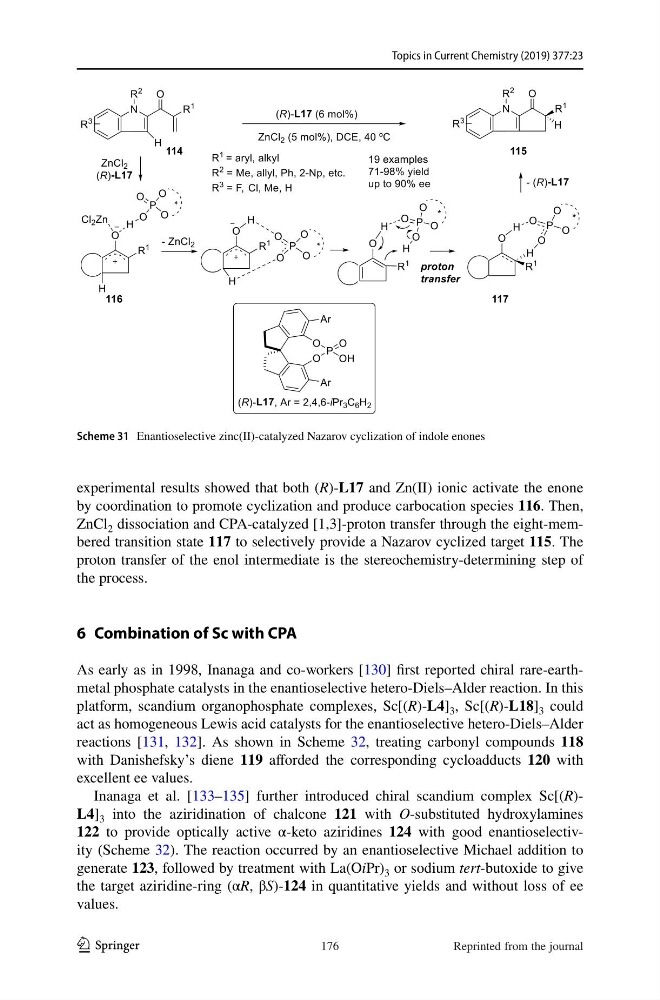
experimental results showed that both (R)-L17 and Zn(II) ionic activate the enone
by coordination to promote cyclization and produce carbocation species 116. Then,
ZnCl 2 dissociation and CPA-catalyzed [1,3]-proton transfer through the eight-membered transition state 117 to selectively provide a Nazarov cyclized target 115. The
proton transfer of the enol intermediate is the stereochemistry-determining step of
the process.
6 Combination of Sc with CPA
As early as in 1998, Inanaga and co-workers [130] first reported chiral rare-earthmetal phosphate catalysts in the enantioselective hetero-Diels–Alder reaction. In this
platform, scandium organophosphate complexes, Sc[(R)-L4] 3 , Sc[(R)-L18] 3 could
act as homogeneous Lewis acid catalysts for the enantioselective hetero-Diels–Alder
reactions [131, 132]. As shown in Scheme 32, treating carbonyl compounds 118
with Danishefsky’s diene 119 afforded the corresponding cycloadducts 120 with
excellent ee values.
Inanaga et al. [133–135] further introduced chiral scandium complex Sc[(R)L4] 3 into the aziridination of chalcone 121 with O-substituted hydroxylamines
122 to provide optically active α-keto aziridines 124 with good enantioselectivity (Scheme 32). The reaction occurred by an enantioselective Michael addition to
generate 123, followed by treatment with La(OiPr) 3 or sodium tert-butoxide to give
the target aziridine-ring (αR, βS)-124 in quantitative yields and without loss of ee
values.
Scheme 31 Enantioselective zinc(II)-catalyzed Nazarov cyclization of indole enones
Reprinted from the journal
176
1 3
experimental results showed that both (R)-L17 and Zn(II) ionic activate the enone
by coordination to promote cyclization and produce carbocation species 116. Then,
ZnCl 2 dissociation and CPA-catalyzed [1,3]-proton transfer through the eight-membered transition state 117 to selectively provide a Nazarov cyclized target 115. The
proton transfer of the enol intermediate is the stereochemistry-determining step of
the process.
6 Combination of Sc with CPA
As early as in 1998, Inanaga and co-workers [130] first reported chiral rare-earthmetal phosphate catalysts in the enantioselective hetero-Diels–Alder reaction. In this
platform, scandium organophosphate complexes, Sc[(R)-L4] 3 , Sc[(R)-L18] 3 could
act as homogeneous Lewis acid catalysts for the enantioselective hetero-Diels–Alder
reactions [131, 132]. As shown in Scheme 32, treating carbonyl compounds 118
with Danishefsky’s diene 119 afforded the corresponding cycloadducts 120 with
excellent ee values.
Inanaga et al. [133–135] further introduced chiral scandium complex Sc[(R)L4] 3 into the aziridination of chalcone 121 with O-substituted hydroxylamines
122 to provide optically active α-keto aziridines 124 with good enantioselectivity (Scheme 32). The reaction occurred by an enantioselective Michael addition to
generate 123, followed by treatment with La(OiPr) 3 or sodium tert-butoxide to give
the target aziridine-ring (αR, βS)-124 in quantitative yields and without loss of ee
values.
Scheme 31 Enantioselective zinc(II)-catalyzed Nazarov cyclization of indole enones
Reprinted from the journal
176