

Topics in Current Chemistry (2019) 377:23
1 3
5 Combination of Zn with CPA
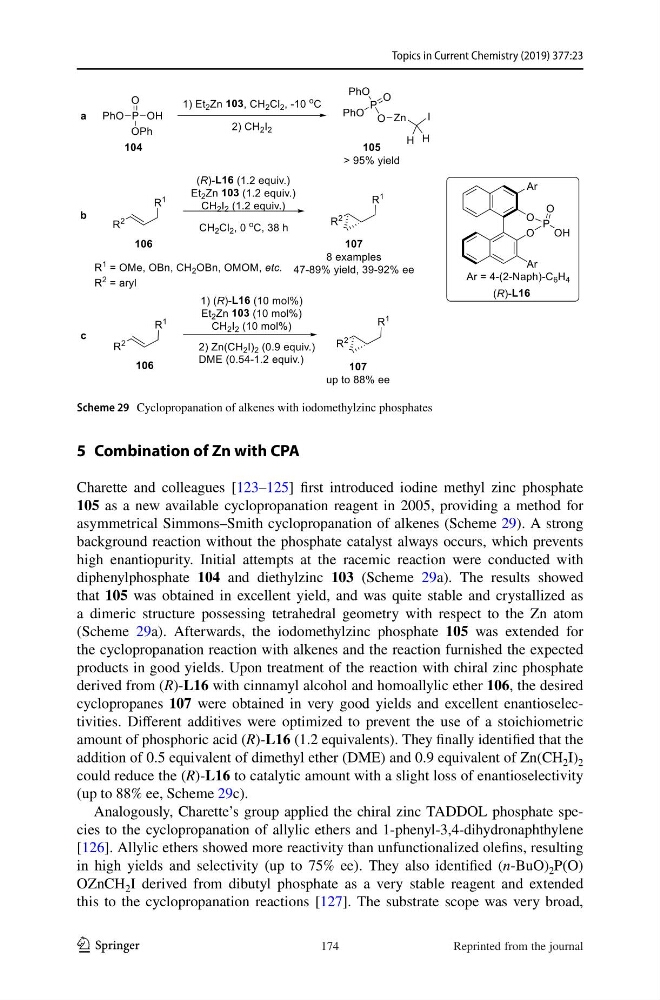
Charette and colleagues [123–125] first introduced iodine methyl zinc phosphate
105 as a new available cyclopropanation reagent in 2005, providing a method for
asymmetrical Simmons–Smith cyclopropanation of alkenes (Scheme 29). A strong
background reaction without the phosphate catalyst always occurs, which prevents
high enantiopurity. Initial attempts at the racemic reaction were conducted with
diphenylphosphate 104 and diethylzinc 103 (Scheme 29a). The results showed
that 105 was obtained in excellent yield, and was quite stable and crystallized as
a dimeric structure possessing tetrahedral geometry with respect to the Zn atom
(Scheme 29a). Afterwards, the iodomethylzinc phosphate 105 was extended for
the cyclopropanation reaction with alkenes and the reaction furnished the expected
products in good yields. Upon treatment of the reaction with chiral zinc phosphate
derived from (R)-L16 with cinnamyl alcohol and homoallylic ether 106, the desired
cyclopropanes 107 were obtained in very good yields and excellent enantioselectivities. Different additives were optimized to prevent the use of a stoichiometric
amount of phosphoric acid (R)-L16 (1.2 equivalents). They finally identified that the
addition of 0.5 equivalent of dimethyl ether (DME) and 0.9 equivalent of Zn(CH 2 I) 2
could reduce the (R)-L16 to catalytic amount with a slight loss of enantioselectivity
(up to 88% ee, Scheme 29c).
Analogously, Charette’s group applied the chiral zinc TADDOL phosphate species to the cyclopropanation of allylic ethers and 1-phenyl-3,4-dihydronaphthylene
[126]. Allylic ethers showed more reactivity than unfunctionalized olefins, resulting
in high yields and selectivity (up to 75% ee). They also identified (n-BuO) 2 P(O)
OZnCH 2 I derived from dibutyl phosphate as a very stable reagent and extended
this to the cyclopropanation reactions [127]. The substrate scope was very broad,
Scheme 29 Cyclopropanation of alkenes with iodomethylzinc phosphates
Reprinted from the journal
174
1 3
5 Combination of Zn with CPA
Charette and colleagues [123–125] first introduced iodine methyl zinc phosphate
105 as a new available cyclopropanation reagent in 2005, providing a method for
asymmetrical Simmons–Smith cyclopropanation of alkenes (Scheme 29). A strong
background reaction without the phosphate catalyst always occurs, which prevents
high enantiopurity. Initial attempts at the racemic reaction were conducted with
diphenylphosphate 104 and diethylzinc 103 (Scheme 29a). The results showed
that 105 was obtained in excellent yield, and was quite stable and crystallized as
a dimeric structure possessing tetrahedral geometry with respect to the Zn atom
(Scheme 29a). Afterwards, the iodomethylzinc phosphate 105 was extended for
the cyclopropanation reaction with alkenes and the reaction furnished the expected
products in good yields. Upon treatment of the reaction with chiral zinc phosphate
derived from (R)-L16 with cinnamyl alcohol and homoallylic ether 106, the desired
cyclopropanes 107 were obtained in very good yields and excellent enantioselectivities. Different additives were optimized to prevent the use of a stoichiometric
amount of phosphoric acid (R)-L16 (1.2 equivalents). They finally identified that the
addition of 0.5 equivalent of dimethyl ether (DME) and 0.9 equivalent of Zn(CH 2 I) 2
could reduce the (R)-L16 to catalytic amount with a slight loss of enantioselectivity
(up to 88% ee, Scheme 29c).
Analogously, Charette’s group applied the chiral zinc TADDOL phosphate species to the cyclopropanation of allylic ethers and 1-phenyl-3,4-dihydronaphthylene
[126]. Allylic ethers showed more reactivity than unfunctionalized olefins, resulting
in high yields and selectivity (up to 75% ee). They also identified (n-BuO) 2 P(O)
OZnCH 2 I derived from dibutyl phosphate as a very stable reagent and extended
this to the cyclopropanation reactions [127]. The substrate scope was very broad,
Scheme 29 Cyclopropanation of alkenes with iodomethylzinc phosphates
Reprinted from the journal
174