

1 3
Topics in Current Chemistry (2019) 377:23
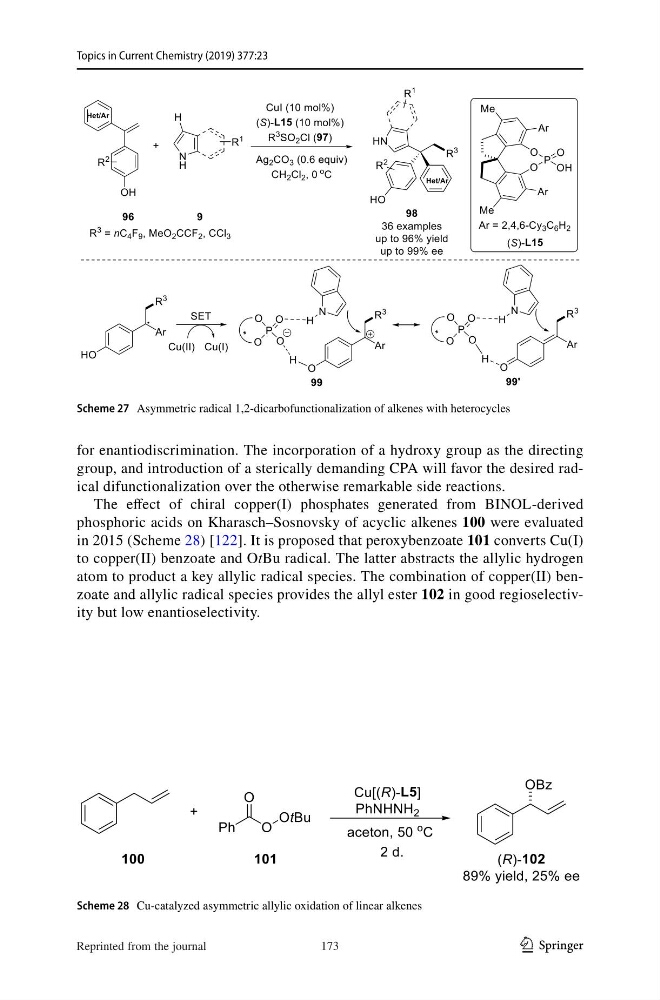
for enantiodiscrimination. The incorporation of a hydroxy group as the directing
group, and introduction of a sterically demanding CPA will favor the desired radical difunctionalization over the otherwise remarkable side reactions.
The effect of chiral copper(I) phosphates generated from BINOL-derived
phosphoric acids on Kharasch–Sosnovsky of acyclic alkenes 100 were evaluated
in 2015 (Scheme 28) [122]. It is proposed that peroxybenzoate 101 converts Cu(I)
to copper(II) benzoate and OtBu radical. The latter abstracts the allylic hydrogen
atom to product a key allylic radical species. The combination of copper(II) benzoate and allylic radical species provides the allyl ester 102 in good regioselectivity but low enantioselectivity.
Scheme 27 Asymmetric radical 1,2-dicarbofunctionalization of alkenes with heterocycles
Scheme 28 Cu-catalyzed asymmetric allylic oxidation of linear alkenes
Reprinted from the journal
173
Topics in Current Chemistry (2019) 377:23
for enantiodiscrimination. The incorporation of a hydroxy group as the directing
group, and introduction of a sterically demanding CPA will favor the desired radical difunctionalization over the otherwise remarkable side reactions.
The effect of chiral copper(I) phosphates generated from BINOL-derived
phosphoric acids on Kharasch–Sosnovsky of acyclic alkenes 100 were evaluated
in 2015 (Scheme 28) [122]. It is proposed that peroxybenzoate 101 converts Cu(I)
to copper(II) benzoate and OtBu radical. The latter abstracts the allylic hydrogen
atom to product a key allylic radical species. The combination of copper(II) benzoate and allylic radical species provides the allyl ester 102 in good regioselectivity but low enantioselectivity.
Scheme 27 Asymmetric radical 1,2-dicarbofunctionalization of alkenes with heterocycles
Scheme 28 Cu-catalyzed asymmetric allylic oxidation of linear alkenes
Reprinted from the journal
173