

Topics in Current Chemistry (2019) 377:23
1 3
expected chiral pyrrolidines with good yields and enantioselectivities [118].
Aryldiazonium salts with methylsulfonyl and nitro group at phenyl moiety were
used as the aryl radical precursor. Very recently, a variant of enantioselective
radical aminosilylation with alkene 82 with (TMS) 3 SiH was developed by Liu’s
group using Cu(I)/CPA cooperative catalysis [119].
Liu’s group revealed that alcohols are also appropriate for asymmetric radical
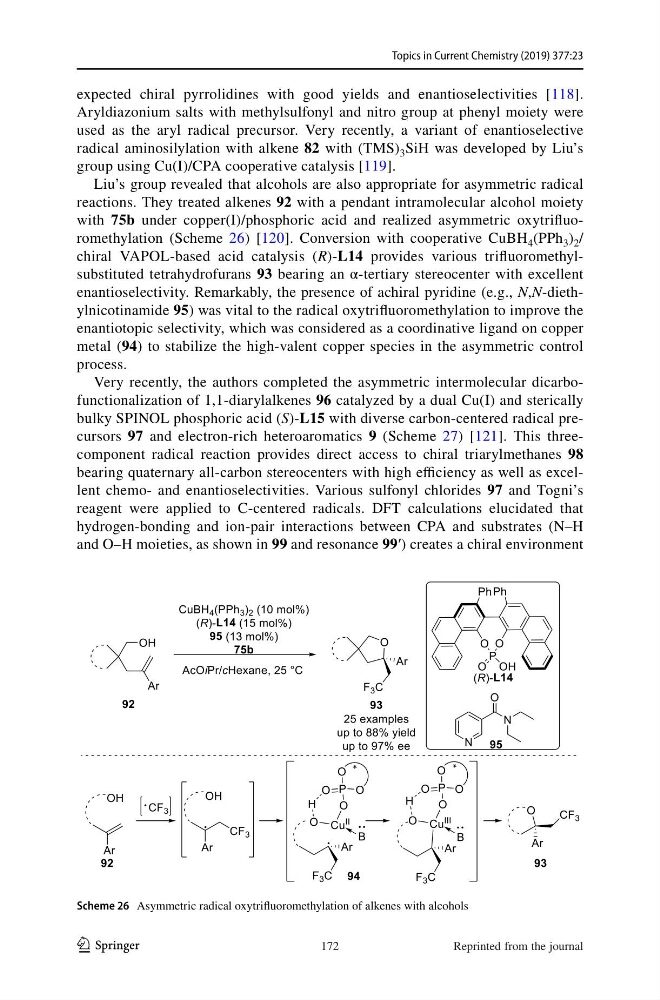
reactions. They treated alkenes 92 with a pendant intramolecular alcohol moiety
with 75b under copper(I)/phosphoric acid and realized asymmetric oxytrifluoromethylation (Scheme 26) [120]. Conversion with cooperative CuBH 4 (PPh 3 ) 2 /
chiral VAPOL-based acid catalysis (R)-L14 provides various trifluoromethylsubstituted tetrahydrofurans 93 bearing an α-tertiary stereocenter with excellent
enantioselectivity. Remarkably, the presence of achiral pyridine (e.g., N,N-diethylnicotinamide 95) was vital to the radical oxytrifluoromethylation to improve the
enantiotopic selectivity, which was considered as a coordinative ligand on copper
metal (94) to stabilize the high-valent copper species in the asymmetric control
process.
Very recently, the authors completed the asymmetric intermolecular dicarbofunctionalization of 1,1-diarylalkenes 96 catalyzed by a dual Cu(I) and sterically
bulky SPINOL phosphoric acid (S)-L15 with diverse carbon-centered radical precursors 97 and electron-rich heteroaromatics 9 (Scheme 27) [121]. This threecomponent radical reaction provides direct access to chiral triarylmethanes 98
bearing quaternary all-carbon stereocenters with high efficiency as well as excellent chemo- and enantioselectivities. Various sulfonyl chlorides 97 and Togni’s
reagent were applied to C-centered radicals. DFT calculations elucidated that
hydrogen-bonding and ion-pair interactions between CPA and substrates (N–H
and O–H moieties, as shown in 99 and resonance 99′) creates a chiral environment
Scheme 26 Asymmetric radical oxytrifluoromethylation of alkenes with alcohols
Reprinted from the journal
172
1 3
expected chiral pyrrolidines with good yields and enantioselectivities [118].
Aryldiazonium salts with methylsulfonyl and nitro group at phenyl moiety were
used as the aryl radical precursor. Very recently, a variant of enantioselective
radical aminosilylation with alkene 82 with (TMS) 3 SiH was developed by Liu’s
group using Cu(I)/CPA cooperative catalysis [119].
Liu’s group revealed that alcohols are also appropriate for asymmetric radical
reactions. They treated alkenes 92 with a pendant intramolecular alcohol moiety
with 75b under copper(I)/phosphoric acid and realized asymmetric oxytrifluoromethylation (Scheme 26) [120]. Conversion with cooperative CuBH 4 (PPh 3 ) 2 /
chiral VAPOL-based acid catalysis (R)-L14 provides various trifluoromethylsubstituted tetrahydrofurans 93 bearing an α-tertiary stereocenter with excellent
enantioselectivity. Remarkably, the presence of achiral pyridine (e.g., N,N-diethylnicotinamide 95) was vital to the radical oxytrifluoromethylation to improve the
enantiotopic selectivity, which was considered as a coordinative ligand on copper
metal (94) to stabilize the high-valent copper species in the asymmetric control
process.
Very recently, the authors completed the asymmetric intermolecular dicarbofunctionalization of 1,1-diarylalkenes 96 catalyzed by a dual Cu(I) and sterically
bulky SPINOL phosphoric acid (S)-L15 with diverse carbon-centered radical precursors 97 and electron-rich heteroaromatics 9 (Scheme 27) [121]. This threecomponent radical reaction provides direct access to chiral triarylmethanes 98
bearing quaternary all-carbon stereocenters with high efficiency as well as excellent chemo- and enantioselectivities. Various sulfonyl chlorides 97 and Togni’s
reagent were applied to C-centered radicals. DFT calculations elucidated that
hydrogen-bonding and ion-pair interactions between CPA and substrates (N–H
and O–H moieties, as shown in 99 and resonance 99′) creates a chiral environment
Scheme 26 Asymmetric radical oxytrifluoromethylation of alkenes with alcohols
Reprinted from the journal
172