

1 3
Topics in Current Chemistry (2019) 377:23
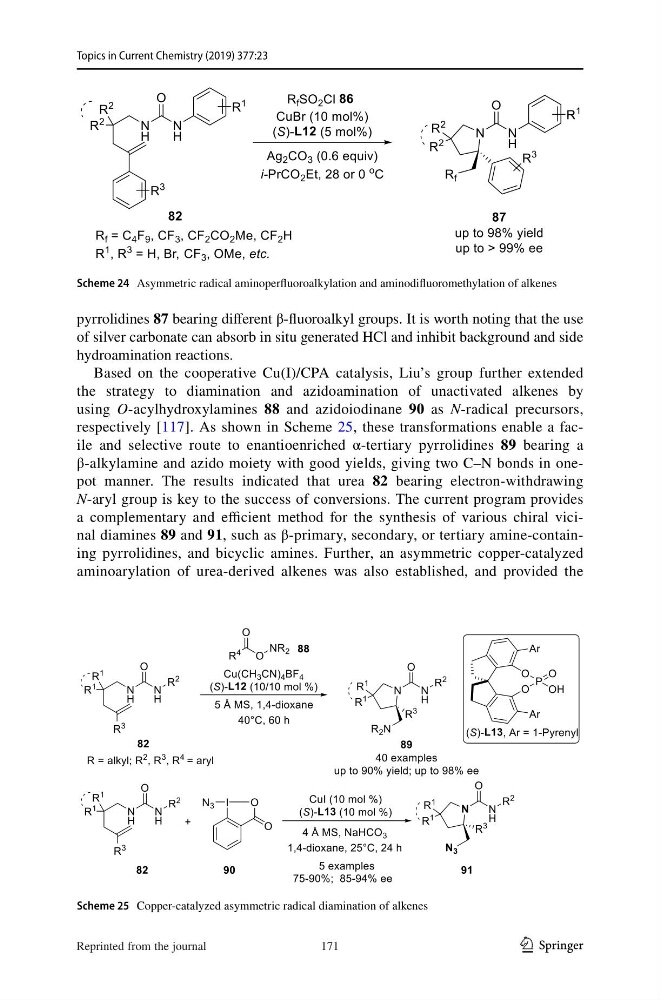
pyrrolidines 87 bearing different β-fluoroalkyl groups. It is worth noting that the use
of silver carbonate can absorb in situ generated HCl and inhibit background and side
hydroamination reactions.
Based on the cooperative Cu(I)/CPA catalysis, Liu’s group further extended
the strategy to diamination and azidoamination of unactivated alkenes by
using O-acylhydroxylamines 88 and azidoiodinane 90 as N-radical precursors,
respectively [117]. As shown in Scheme 25, these transformations enable a facile and selective route to enantioenriched α-tertiary pyrrolidines 89 bearing a
β-alkylamine and azido moiety with good yields, giving two C–N bonds in onepot manner. The results indicated that urea 82 bearing electron-withdrawing
N-aryl group is key to the success of conversions. The current program provides
a complementary and efficient method for the synthesis of various chiral vicinal diamines 89 and 91, such as β-primary, secondary, or tertiary amine-containing pyrrolidines, and bicyclic amines. Further, an asymmetric copper-catalyzed
aminoarylation of urea-derived alkenes was also established, and provided the
Scheme 24 Asymmetric radical aminoperfluoroalkylation and aminodifluoromethylation of alkenes
Scheme 25 Copper-catalyzed asymmetric radical diamination of alkenes
Reprinted from the journal
171
Topics in Current Chemistry (2019) 377:23
pyrrolidines 87 bearing different β-fluoroalkyl groups. It is worth noting that the use
of silver carbonate can absorb in situ generated HCl and inhibit background and side
hydroamination reactions.
Based on the cooperative Cu(I)/CPA catalysis, Liu’s group further extended
the strategy to diamination and azidoamination of unactivated alkenes by
using O-acylhydroxylamines 88 and azidoiodinane 90 as N-radical precursors,
respectively [117]. As shown in Scheme 25, these transformations enable a facile and selective route to enantioenriched α-tertiary pyrrolidines 89 bearing a
β-alkylamine and azido moiety with good yields, giving two C–N bonds in onepot manner. The results indicated that urea 82 bearing electron-withdrawing
N-aryl group is key to the success of conversions. The current program provides
a complementary and efficient method for the synthesis of various chiral vicinal diamines 89 and 91, such as β-primary, secondary, or tertiary amine-containing pyrrolidines, and bicyclic amines. Further, an asymmetric copper-catalyzed
aminoarylation of urea-derived alkenes was also established, and provided the
Scheme 24 Asymmetric radical aminoperfluoroalkylation and aminodifluoromethylation of alkenes
Scheme 25 Copper-catalyzed asymmetric radical diamination of alkenes
Reprinted from the journal
171