

Topics in Current Chemistry (2019) 377:23
1 3
trifluoromethylated indole compounds 81 in moderate to good yields and enantioselectivities (up to 86% ee).
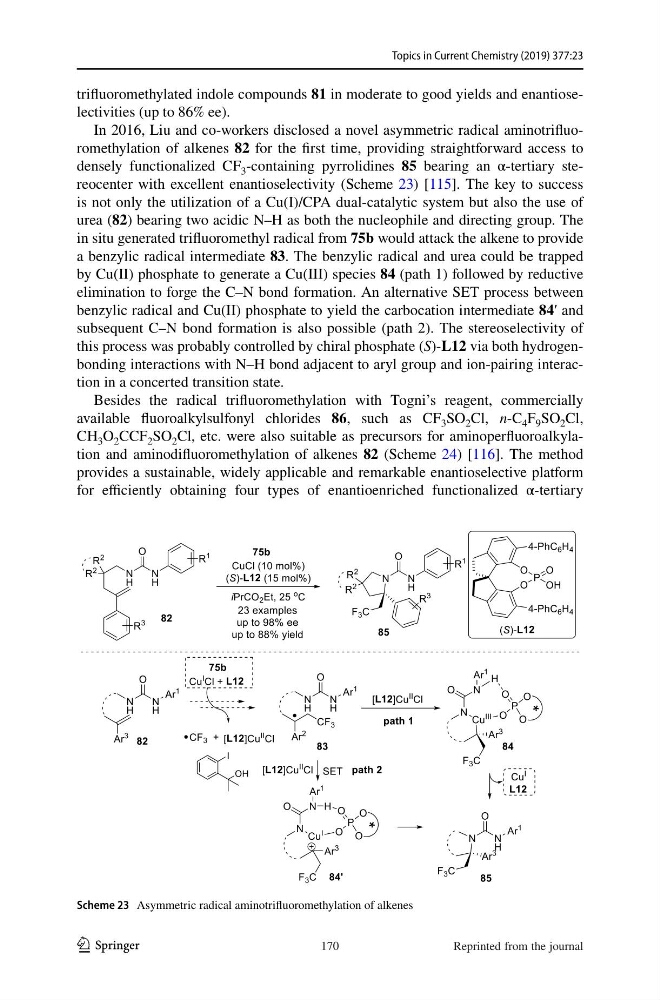
In 2016, Liu and co-workers disclosed a novel asymmetric radical aminotrifluoromethylation of alkenes 82 for the first time, providing straightforward access to
densely functionalized CF 3 -containing pyrrolidines 85 bearing an α-tertiary stereocenter with excellent enantioselectivity (Scheme 23) [115]. The key to success
is not only the utilization of a Cu(I)/CPA dual-catalytic system but also the use of
urea (82) bearing two acidic N–H as both the nucleophile and directing group. The
in situ generated trifluoromethyl radical from 75b would attack the alkene to provide
a benzylic radical intermediate 83. The benzylic radical and urea could be trapped
by Cu(II) phosphate to generate a Cu(III) species 84 (path 1) followed by reductive
elimination to forge the C–N bond formation. An alternative SET process between
benzylic radical and Cu(II) phosphate to yield the carbocation intermediate 84′ and
subsequent C–N bond formation is also possible (path 2). The stereoselectivity of
this process was probably controlled by chiral phosphate (S)-L12 via both hydrogenbonding interactions with N–H bond adjacent to aryl group and ion-pairing interaction in a concerted transition state.
Besides the radical trifluoromethylation with Togni’s reagent, commercially
available fluoroalkylsulfonyl chlorides 86, such as CF 3 SO 2 Cl, n-C 4 F 9 SO 2 Cl,
CH 3 O 2 CCF 2 SO 2 Cl, etc. were also suitable as precursors for aminoperfluoroalkylation and aminodifluoromethylation of alkenes 82 (Scheme 24) [116]. The method
provides a sustainable, widely applicable and remarkable enantioselective platform
for efficiently obtaining four types of enantioenriched functionalized α-tertiary
Scheme 23 Asymmetric radical aminotrifluoromethylation of alkenes
Reprinted from the journal
170
1 3
trifluoromethylated indole compounds 81 in moderate to good yields and enantioselectivities (up to 86% ee).
In 2016, Liu and co-workers disclosed a novel asymmetric radical aminotrifluoromethylation of alkenes 82 for the first time, providing straightforward access to
densely functionalized CF 3 -containing pyrrolidines 85 bearing an α-tertiary stereocenter with excellent enantioselectivity (Scheme 23) [115]. The key to success
is not only the utilization of a Cu(I)/CPA dual-catalytic system but also the use of
urea (82) bearing two acidic N–H as both the nucleophile and directing group. The
in situ generated trifluoromethyl radical from 75b would attack the alkene to provide
a benzylic radical intermediate 83. The benzylic radical and urea could be trapped
by Cu(II) phosphate to generate a Cu(III) species 84 (path 1) followed by reductive
elimination to forge the C–N bond formation. An alternative SET process between
benzylic radical and Cu(II) phosphate to yield the carbocation intermediate 84′ and
subsequent C–N bond formation is also possible (path 2). The stereoselectivity of
this process was probably controlled by chiral phosphate (S)-L12 via both hydrogenbonding interactions with N–H bond adjacent to aryl group and ion-pairing interaction in a concerted transition state.
Besides the radical trifluoromethylation with Togni’s reagent, commercially
available fluoroalkylsulfonyl chlorides 86, such as CF 3 SO 2 Cl, n-C 4 F 9 SO 2 Cl,
CH 3 O 2 CCF 2 SO 2 Cl, etc. were also suitable as precursors for aminoperfluoroalkylation and aminodifluoromethylation of alkenes 82 (Scheme 24) [116]. The method
provides a sustainable, widely applicable and remarkable enantioselective platform
for efficiently obtaining four types of enantioenriched functionalized α-tertiary
Scheme 23 Asymmetric radical aminotrifluoromethylation of alkenes
Reprinted from the journal
170