

1 3
Topics in Current Chemistry (2019) 377:23
combines copper and CPA to handle these intrinsically reactive species and further
capture different nucleophiles to create new bonds [113]. In 2014, they reported
the first example of highly enantioselective radical trifluoromethylation of alkenes
which uses a dual copper(I)/CPA catalytic system for simultaneous installation of
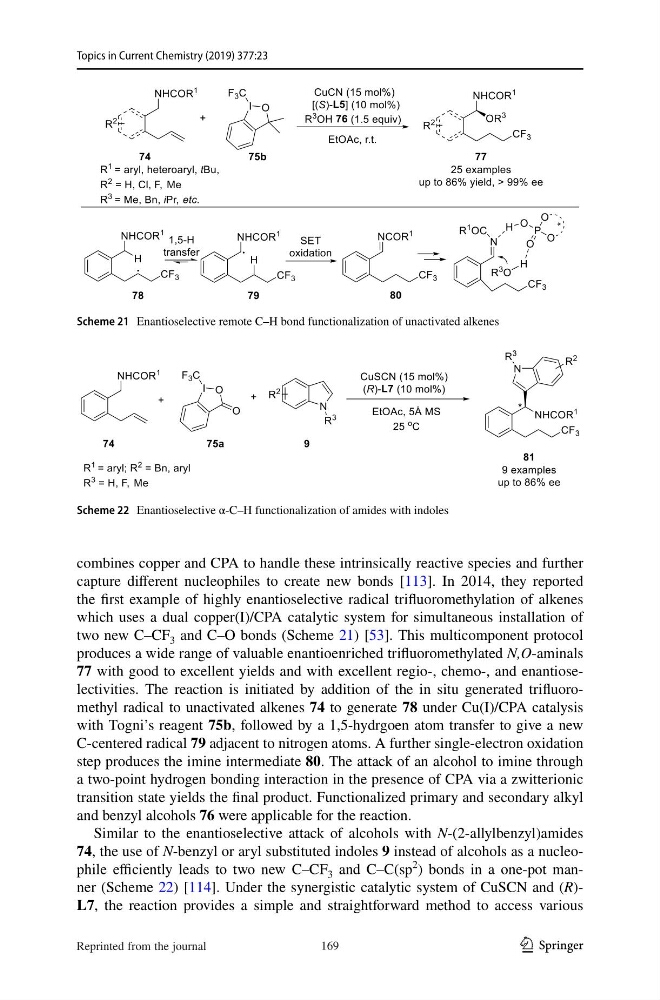
two new C–CF 3 and C–O bonds (Scheme 21) [53]. This multicomponent protocol
produces a wide range of valuable enantioenriched trifluoromethylated N,O-aminals
77 with good to excellent yields and with excellent regio-, chemo-, and enantioselectivities. The reaction is initiated by addition of the in situ generated trifluoromethyl radical to unactivated alkenes 74 to generate 78 under Cu(I)/CPA catalysis
with Togni’s reagent 75b, followed by a 1,5-hydrgoen atom transfer to give a new
C-centered radical 79 adjacent to nitrogen atoms. A further single-electron oxidation
step produces the imine intermediate 80. The attack of an alcohol to imine through
a two-point hydrogen bonding interaction in the presence of CPA via a zwitterionic
transition state yields the final product. Functionalized primary and secondary alkyl
and benzyl alcohols 76 were applicable for the reaction.
Similar to the enantioselective attack of alcohols with N-(2-allylbenzyl)amides
74, the use of N-benzyl or aryl substituted indoles 9 instead of alcohols as a nucleophile efficiently leads to two new C–CF 3 and C–C(sp
2
) bonds in a one-pot manner (Scheme 22) [114]. Under the synergistic catalytic system of CuSCN and (R)L7, the reaction provides a simple and straightforward method to access various
Scheme 21 Enantioselective remote C–H bond functionalization of unactivated alkenes
Scheme 22 Enantioselective α-C–H functionalization of amides with indoles
Reprinted from the journal
169
Topics in Current Chemistry (2019) 377:23
combines copper and CPA to handle these intrinsically reactive species and further
capture different nucleophiles to create new bonds [113]. In 2014, they reported
the first example of highly enantioselective radical trifluoromethylation of alkenes
which uses a dual copper(I)/CPA catalytic system for simultaneous installation of
two new C–CF 3 and C–O bonds (Scheme 21) [53]. This multicomponent protocol
produces a wide range of valuable enantioenriched trifluoromethylated N,O-aminals
77 with good to excellent yields and with excellent regio-, chemo-, and enantioselectivities. The reaction is initiated by addition of the in situ generated trifluoromethyl radical to unactivated alkenes 74 to generate 78 under Cu(I)/CPA catalysis
with Togni’s reagent 75b, followed by a 1,5-hydrgoen atom transfer to give a new
C-centered radical 79 adjacent to nitrogen atoms. A further single-electron oxidation
step produces the imine intermediate 80. The attack of an alcohol to imine through
a two-point hydrogen bonding interaction in the presence of CPA via a zwitterionic
transition state yields the final product. Functionalized primary and secondary alkyl
and benzyl alcohols 76 were applicable for the reaction.
Similar to the enantioselective attack of alcohols with N-(2-allylbenzyl)amides
74, the use of N-benzyl or aryl substituted indoles 9 instead of alcohols as a nucleophile efficiently leads to two new C–CF 3 and C–C(sp
2
) bonds in a one-pot manner (Scheme 22) [114]. Under the synergistic catalytic system of CuSCN and (R)L7, the reaction provides a simple and straightforward method to access various
Scheme 21 Enantioselective remote C–H bond functionalization of unactivated alkenes
Scheme 22 Enantioselective α-C–H functionalization of amides with indoles
Reprinted from the journal
169