

Topics in Current Chemistry (2019) 377:23
1 3
4.3 Radical‑Involved Transformations
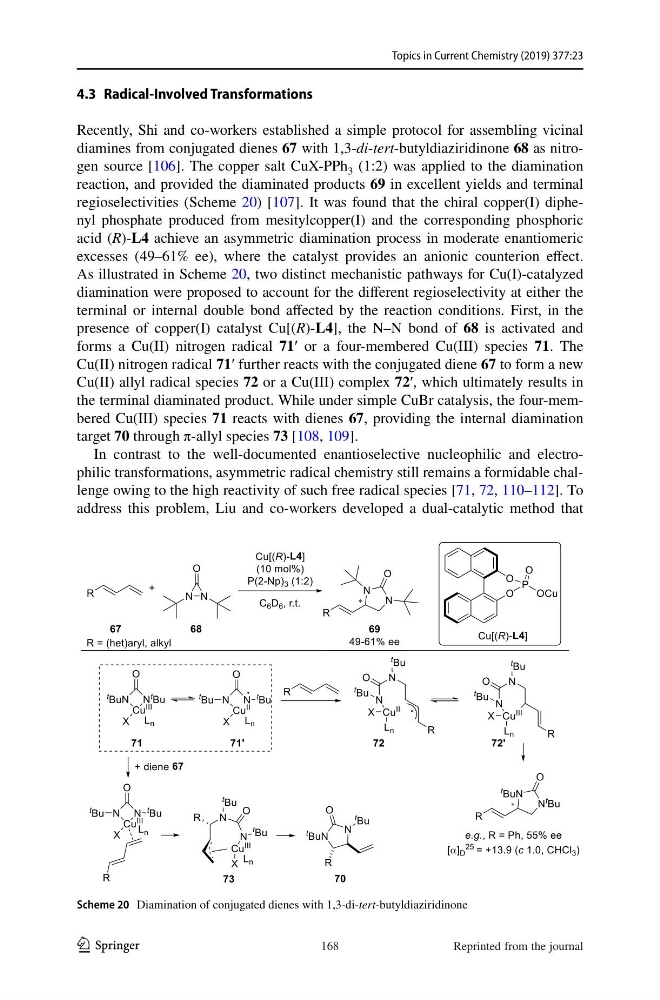
Recently, Shi and co-workers established a simple protocol for assembling vicinal
diamines from conjugated dienes 67 with 1,3-di-tert-butyldiaziridinone 68 as nitrogen source [106]. The copper salt CuX-PPh 3 (1:2) was applied to the diamination
reaction, and provided the diaminated products 69 in excellent yields and terminal
regioselectivities (Scheme 20) [107]. It was found that the chiral copper(I) diphenyl phosphate produced from mesitylcopper(I) and the corresponding phosphoric
acid (R)-L4 achieve an asymmetric diamination process in moderate enantiomeric
excesses (49–61% ee), where the catalyst provides an anionic counterion effect.
As illustrated in Scheme 20, two distinct mechanistic pathways for Cu(I)-catalyzed
diamination were proposed to account for the different regioselectivity at either the
terminal or internal double bond affected by the reaction conditions. First, in the
presence of copper(I) catalyst Cu[(R)-L4], the N–N bond of 68 is activated and
forms a Cu(II) nitrogen radical 71′ or a four-membered Cu(III) species 71. The
Cu(II) nitrogen radical 71′ further reacts with the conjugated diene 67 to form a new
Cu(II) allyl radical species 72 or a Cu(III) complex 72′, which ultimately results in
the terminal diaminated product. While under simple CuBr catalysis, the four-membered Cu(III) species 71 reacts with dienes 67, providing the internal diamination
target 70 through π-allyl species 73 [108, 109].
In contrast to the well-documented enantioselective nucleophilic and electrophilic transformations, asymmetric radical chemistry still remains a formidable challenge owing to the high reactivity of such free radical species [71, 72, 110–112]. To
address this problem, Liu and co-workers developed a dual-catalytic method that
Scheme 20 Diamination of conjugated dienes with 1,3-di-tert-butyldiaziridinone
Reprinted from the journal
168
1 3
4.3 Radical‑Involved Transformations
Recently, Shi and co-workers established a simple protocol for assembling vicinal
diamines from conjugated dienes 67 with 1,3-di-tert-butyldiaziridinone 68 as nitrogen source [106]. The copper salt CuX-PPh 3 (1:2) was applied to the diamination
reaction, and provided the diaminated products 69 in excellent yields and terminal
regioselectivities (Scheme 20) [107]. It was found that the chiral copper(I) diphenyl phosphate produced from mesitylcopper(I) and the corresponding phosphoric
acid (R)-L4 achieve an asymmetric diamination process in moderate enantiomeric
excesses (49–61% ee), where the catalyst provides an anionic counterion effect.
As illustrated in Scheme 20, two distinct mechanistic pathways for Cu(I)-catalyzed
diamination were proposed to account for the different regioselectivity at either the
terminal or internal double bond affected by the reaction conditions. First, in the
presence of copper(I) catalyst Cu[(R)-L4], the N–N bond of 68 is activated and
forms a Cu(II) nitrogen radical 71′ or a four-membered Cu(III) species 71. The
Cu(II) nitrogen radical 71′ further reacts with the conjugated diene 67 to form a new
Cu(II) allyl radical species 72 or a Cu(III) complex 72′, which ultimately results in
the terminal diaminated product. While under simple CuBr catalysis, the four-membered Cu(III) species 71 reacts with dienes 67, providing the internal diamination
target 70 through π-allyl species 73 [108, 109].
In contrast to the well-documented enantioselective nucleophilic and electrophilic transformations, asymmetric radical chemistry still remains a formidable challenge owing to the high reactivity of such free radical species [71, 72, 110–112]. To
address this problem, Liu and co-workers developed a dual-catalytic method that
Scheme 20 Diamination of conjugated dienes with 1,3-di-tert-butyldiaziridinone
Reprinted from the journal
168