

1 3
Topics in Current Chemistry (2019) 377:23
by sequential intramolecular cyclization and asymmetric transfer hydrogenation.
This strategy furnishes an enantioselective synthesis of multisubstituted isochromenes 61 containing various substituents in high yields with good-to-excellent
enantioselectivities.
4.2 Conjugate Additions
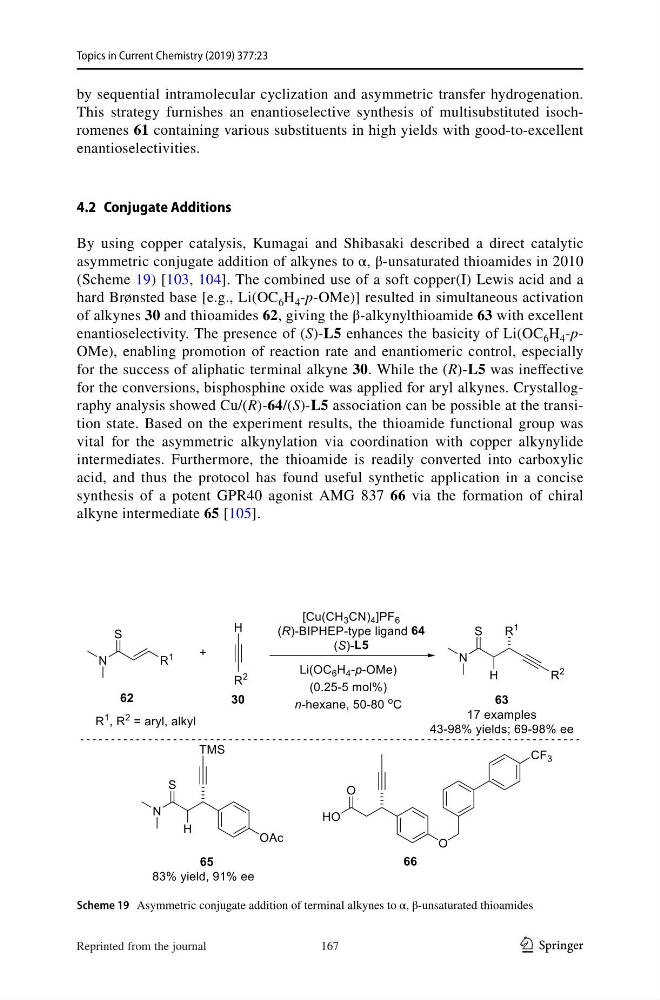
By using copper catalysis, Kumagai and Shibasaki described a direct catalytic
asymmetric conjugate addition of alkynes to α, β-unsaturated thioamides in 2010
(Scheme 19) [103, 104]. The combined use of a soft copper(I) Lewis acid and a
hard Brønsted base [e.g., Li(OC 6 H 4 -p-OMe)] resulted in simultaneous activation
of alkynes 30 and thioamides 62, giving the β-alkynylthioamide 63 with excellent
enantioselectivity. The presence of (S)-L5 enhances the basicity of Li(OC 6 H 4 -pOMe), enabling promotion of reaction rate and enantiomeric control, especially
for the success of aliphatic terminal alkyne 30. While the (R)-L5 was ineffective
for the conversions, bisphosphine oxide was applied for aryl alkynes. Crystallography analysis showed Cu/(R)-64/(S)-L5 association can be possible at the transition state. Based on the experiment results, the thioamide functional group was
vital for the asymmetric alkynylation via coordination with copper alkynylide
intermediates. Furthermore, the thioamide is readily converted into carboxylic
acid, and thus the protocol has found useful synthetic application in a concise
synthesis of a potent GPR40 agonist AMG 837 66 via the formation of chiral
alkyne intermediate 65 [105].
Scheme 19 Asymmetric conjugate addition of terminal alkynes to α, β-unsaturated thioamides
Reprinted from the journal
167
Topics in Current Chemistry (2019) 377:23
by sequential intramolecular cyclization and asymmetric transfer hydrogenation.
This strategy furnishes an enantioselective synthesis of multisubstituted isochromenes 61 containing various substituents in high yields with good-to-excellent
enantioselectivities.
4.2 Conjugate Additions
By using copper catalysis, Kumagai and Shibasaki described a direct catalytic
asymmetric conjugate addition of alkynes to α, β-unsaturated thioamides in 2010
(Scheme 19) [103, 104]. The combined use of a soft copper(I) Lewis acid and a
hard Brønsted base [e.g., Li(OC 6 H 4 -p-OMe)] resulted in simultaneous activation
of alkynes 30 and thioamides 62, giving the β-alkynylthioamide 63 with excellent
enantioselectivity. The presence of (S)-L5 enhances the basicity of Li(OC 6 H 4 -pOMe), enabling promotion of reaction rate and enantiomeric control, especially
for the success of aliphatic terminal alkyne 30. While the (R)-L5 was ineffective
for the conversions, bisphosphine oxide was applied for aryl alkynes. Crystallography analysis showed Cu/(R)-64/(S)-L5 association can be possible at the transition state. Based on the experiment results, the thioamide functional group was
vital for the asymmetric alkynylation via coordination with copper alkynylide
intermediates. Furthermore, the thioamide is readily converted into carboxylic
acid, and thus the protocol has found useful synthetic application in a concise
synthesis of a potent GPR40 agonist AMG 837 66 via the formation of chiral
alkyne intermediate 65 [105].
Scheme 19 Asymmetric conjugate addition of terminal alkynes to α, β-unsaturated thioamides
Reprinted from the journal
167