

Topics in Current Chemistry (2019) 377:23
1 3
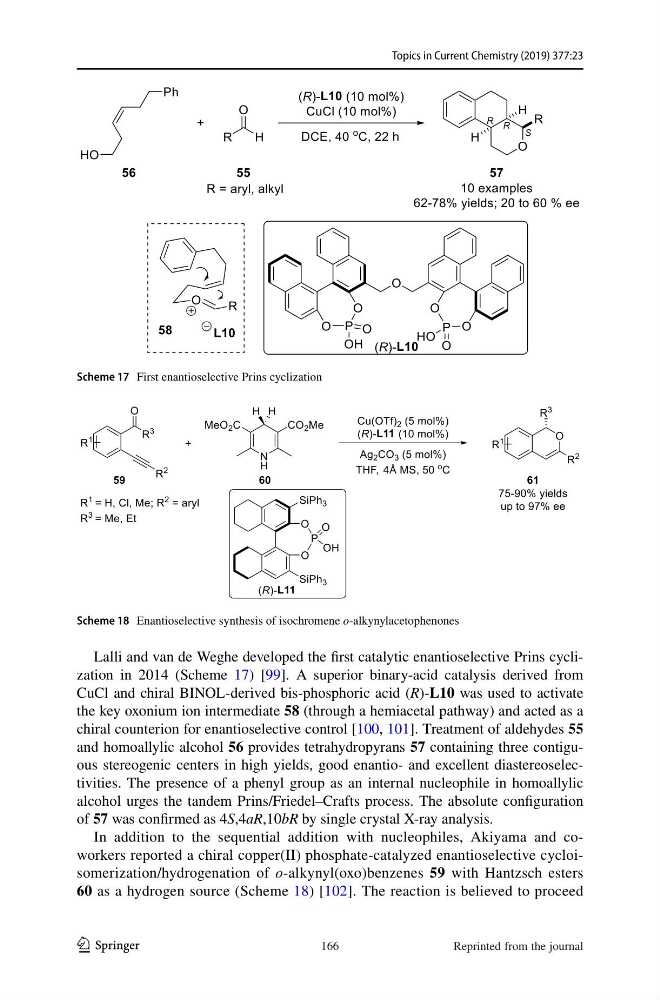
Lalli and van de Weghe developed the first catalytic enantioselective Prins cyclization in 2014 (Scheme 17) [99]. A superior binary-acid catalysis derived from
CuCl and chiral BINOL-derived bis-phosphoric acid (R)-L10 was used to activate
the key oxonium ion intermediate 58 (through a hemiacetal pathway) and acted as a
chiral counterion for enantioselective control [100, 101]. Treatment of aldehydes 55
and homoallylic alcohol 56 provides tetrahydropyrans 57 containing three contiguous stereogenic centers in high yields, good enantio- and excellent diastereoselectivities. The presence of a phenyl group as an internal nucleophile in homoallylic
alcohol urges the tandem Prins/Friedel–Crafts process. The absolute configuration
of 57 was confirmed as 4S,4aR,10bR by single crystal X-ray analysis.
In addition to the sequential addition with nucleophiles, Akiyama and coworkers reported a chiral copper(II) phosphate-catalyzed enantioselective cycloisomerization/hydrogenation of o-alkynyl(oxo)benzenes 59 with Hantzsch esters
60 as a hydrogen source (Scheme 18) [102]. The reaction is believed to proceed
Scheme 17 First enantioselective Prins cyclization
Scheme 18 Enantioselective synthesis of isochromene o-alkynylacetophenones
Reprinted from the journal
166
1 3
Lalli and van de Weghe developed the first catalytic enantioselective Prins cyclization in 2014 (Scheme 17) [99]. A superior binary-acid catalysis derived from
CuCl and chiral BINOL-derived bis-phosphoric acid (R)-L10 was used to activate
the key oxonium ion intermediate 58 (through a hemiacetal pathway) and acted as a
chiral counterion for enantioselective control [100, 101]. Treatment of aldehydes 55
and homoallylic alcohol 56 provides tetrahydropyrans 57 containing three contiguous stereogenic centers in high yields, good enantio- and excellent diastereoselectivities. The presence of a phenyl group as an internal nucleophile in homoallylic
alcohol urges the tandem Prins/Friedel–Crafts process. The absolute configuration
of 57 was confirmed as 4S,4aR,10bR by single crystal X-ray analysis.
In addition to the sequential addition with nucleophiles, Akiyama and coworkers reported a chiral copper(II) phosphate-catalyzed enantioselective cycloisomerization/hydrogenation of o-alkynyl(oxo)benzenes 59 with Hantzsch esters
60 as a hydrogen source (Scheme 18) [102]. The reaction is believed to proceed
Scheme 17 First enantioselective Prins cyclization
Scheme 18 Enantioselective synthesis of isochromene o-alkynylacetophenones
Reprinted from the journal
166