

Topics in Current Chemistry (2019) 377:23
1 3
bounded naphthoxyl radical 23 followed by an intramolecular coupling afforded the
expected polycyclic hemiacetal product 22.
3.2 Enantioselective Reductions
Recently, non-noble metal catalysts for the homogeneous hydrogenation of simple
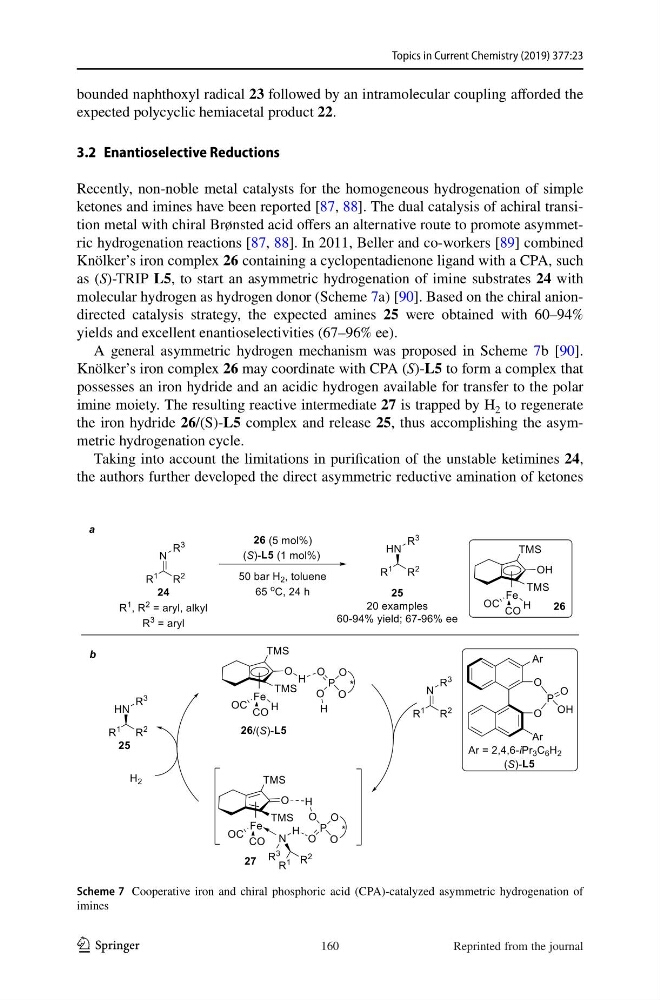
ketones and imines have been reported [87, 88]. The dual catalysis of achiral transition metal with chiral Brønsted acid offers an alternative route to promote asymmetric hydrogenation reactions [87, 88]. In 2011, Beller and co-workers [89] combined
Knölker’s iron complex 26 containing a cyclopentadienone ligand with a CPA, such
as (S)-TRIP L5, to start an asymmetric hydrogenation of imine substrates 24 with
molecular hydrogen as hydrogen donor (Scheme 7a) [90]. Based on the chiral aniondirected catalysis strategy, the expected amines 25 were obtained with 60–94%
yields and excellent enantioselectivities (67–96% ee).
A general asymmetric hydrogen mechanism was proposed in Scheme 7b [90].
Knölker’s iron complex 26 may coordinate with CPA (S)-L5 to form a complex that
possesses an iron hydride and an acidic hydrogen available for transfer to the polar
imine moiety. The resulting reactive intermediate 27 is trapped by H 2 to regenerate
the iron hydride 26/(S)-L5 complex and release 25, thus accomplishing the asymmetric hydrogenation cycle.
Taking into account the limitations in purification of the unstable ketimines 24,
the authors further developed the direct asymmetric reductive amination of ketones
Scheme 7 Cooperative iron and chiral phosphoric acid (CPA)-catalyzed asymmetric hydrogenation of
imines
Reprinted from the journal
160
1 3
bounded naphthoxyl radical 23 followed by an intramolecular coupling afforded the
expected polycyclic hemiacetal product 22.
3.2 Enantioselective Reductions
Recently, non-noble metal catalysts for the homogeneous hydrogenation of simple
ketones and imines have been reported [87, 88]. The dual catalysis of achiral transition metal with chiral Brønsted acid offers an alternative route to promote asymmetric hydrogenation reactions [87, 88]. In 2011, Beller and co-workers [89] combined
Knölker’s iron complex 26 containing a cyclopentadienone ligand with a CPA, such
as (S)-TRIP L5, to start an asymmetric hydrogenation of imine substrates 24 with
molecular hydrogen as hydrogen donor (Scheme 7a) [90]. Based on the chiral aniondirected catalysis strategy, the expected amines 25 were obtained with 60–94%
yields and excellent enantioselectivities (67–96% ee).
A general asymmetric hydrogen mechanism was proposed in Scheme 7b [90].
Knölker’s iron complex 26 may coordinate with CPA (S)-L5 to form a complex that
possesses an iron hydride and an acidic hydrogen available for transfer to the polar
imine moiety. The resulting reactive intermediate 27 is trapped by H 2 to regenerate
the iron hydride 26/(S)-L5 complex and release 25, thus accomplishing the asymmetric hydrogenation cycle.
Taking into account the limitations in purification of the unstable ketimines 24,
the authors further developed the direct asymmetric reductive amination of ketones
Scheme 7 Cooperative iron and chiral phosphoric acid (CPA)-catalyzed asymmetric hydrogenation of
imines
Reprinted from the journal
160