

1 3
Topics in Current Chemistry (2019) 377:23
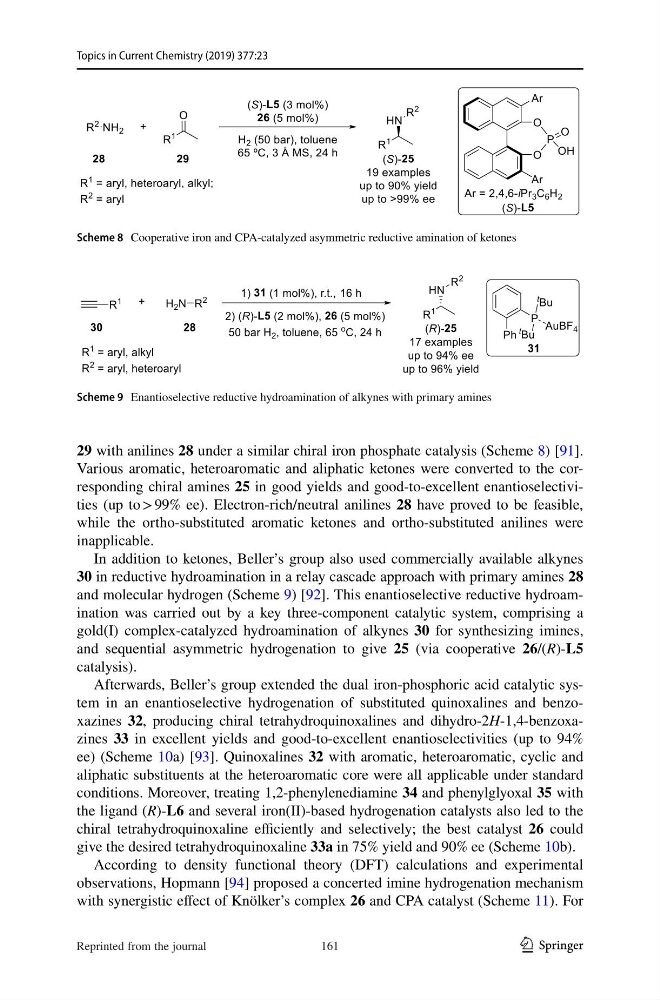
29 with anilines 28 under a similar chiral iron phosphate catalysis (Scheme 8) [91].
Various aromatic, heteroaromatic and aliphatic ketones were converted to the corresponding chiral amines 25 in good yields and good-to-excellent enantioselectivities (up to > 99% ee). Electron-rich/neutral anilines 28 have proved to be feasible,
while the ortho-substituted aromatic ketones and ortho-substituted anilines were
inapplicable.
In addition to ketones, Beller’s group also used commercially available alkynes
30 in reductive hydroamination in a relay cascade approach with primary amines 28
and molecular hydrogen (Scheme 9) [92]. This enantioselective reductive hydroamination was carried out by a key three-component catalytic system, comprising a
gold(I) complex-catalyzed hydroamination of alkynes 30 for synthesizing imines,
and sequential asymmetric hydrogenation to give 25 (via cooperative 26/(R)-L5
catalysis).
Afterwards, Beller’s group extended the dual iron-phosphoric acid catalytic system in an enantioselective hydrogenation of substituted quinoxalines and benzoxazines 32, producing chiral tetrahydroquinoxalines and dihydro-2H-1,4-benzoxazines 33 in excellent yields and good-to-excellent enantioselectivities (up to 94%
ee) (Scheme 10a) [93]. Quinoxalines 32 with aromatic, heteroaromatic, cyclic and
aliphatic substituents at the heteroaromatic core were all applicable under standard
conditions. Moreover, treating 1,2-phenylenediamine 34 and phenylglyoxal 35 with
the ligand (R)-L6 and several iron(II)-based hydrogenation catalysts also led to the
chiral tetrahydroquinoxaline efficiently and selectively; the best catalyst 26 could
give the desired tetrahydroquinoxaline 33a in 75% yield and 90% ee (Scheme 10b).
According to density functional theory (DFT) calculations and experimental
observations, Hopmann [94] proposed a concerted imine hydrogenation mechanism
with synergistic effect of Knölker’s complex 26 and CPA catalyst (Scheme 11). For
Scheme 8 Cooperative iron and CPA-catalyzed asymmetric reductive amination of ketones
Scheme 9 Enantioselective reductive hydroamination of alkynes with primary amines
Reprinted from the journal
161
Topics in Current Chemistry (2019) 377:23
29 with anilines 28 under a similar chiral iron phosphate catalysis (Scheme 8) [91].
Various aromatic, heteroaromatic and aliphatic ketones were converted to the corresponding chiral amines 25 in good yields and good-to-excellent enantioselectivities (up to > 99% ee). Electron-rich/neutral anilines 28 have proved to be feasible,
while the ortho-substituted aromatic ketones and ortho-substituted anilines were
inapplicable.
In addition to ketones, Beller’s group also used commercially available alkynes
30 in reductive hydroamination in a relay cascade approach with primary amines 28
and molecular hydrogen (Scheme 9) [92]. This enantioselective reductive hydroamination was carried out by a key three-component catalytic system, comprising a
gold(I) complex-catalyzed hydroamination of alkynes 30 for synthesizing imines,
and sequential asymmetric hydrogenation to give 25 (via cooperative 26/(R)-L5
catalysis).
Afterwards, Beller’s group extended the dual iron-phosphoric acid catalytic system in an enantioselective hydrogenation of substituted quinoxalines and benzoxazines 32, producing chiral tetrahydroquinoxalines and dihydro-2H-1,4-benzoxazines 33 in excellent yields and good-to-excellent enantioselectivities (up to 94%
ee) (Scheme 10a) [93]. Quinoxalines 32 with aromatic, heteroaromatic, cyclic and
aliphatic substituents at the heteroaromatic core were all applicable under standard
conditions. Moreover, treating 1,2-phenylenediamine 34 and phenylglyoxal 35 with
the ligand (R)-L6 and several iron(II)-based hydrogenation catalysts also led to the
chiral tetrahydroquinoxaline efficiently and selectively; the best catalyst 26 could
give the desired tetrahydroquinoxaline 33a in 75% yield and 90% ee (Scheme 10b).
According to density functional theory (DFT) calculations and experimental
observations, Hopmann [94] proposed a concerted imine hydrogenation mechanism
with synergistic effect of Knölker’s complex 26 and CPA catalyst (Scheme 11). For
Scheme 8 Cooperative iron and CPA-catalyzed asymmetric reductive amination of ketones
Scheme 9 Enantioselective reductive hydroamination of alkynes with primary amines
Reprinted from the journal
161