

Topics in Current Chemistry (2019) 377:23
1 3
3 Combination of Fe with CPAs
3.1 Enantioselective Oxidations
Inspired by the study of ACDC chemistry [29] and the Mn(III)–salen system, in
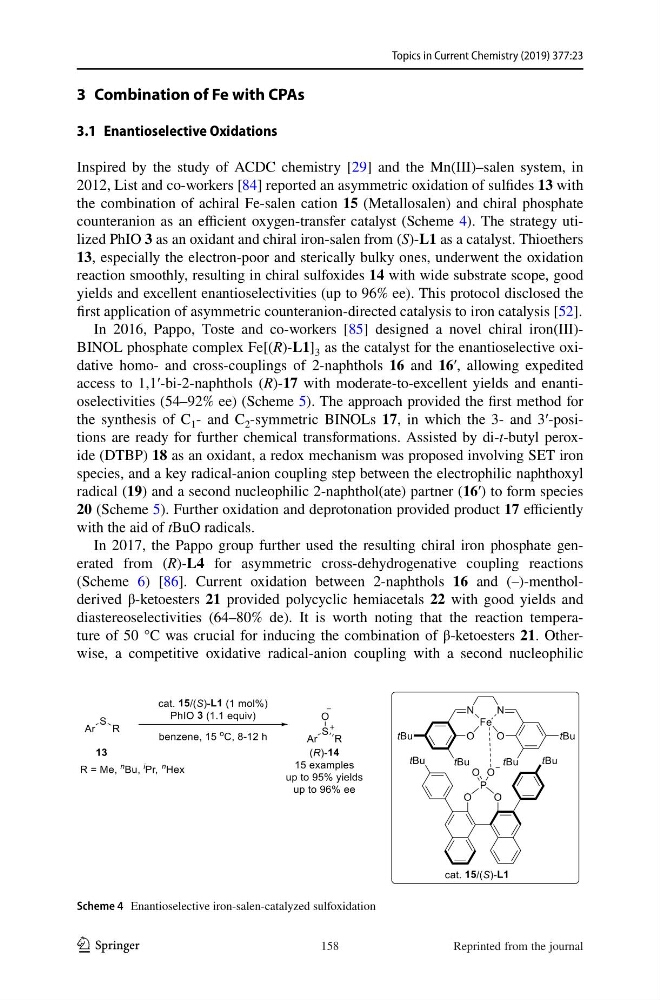
2012, List and co-workers [84] reported an asymmetric oxidation of sulfides 13 with
the combination of achiral Fe-salen cation 15 (Metallosalen) and chiral phosphate
counteranion as an efficient oxygen-transfer catalyst (Scheme 4). The strategy utilized PhIO 3 as an oxidant and chiral iron-salen from (S)-L1 as a catalyst. Thioethers
13, especially the electron-poor and sterically bulky ones, underwent the oxidation
reaction smoothly, resulting in chiral sulfoxides 14 with wide substrate scope, good
yields and excellent enantioselectivities (up to 96% ee). This protocol disclosed the
first application of asymmetric counteranion-directed catalysis to iron catalysis [52].
In 2016, Pappo, Toste and co-workers [85] designed a novel chiral iron(III)BINOL phosphate complex Fe[(R)-L1] 3 as the catalyst for the enantioselective oxidative homo- and cross-couplings of 2-naphthols 16 and 16′, allowing expedited
access to 1,1′-bi-2-naphthols (R)-17 with moderate-to-excellent yields and enantioselectivities (54–92% ee) (Scheme 5). The approach provided the first method for
the synthesis of C 1 - and C 2 -symmetric BINOLs 17, in which the 3- and 3′-positions are ready for further chemical transformations. Assisted by di-t-butyl peroxide (DTBP) 18 as an oxidant, a redox mechanism was proposed involving SET iron
species, and a key radical-anion coupling step between the electrophilic naphthoxyl
radical (19) and a second nucleophilic 2-naphthol(ate) partner (16′) to form species
20 (Scheme 5). Further oxidation and deprotonation provided product 17 efficiently
with the aid of tBuO radicals.
In 2017, the Pappo group further used the resulting chiral iron phosphate generated from (R)-L4 for asymmetric cross-dehydrogenative coupling reactions
(Scheme 6) [86]. Current oxidation between 2-naphthols 16 and (–)-mentholderived β-ketoesters 21 provided polycyclic hemiacetals 22 with good yields and
diastereoselectivities (64–80% de). It is worth noting that the reaction temperature of 50 °C was crucial for inducing the combination of β-ketoesters 21. Otherwise, a competitive oxidative radical-anion coupling with a second nucleophilic
Scheme 4 Enantioselective iron-salen-catalyzed sulfoxidation
Reprinted from the journal
158
1 3
3 Combination of Fe with CPAs
3.1 Enantioselective Oxidations
Inspired by the study of ACDC chemistry [29] and the Mn(III)–salen system, in
2012, List and co-workers [84] reported an asymmetric oxidation of sulfides 13 with
the combination of achiral Fe-salen cation 15 (Metallosalen) and chiral phosphate
counteranion as an efficient oxygen-transfer catalyst (Scheme 4). The strategy utilized PhIO 3 as an oxidant and chiral iron-salen from (S)-L1 as a catalyst. Thioethers
13, especially the electron-poor and sterically bulky ones, underwent the oxidation
reaction smoothly, resulting in chiral sulfoxides 14 with wide substrate scope, good
yields and excellent enantioselectivities (up to 96% ee). This protocol disclosed the
first application of asymmetric counteranion-directed catalysis to iron catalysis [52].
In 2016, Pappo, Toste and co-workers [85] designed a novel chiral iron(III)BINOL phosphate complex Fe[(R)-L1] 3 as the catalyst for the enantioselective oxidative homo- and cross-couplings of 2-naphthols 16 and 16′, allowing expedited
access to 1,1′-bi-2-naphthols (R)-17 with moderate-to-excellent yields and enantioselectivities (54–92% ee) (Scheme 5). The approach provided the first method for
the synthesis of C 1 - and C 2 -symmetric BINOLs 17, in which the 3- and 3′-positions are ready for further chemical transformations. Assisted by di-t-butyl peroxide (DTBP) 18 as an oxidant, a redox mechanism was proposed involving SET iron
species, and a key radical-anion coupling step between the electrophilic naphthoxyl
radical (19) and a second nucleophilic 2-naphthol(ate) partner (16′) to form species
20 (Scheme 5). Further oxidation and deprotonation provided product 17 efficiently
with the aid of tBuO radicals.
In 2017, the Pappo group further used the resulting chiral iron phosphate generated from (R)-L4 for asymmetric cross-dehydrogenative coupling reactions
(Scheme 6) [86]. Current oxidation between 2-naphthols 16 and (–)-mentholderived β-ketoesters 21 provided polycyclic hemiacetals 22 with good yields and
diastereoselectivities (64–80% de). It is worth noting that the reaction temperature of 50 °C was crucial for inducing the combination of β-ketoesters 21. Otherwise, a competitive oxidative radical-anion coupling with a second nucleophilic
Scheme 4 Enantioselective iron-salen-catalyzed sulfoxidation
Reprinted from the journal
158