

Topics in Current Chemistry (2019) 377:23
1 3
2 Combination of Mn with CPAs
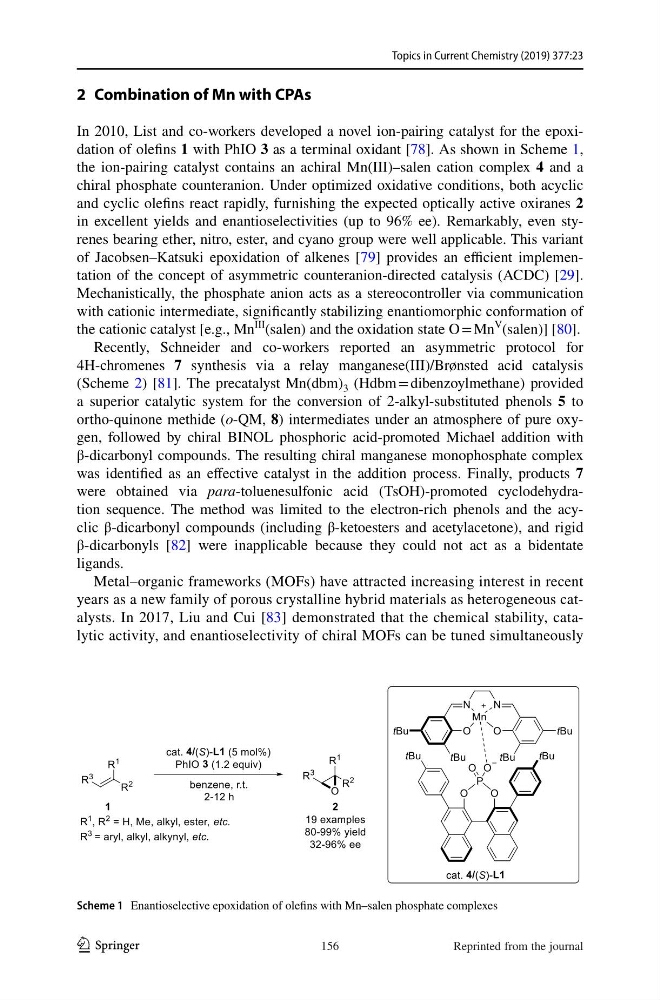
In 2010, List and co-workers developed a novel ion-pairing catalyst for the epoxidation of olefins 1 with PhIO 3 as a terminal oxidant [78]. As shown in Scheme 1,
the ion-pairing catalyst contains an achiral Mn(III)–salen cation complex 4 and a
chiral phosphate counteranion. Under optimized oxidative conditions, both acyclic
and cyclic olefins react rapidly, furnishing the expected optically active oxiranes 2
in excellent yields and enantioselectivities (up to 96% ee). Remarkably, even styrenes bearing ether, nitro, ester, and cyano group were well applicable. This variant
of Jacobsen–Katsuki epoxidation of alkenes [79] provides an efficient implementation of the concept of asymmetric counteranion-directed catalysis (ACDC) [29].
Mechanistically, the phosphate anion acts as a stereocontroller via communication
with cationic intermediate, significantly stabilizing enantiomorphic conformation of
the cationic catalyst [e.g., Mn
III
(salen) and the oxidation state O = Mn
V
(salen)] [80].
Recently, Schneider and co-workers reported an asymmetric protocol for
4H-chromenes 7 synthesis via a relay manganese(III)/Brønsted acid catalysis
(Scheme 2) [81]. The precatalyst Mn(dbm) 3 (Hdbm = dibenzoylmethane) provided
a superior catalytic system for the conversion of 2-alkyl-substituted phenols 5 to
ortho-quinone methide (o-QM, 8) intermediates under an atmosphere of pure oxygen, followed by chiral BINOL phosphoric acid-promoted Michael addition with
β-dicarbonyl compounds. The resulting chiral manganese monophosphate complex
was identified as an effective catalyst in the addition process. Finally, products 7
were obtained via para-toluenesulfonic acid (TsOH)-promoted cyclodehydration sequence. The method was limited to the electron-rich phenols and the acyclic β-dicarbonyl compounds (including β-ketoesters and acetylacetone), and rigid
β-dicarbonyls [82] were inapplicable because they could not act as a bidentate
ligands.
Metal–organic frameworks (MOFs) have attracted increasing interest in recent
years as a new family of porous crystalline hybrid materials as heterogeneous catalysts. In 2017, Liu and Cui [83] demonstrated that the chemical stability, catalytic activity, and enantioselectivity of chiral MOFs can be tuned simultaneously
Scheme 1 Enantioselective epoxidation of olefins with Mn–salen phosphate complexes
Reprinted from the journal
156
1 3
2 Combination of Mn with CPAs
In 2010, List and co-workers developed a novel ion-pairing catalyst for the epoxidation of olefins 1 with PhIO 3 as a terminal oxidant [78]. As shown in Scheme 1,
the ion-pairing catalyst contains an achiral Mn(III)–salen cation complex 4 and a
chiral phosphate counteranion. Under optimized oxidative conditions, both acyclic
and cyclic olefins react rapidly, furnishing the expected optically active oxiranes 2
in excellent yields and enantioselectivities (up to 96% ee). Remarkably, even styrenes bearing ether, nitro, ester, and cyano group were well applicable. This variant
of Jacobsen–Katsuki epoxidation of alkenes [79] provides an efficient implementation of the concept of asymmetric counteranion-directed catalysis (ACDC) [29].
Mechanistically, the phosphate anion acts as a stereocontroller via communication
with cationic intermediate, significantly stabilizing enantiomorphic conformation of
the cationic catalyst [e.g., Mn
III
(salen) and the oxidation state O = Mn
V
(salen)] [80].
Recently, Schneider and co-workers reported an asymmetric protocol for
4H-chromenes 7 synthesis via a relay manganese(III)/Brønsted acid catalysis
(Scheme 2) [81]. The precatalyst Mn(dbm) 3 (Hdbm = dibenzoylmethane) provided
a superior catalytic system for the conversion of 2-alkyl-substituted phenols 5 to
ortho-quinone methide (o-QM, 8) intermediates under an atmosphere of pure oxygen, followed by chiral BINOL phosphoric acid-promoted Michael addition with
β-dicarbonyl compounds. The resulting chiral manganese monophosphate complex
was identified as an effective catalyst in the addition process. Finally, products 7
were obtained via para-toluenesulfonic acid (TsOH)-promoted cyclodehydration sequence. The method was limited to the electron-rich phenols and the acyclic β-dicarbonyl compounds (including β-ketoesters and acetylacetone), and rigid
β-dicarbonyls [82] were inapplicable because they could not act as a bidentate
ligands.
Metal–organic frameworks (MOFs) have attracted increasing interest in recent
years as a new family of porous crystalline hybrid materials as heterogeneous catalysts. In 2017, Liu and Cui [83] demonstrated that the chemical stability, catalytic activity, and enantioselectivity of chiral MOFs can be tuned simultaneously
Scheme 1 Enantioselective epoxidation of olefins with Mn–salen phosphate complexes
Reprinted from the journal
156