

1 3
Topics in Current Chemistry (2019) 377:23
Among the wide range of transition metals, first-row transition metals (Sc–Zn)
display unique advantages (Fig. 3), such as affordability, less toxicity, environment-friendliness, and abundance, ranging from 16 ppm (Sc) to 43,200 ppm (Fe)
in the Earth’s continental crust [63–70]. Further, these metal complexes have
proven to be powerful Lewis acid catalysts, as well as redox catalysts for reactions via either one- or two-electron transfers [66, 71]. For example, copper [72,
73] and nickel [74–77] have been well established as single-electron transfer
(SET) catalysts to initiate radical reactions. Based on a statistical analysis of the
literature, the combination of first-row transition metals (Mn, Fe, Cu, Zn, etc.)
with CPAs has received continuous attention and great progress has been made
in this field in recent years. In this current review, we summarize recent advances
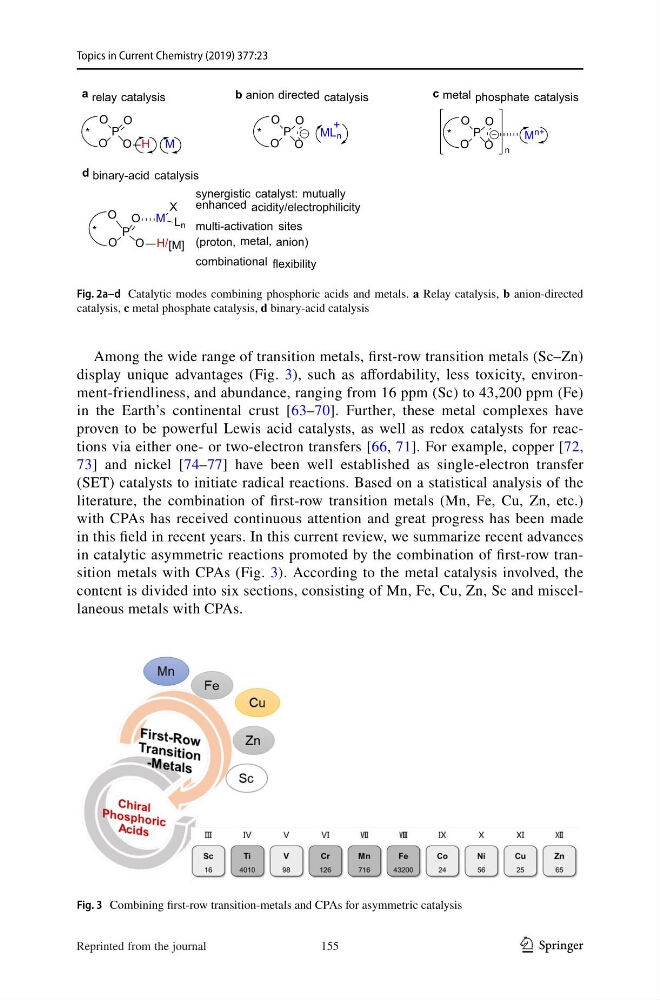
in catalytic asymmetric reactions promoted by the combination of first-row transition metals with CPAs (Fig. 3). According to the metal catalysis involved, the
content is divided into six sections, consisting of Mn, Fe, Cu, Zn, Sc and miscellaneous metals with CPAs.
synergistic catalyst: mutually
enhanced acidity/electrophilicity
multi-activation sites
(proton, metal, anion)
combinational flexibility
O
O
P
O
O H/ [M]
M
d binary-acid catalysis
O
O
P
O
O
*
*
a relay catalysis
b anion directed catalysis
c metal phosphate catalysis
H
O
O
P
O
O
*
M
ML n
+
O
O
P
O
O
*
n
M n+
X
L n
Fig. 2a–d Catalytic modes combining phosphoric acids and metals. a Relay catalysis, b anion-directed
catalysis, c metal phosphate catalysis, d binary-acid catalysis
Fig. 3 Combining first-row transition-metals and CPAs for asymmetric catalysis
Reprinted from the journal
155
Topics in Current Chemistry (2019) 377:23
Among the wide range of transition metals, first-row transition metals (Sc–Zn)
display unique advantages (Fig. 3), such as affordability, less toxicity, environment-friendliness, and abundance, ranging from 16 ppm (Sc) to 43,200 ppm (Fe)
in the Earth’s continental crust [63–70]. Further, these metal complexes have
proven to be powerful Lewis acid catalysts, as well as redox catalysts for reactions via either one- or two-electron transfers [66, 71]. For example, copper [72,
73] and nickel [74–77] have been well established as single-electron transfer
(SET) catalysts to initiate radical reactions. Based on a statistical analysis of the
literature, the combination of first-row transition metals (Mn, Fe, Cu, Zn, etc.)
with CPAs has received continuous attention and great progress has been made
in this field in recent years. In this current review, we summarize recent advances
in catalytic asymmetric reactions promoted by the combination of first-row transition metals with CPAs (Fig. 3). According to the metal catalysis involved, the
content is divided into six sections, consisting of Mn, Fe, Cu, Zn, Sc and miscellaneous metals with CPAs.
synergistic catalyst: mutually
enhanced acidity/electrophilicity
multi-activation sites
(proton, metal, anion)
combinational flexibility
O
O
P
O
O H/ [M]
M
d binary-acid catalysis
O
O
P
O
O
*
*
a relay catalysis
b anion directed catalysis
c metal phosphate catalysis
H
O
O
P
O
O
*
M
ML n
+
O
O
P
O
O
*
n
M n+
X
L n
Fig. 2a–d Catalytic modes combining phosphoric acids and metals. a Relay catalysis, b anion-directed
catalysis, c metal phosphate catalysis, d binary-acid catalysis
Fig. 3 Combining first-row transition-metals and CPAs for asymmetric catalysis
Reprinted from the journal
155